
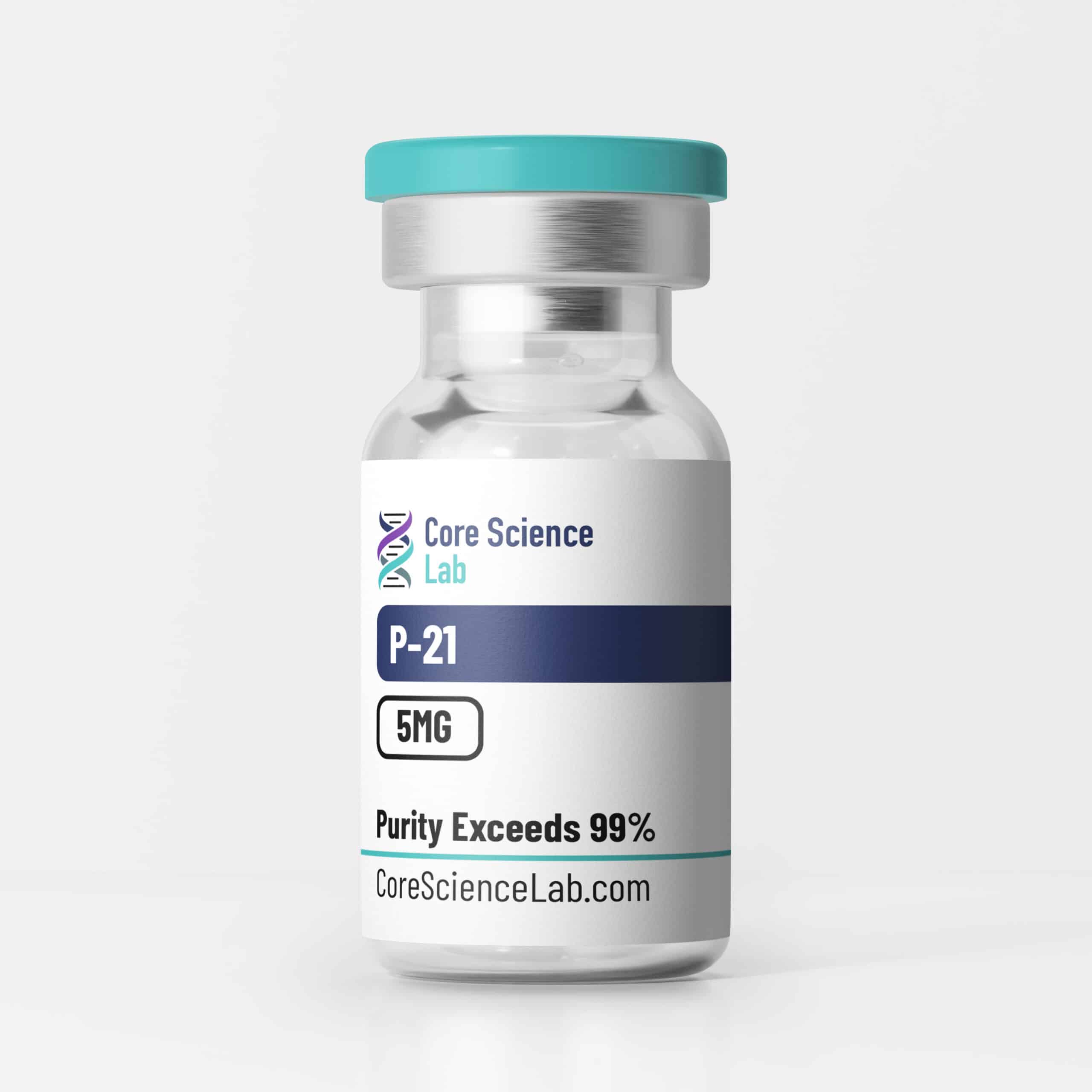
A high-purity, lyophilized synthetic peptide analogue derived from the active epitope of Ciliary Neurotrophic Factor (CNTF). It is characterized strictly for research applications involving adult neurogenesis, synaptic plasticity, the modulation of the leukemia inhibitory factor (LIF) signaling pathway, and cognitive preservation in neurodegenerative models.
Trust & Quality Verification
Purity Standard
Verified Analysis
Available
Shipping
P-21 (often documented in preclinical literature as P021) is a highly stable, blood-brain barrier-permeable synthetic peptide mimetic derived from the most neurogenic region of human Ciliary Neurotrophic Factor (CNTF). In endogenous systems, CNTF acts as a potent survival factor for neurons and oligodendrocytes. However, its therapeutic utility in isolated studies was historically limited by poor permeability, a short half-life, and the rapid formation of neutralizing antibodies.
P-21 was engineered to overcome these limitations. By mimicking the active epitope of CNTF, P-21 acts as a highly targeted chemical probe in laboratory settings. Researchers utilize this compound to investigate the shifting of neural stem cell differentiation away from astrogliogenesis and toward robust neurogenesis, particularly within the dentate gyrus of the hippocampus. It is a foundational research reagent for exploring the reversal of synaptic deficits and the attenuation of tau pathology in experimental models of Alzheimer’s disease and traumatic brain injury.
Biochemical Characteristics
Chemically, P-21 functions as an adamantylated short peptide, a structural modification specifically designed to enhance lipophilicity and protect the active sequence from rapid enzymatic degradation in systemic circulation.
Chemical Properties
| Property | Specification |
| Molecule Name | P-21 |
| Synonyms | P021; CNTF-derived peptide; Cerebrolysin mimetic |
| Molecular Formula | C30H46N6O8 |
| Molecular Weight | 618.72 g/mol |
| Form | Lyophilized Powder |
| Purity | ≥99% (Verified via HPLC) |
| Solubility | Soluble in water and organic solvents (refer to SDS) |
| Documentation | COA available per lot; SDS available |
P-21 is strictly for laboratory research and is commonly employed in the following investigational areas:
Neurogenesis and Dentate Gyrus Assays
P-21 is heavily utilized in cellular models of adult neurogenesis. Researchers apply the peptide to cultured neural stem cells to quantify its ability to rapidly induce maturation and survival of newly formed neurons, mapping structural changes in the dentate gyrus.
Alzheimer’s Disease and Tau Pathology
In experimental models of neurodegeneration, researchers use P-21 to study the mitigation of tau hyperphosphorylation and the preservation of spatial memory. Assays focus on how the peptide prevents synaptic density loss and rescues cognitive endpoint markers under severe neurotoxic stress.
Traumatic Brain Injury (TBI) and Ischemia
Because of its cytoprotective traits, P-21 is investigated in mechanical trauma and stroke models. Protocols assess the reduction of secondary neuronal death and the acceleration of functional motor recovery following induced lesions to the central nervous system.
Synaptic Plasticity and BDNF Modulation
Physiological studies employ P-21 to observe its regulatory effects on native neurotrophin levels. Researchers evaluate its capacity to upregulate endogenous Brain-Derived Neurotrophic Factor (BDNF) and Nerve Growth Factor (NGF), mapping downstream enhancements in long-term potentiation (LTP).
Pathway / Mechanistic Context
The primary mechanism of action for P-21 in research settings involves the targeted antagonism of astrogliogenic pathways and the direct stimulation of neurotrophic cascades.
Preclinical Research Summary
Published preclinical literature documents investigations of P-21 (P021) across multiple experimental models for pathway characterization and endpoint measurement:
Form & Analytical Testing
This material is produced via robust solid-phase chemical synthesis and supplied as a lyophilized (freeze-dried) powder.
Referenced Citations
References are provided for informational purposes only and are not clinical claims.
RESEARCH USE ONLY
This product is intended strictly for laboratory research use only. It is not for human or veterinary use. It is not intended for diagnosis, treatment, cure, or prevention of any disease. All purchases are subject to our Terms of Service and Purity Guarantee.
No COAs available for this product.
RESEARCH USE ONLY
This product is intended strictly for laboratory research use only. It is not for human or veterinary use. It is not intended for diagnosis, treatment, cure, or prevention of any disease. All purchases are subject to our Terms of Service and Purity Guarantee.

Reviews
There are no reviews yet.