
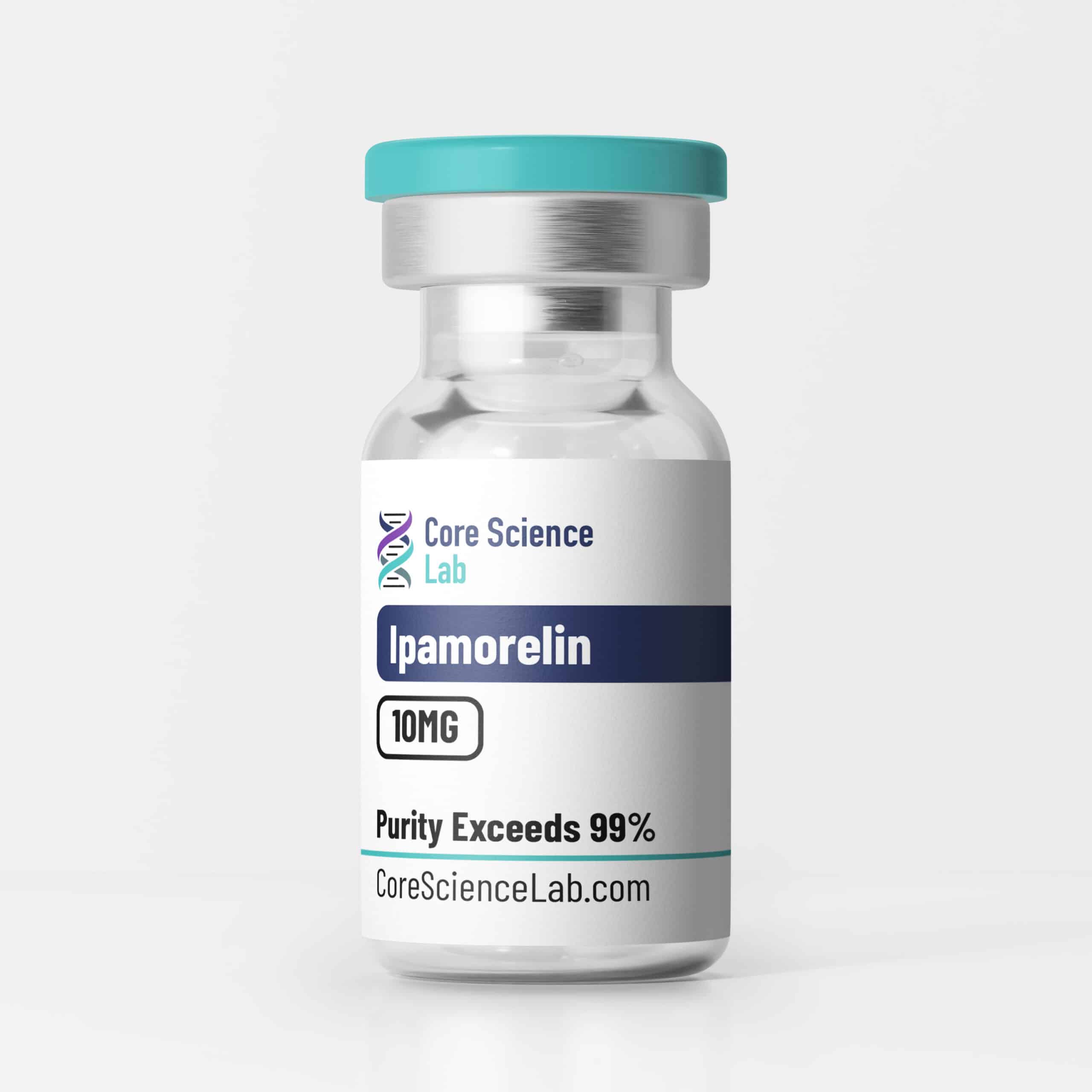
A highly selective, synthetic pentapeptide growth hormone secretagogue (GHS) noted for its ability to stimulate growth hormone release without significantly elevating adrenocorticotropic hormone (ACTH) or cortisol, characterized for research into bone mineralization, body composition, and gastric motility.
Trust & Quality Verification
Purity Standard
Verified Analysis
Available
Shipping
Ipamorelin is a synthetic pentapeptide that functions as a selective agonist of the growth hormone secretagogue receptor (GHS-R1a) and a ghrelin mimetic. It was the first GHS developed to display a high degree of specificity for growth hormone (GH) release, distinct from other secretagogues like GHRP-6 or GHRP-2 by its lack of significant impact on ACTH, cortisol, or prolactin levels in experimental models.
In laboratory settings, Ipamorelin is widely utilized to investigate the regulation of body composition, particularly in models of hypogonadism. Its unique selectivity profile makes it a critical tool for researchers aiming to isolate the downstream effects of GH signaling—such as insulin-like growth factor 1 (IGF-1) production—without the confounding variables of the stress hormone cascade.
Biochemical Characteristics
Chemically, Ipamorelin is a pentapeptide (Aib-His-D-2-Nal-D-Phe-Lys-NH2) designed for high receptor affinity and specificity.
Chemical Properties
| Property | Specification |
| Molecule Name | Ipamorelin |
| Synonyms | NNC 26-0161 |
| Molecular Formula | C₃₈H₄₉N₉O₅ |
| Molecular Weight | 711.86 g/mol |
| Form | Lyophilized Powder |
| Purity | ≥99% (Verified via HPLC) |
| Solubility | Soluble in water and organic solvents (refer to SDS) |
| Documentation | COA available per lot; SDS available |
Ipamorelin is strictly for laboratory research and is commonly employed in the following investigational areas:
Bone Health and Mineralization
Ipamorelin is extensively studied for its impact on skeletal integrity. In adult female rat models, administration of Ipamorelin has been shown to increase bone mineral content (BMC). Furthermore, it is used to investigate countermeasures against catabolic states; research indicates it can counteract the decrease in bone formation induced by glucocorticoid treatment.
Gastric Motility and Ileus
Functioning as a ghrelin mimetic, Ipamorelin is used to study gastrointestinal contractility. In rodent models of postoperative ileus, researchers utilize this peptide to assess its efficacy in accelerating gastric emptying and ameliorating gastric dysmotility.
Body Composition and Metabolism
Researchers employ Ipamorelin to explore the management of body composition, particularly in the context of hypogonadism where muscle retention and adipose tissue regulation are primary endpoints.
Pathway / Mechanistic Context
The primary mechanism of action for Ipamorelin in research settings is the selective agonism of the GHS-R1a.
Preclinical Research Summary
Published preclinical literature documents investigations of Ipamorelin across multiple experimental models:
Form & Analytical Testing
This material is produced via robust solid-phase peptide synthesis and supplied as a lyophilized (freeze-dried) powder.
Referenced Citations
References are provided for informational purposes only and are not clinical claims.
RESEARCH USE ONLY
This product is intended strictly for laboratory research use only. It is not for human or veterinary use. It is not intended for diagnosis, treatment, cure, or prevention of any disease. All purchases are subject to our Terms of Service and Purity Guarantee.
No COAs available for this product.
RESEARCH USE ONLY
This product is intended strictly for laboratory research use only. It is not for human or veterinary use. It is not intended for diagnosis, treatment, cure, or prevention of any disease. All purchases are subject to our Terms of Service and Purity Guarantee.
Reviews
There are no reviews yet.