Description
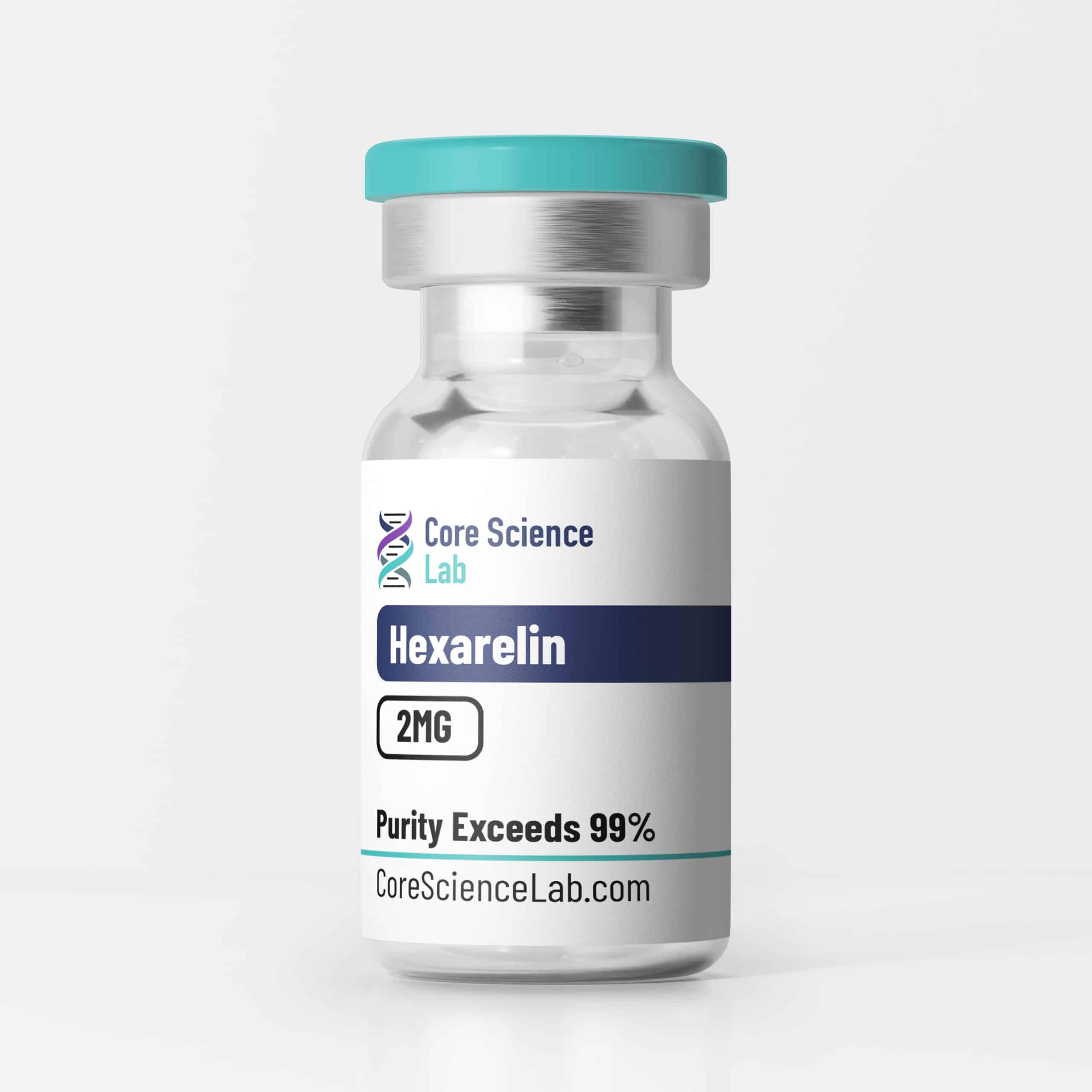
Hexarelin (also known as Examorelin) is a synthetic, centrally penetrant hexapeptide engineered to act as a potent, highly selective agonist of the ghrelin/growth hormone secretagogue receptor (GHSR-1a). Derived from the GHRP-6 structural family, Hexarelin is widely utilized in experimental pharmacology to investigate the dose-dependent stimulation of endogenous growth hormone (GH) release from the anterior pituitary.
Distinct from many other secretagogues, Hexarelin exhibits unique, GH-independent biological activities due to its high binding affinity for the non-GHSR CD36 scavenger receptor. This dual-receptor engagement makes Hexarelin a critical research reagent for investigating profound cardioprotective pathways, particularly concerning the attenuation of cardiac fibrosis, recovery from ischemia-reperfusion (I/R) injury, and the regulation of lipid metabolism and macrophage cholesterol efflux in atherosclerosis models.
Biochemical Characteristics
Chemically, Hexarelin functions as a highly stabilized, truncated peptide engineered to resist rapid enzymatic degradation while maintaining robust receptor binding.
- Sequence/Structure: Hexapeptide; His-D-2-methyl-Trp-Ala-Trp-D-Phe-Lys-NH2.
- Receptor Affinity: Binds with high specificity to both the GHSR-1a (stimulating the somatotropic axis) and the CD36 scavenger receptor (mediating peripheral cardiovascular and metabolic effects).
- Stability: Supplied as a lyophilized salt to ensure long-term stability. Its specific sequence modifications (including D-amino acid substitutions) protect it from rapid proteolytic cleavage, extending its experimental half-life.
- Specificity: Utilized to selectively stimulate acute endogenous GH secretory pathways and localized CD36-dependent tissue repair mechanisms without broad-spectrum toxicity.
Chemical Properties
| Property |
Specification |
| Molecule Name |
Hexarelin |
| Synonyms |
Examorelin; EP-23905 |
| PubChem CID |
6918297 |
| Molecular Formula |
C47H58N12O6 |
| Molecular Weight |
887.05 g/mol |
| Form |
Lyophilized Powder |
| Purity |
≥99% (Verified via HPLC) |
| Solubility |
Soluble in water and organic solvents (refer to SDS) |
| Documentation |
COA available per lot; SDS available |
Hexarelin is strictly for laboratory research and is commonly employed in the following investigational areas:
Somatotropic Axis & Pituitary Function
Hexarelin is utilized as a chemical probe to study the biophysics of pituitary receptor activation. Researchers employ this peptide to quantify the acute, dose-dependent release of GH, evaluating its synergistic effects when co-administered with Growth Hormone-Releasing Hormone (GHRH) in isolated neuroendocrine models.
Cardioprotection & Ischemia-Reperfusion (I/R) Injury
Because of its CD36 receptor affinity, Hexarelin is heavily researched in cardiovascular models. Assays focus on quantifying the reduction of infarct size, the preservation of left ventricular (LV) ejection fraction, and the prevention of cardiomyocyte apoptosis following experimentally induced myocardial ischemia and reperfusion.
Fibrosis & Extracellular Matrix Remodeling
In vitro studies utilizing cultured cardiac fibroblasts employ Hexarelin to observe its inhibitory impact on collagen synthesis and cellular proliferation. Investigations focus on how the peptide modulates transforming growth factor (TGF)-β expression and matrix metalloproteinase (MMP) activity to attenuate pathological tissue remodeling.
Lipid Metabolism & Atherosclerosis Models
Experimental protocols evaluate Hexarelin for its metabolic properties. Studies investigate its ability to upregulate specific sterol transporters (like ABCA1) via peroxisome proliferator-activated receptor (PPAR)-γ pathways, promoting cholesterol efflux in macrophages and mitigating ectopic fat deposition.
Pathway / Mechanistic Context
The primary mechanism of action for Hexarelin in research settings involves the targeted activation of dual GPCR and scavenger receptor pathways.
- GHSR-1a Activation: Binds to the ghrelin receptor in the pituitary and hypothalamus, activating the phospholipase C (PLC) pathway to trigger an influx of intracellular calcium, driving immediate GH vesicle exocytosis.
- CD36 Receptor Activation: Binds to the CD36 scavenger receptor present on cardiomyocytes, endothelial cells, and macrophages. This initiates downstream transcriptional activation of PPARγ, which upregulates target genes involved in cellular lipid metabolism and reduces the formation of foam cells.
- PTEN/Akt/mTOR Modulation: In cardiac stress models, Hexarelin upregulates Phosphatase and tensin homologue (PTEN) expression, subsequently inhibiting the hyper-phosphorylation of the Akt/mTOR pathway to ameliorate adverse left ventricular remodeling and oxidative stress.
Preclinical Research Summary
Published preclinical literature documents investigations of Hexarelin across multiple experimental models for pathway characterization and endpoint measurement:
- Cardiovascular Recovery: Studies in myocardial infarction models demonstrate that Hexarelin administration significantly preserves left ventricular function, reduces interstitial collagen deposition, and decreases pro-inflammatory cytokine expression (e.g., TNF-α).
- Fibrosis Suppression: Research in spontaneously hypertensive rats indicates that chronic Hexarelin exposure attenuates cardiac fibrosis by reducing collagen I and III mRNA expression and accelerating collagen degradation.
- Metabolic Homeostasis: Data from nonobese insulin-resistant models show that Hexarelin improves glucose tolerance, decreases hepatic triglycerides, and corrects abnormal body composition by facilitating localized adipocyte differentiation.
- Neuroendocrine Output: High-frequency endocrine sampling confirms that Hexarelin produces a massive, dose-dependent release of GH that is superior to native GHRH, while also modestly stimulating the HPA axis via arginine vasopressin signaling.
Form & Analytical Testing
This material is produced via robust chemical synthesis and supplied as a lyophilized (freeze-dried) powder.
- Lyophilization: Removes water content under vacuum to maintain compound integrity and extend shelf-life.
- Identity Verification: Each lot undergoes Mass Spectrometry (MS) to confirm molecular weight and identity.
- Purity Verification: High-Performance Liquid Chromatography (HPLC) is performed to ensure the product meets the ≥99% purity standard required for reproducible research data.
Referenced Citations
References are provided for informational purposes only and are not clinical claims.
- Bodart, V., et al. (2002). CD36 Mediates the Cardiovascular Action of Growth Hormone-Releasing Peptides in the Heart. Circulation Research. https://doi.org/10.1161/01.res.0000016164.02525.b4
- Zhao, I. G., et al. (2011). Chronic administration of hexarelin attenuates cardiac fibrosis in the spontaneously hypertensive rat. American Journal of Physiology-Heart and Circulatory Physiology.https://pubmed.ncbi.nlm.nih.gov/22842067/
- McDonald, H., et al. (2020). Hexarelin targets neuroinflammatory pathways to preserve cardiac morphology and function in a mouse model of myocardial ischemia-reperfusion. Biomedicine & Pharmacotherapy, 127, 110165. https://doi.org/10.1016/j.biopha.2020.110165
- Berti, F., et al. (1998). Hexarelin exhibits protective activity against cardiac ischaemia in hearts from growth hormone-deficient rats. Growth Hormone & IGF Research, 8 Suppl B, 149-152.https://pubmed.ncbi.nlm.nih.gov/10990152/
- Mao, Y., et al. (2014). One dose of oral hexarelin protects chronic cardiac function after myocardial infarction. Peptides, 56, 26-34. https://doi.org/10.1016/j.peptides.2014.04.004
- Huang, J., et al. (2007). Hexarelin suppresses cardiac fibroblast proliferation and collagen synthesis in rat. American Journal of Physiology-Heart and Circulatory Physiology. https://doi.org/10.1152/ajpheart.00004.2007
- Mosa, R., et al. (2017). Hexarelin, a Growth Hormone Secretagogue, Improves Lipid Metabolic Aberrations in Nonobese Insulin-Resistant Male MKR Mice. Endocrinology, 158(10), 3174-3187. https://doi.org/10.1210/en.2017-00168
- Korbonits, M., et al. (1999). The growth hormone secretagogue hexarelin stimulates the hypothalamo-pituitary-adrenal axis via arginine vasopressin. The Journal of Clinical Endocrinology & Metabolism, 84(7), 2489-2495. https://doi.org/10.1210/jcem.84.7.5811
- Torsello, A., et al. (2004). Hexarelin modulates the expression of growth hormone secretagogue receptor type 1a mRNA at hypothalamic and pituitary sites. Neuroendocrinology, 79(3), 133-138.https://pubmed.ncbi.nlm.nih.gov/15361691/
- Dixit, V. D., et al. (2002). Growth Hormone Secretagogue (GHS) Analogue, Hexarelin Stimulates GH From Peripheral Lymphocytes. Hormone and Metabolic Research, 34(10), 549-551.https://pubmed.ncbi.nlm.nih.gov/12397533/
- Locatelli, V., et al. (1997). Cardiac ischemia and impairment of vascular endothelium function in hearts from growth hormone-deficient rats: protection by hexarelin. European Journal of Pharmacology, 338(3), 221-228. https://doi.org/10.1016/s0014-2999(97)01178-3
RESEARCH USE ONLY
This product is intended strictly for laboratory research use only. It is not for human or veterinary use. It is not intended for diagnosis, treatment, cure, or prevention of any disease. All purchases are subject to our Terms of Service and Purity Guarantee.
No COAs available for this product.

Reviews
There are no reviews yet.