
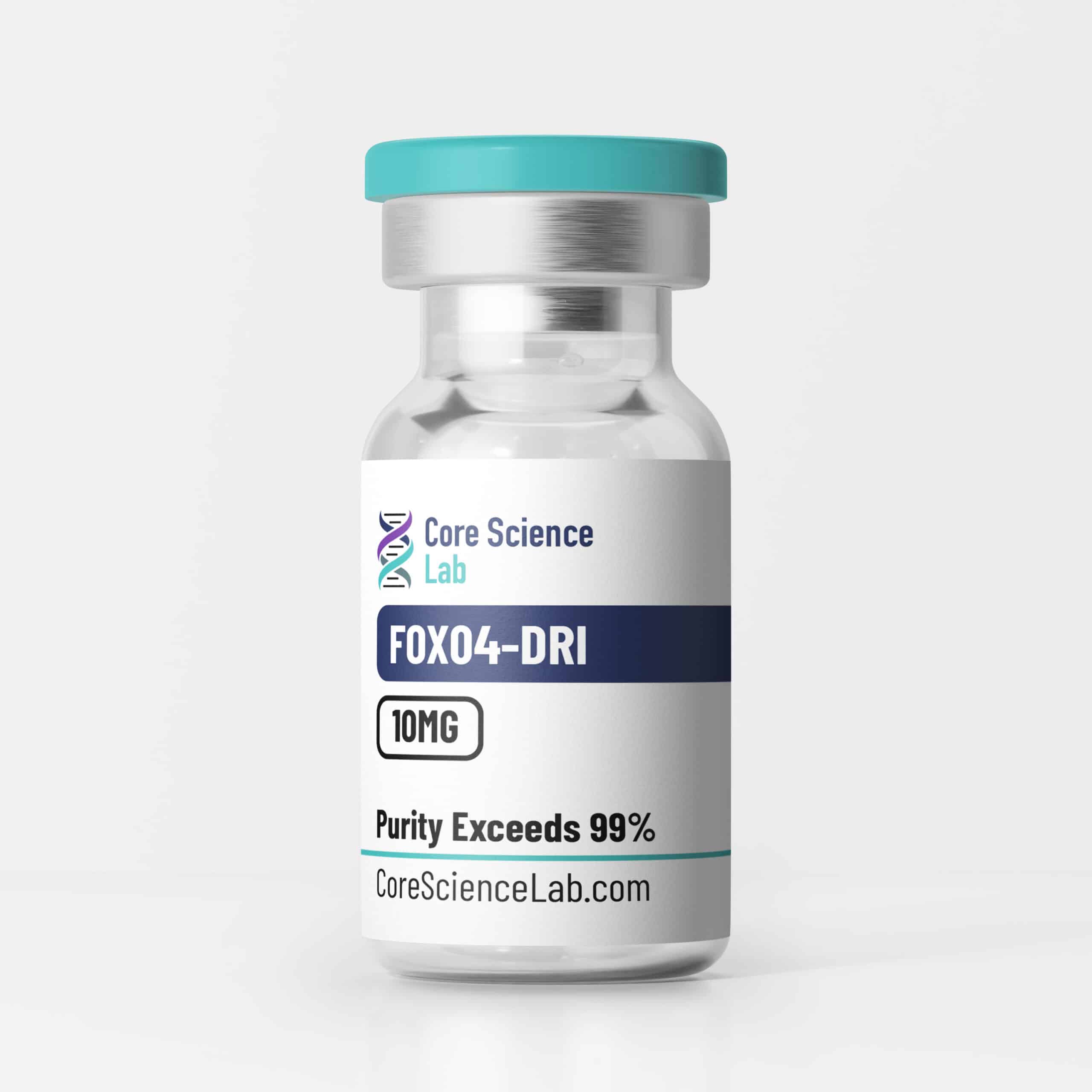
A specialized, cell-permeable D-retro-inverso peptide designed to selectively disrupt the interaction between FOXO4 and p53, characterized for research applications involving cellular senescence, apoptosis induction in senescent cells (senolysis), and tissue homeostasis.
Trust & Quality Verification
Purity Standard
Verified Analysis
Available
Shipping
FOXO4-DRI is a synthetic, reduced-size peptide modified with D-amino acids in a retro-inverso sequence to enhance stability and biological half-life. It functions as a specific antagonist to the interaction between the transcription factor FOXO4 and the tumor suppressor p53. In senescent cells, FOXO4 sequesters p53 in the nucleus, preventing it from inducing apoptosis.
By competitively inhibiting this binding, FOXO4-DRI releases p53, allowing it to activate mitochondrial apoptotic pathways (via BAX/PUMA) specifically in senescent cells. This “senolytic” capability makes it a critical tool in research focused on aging, tissue fibrosis, and chemotherapy resistance, where the elimination of senescent cells is a primary investigational endpoint.
Biochemical Characteristics
Chemically, FOXO4-DRI is distinguished by its D-retro-inverso modification, which renders it resistant to intracellular peptidases while maintaining the 3D-structural capability to bind the FOXO4 binding domain on p53.
Chemical Properties
| Property | Specification |
| Molecule Name | FOXO4-DRI |
| Synonyms | FOXO4 D-Retro-Inverso; Proxofim-related peptide |
| Sequence | H-LTLRKEPASEIAQSILEAYSQNGWANRRSGGKRPPPRRRQRRKKRG-OH (D-isoforms) |
| Molecular Formula | C₂₂₈H₃₈₈N₈₆O₇₈S₂ (Typical) |
| Molecular Weight | 5358.1 g/mol |
| Form | Lyophilized Powder |
| Purity | ≥99% (Verified via HPLC) |
| Solubility | Soluble in water and organic solvents (refer to SDS) |
| Documentation | COA available per lot; SDS available |
FOXO4-DRI is strictly for laboratory research and is commonly employed in the following investigational areas:
Cellular Senescence and Chondrocyte Biology
FOXO4-DRI is utilized to selectively eliminate senescent cells from in vitro expanded tissues. Research involving human chondrocytes demonstrates its utility in clearing senescent cells to improve the quality of tissue engineering constructs, without affecting the viability of healthy, proliferating chondrocytes.
Pulmonary Fibrosis and ECM Regulation
In models of bleomycin-induced pulmonary fibrosis, FOXO4-DRI is used to investigate the role of myofibroblasts in tissue scarring. Studies quantify the peptide’s ability to ameliorate fibrosis by targeting myofibroblasts and modulating the ECM-receptor interaction pathway.
Endocrine Aging and Leydig Cell Function
Researchers employ FOXO4-DRI to study age-related testosterone insufficiency. Experimental protocols involve treating aged models to assess the elimination of senescent Leydig cells and the subsequent restoration of testosterone secretion and testicular function.
Oncology and Radiosensitivity
In cancer research, specifically non-small cell lung cancer (NSCLC), FOXO4-DRI is investigated for its potential to enhance radiosensitivity. Researchers measure changes in apoptosis rates and cell survival following combined treatment with radiation, providing data on overcoming therapeutic resistance.
Pathway / Mechanistic Context
The primary mechanism of action for FOXO4-DRI in research settings is the disruption of the FOXO4-p53 axis.
Preclinical Research Summary
Published preclinical literature documents investigations of FOXO4-DRI across multiple experimental models for pathway characterization and endpoint measurement:
Form & Analytical Testing
This material is produced via robust solid-phase peptide synthesis and supplied as a lyophilized (freeze-dried) powder.
Referenced Citations
References are provided for informational purposes only and are not clinical claims.
RESEARCH USE ONLY
This product is intended strictly for laboratory research use only. It is not for human or veterinary use. It is not intended for diagnosis, treatment, cure, or prevention of any disease. All purchases are subject to our Terms of Service and Purity Guarantee.
No COAs available for this product.
RESEARCH USE ONLY
This product is intended strictly for laboratory research use only. It is not for human or veterinary use. It is not intended for diagnosis, treatment, cure, or prevention of any disease. All purchases are subject to our Terms of Service and Purity Guarantee.
Reviews
There are no reviews yet.