
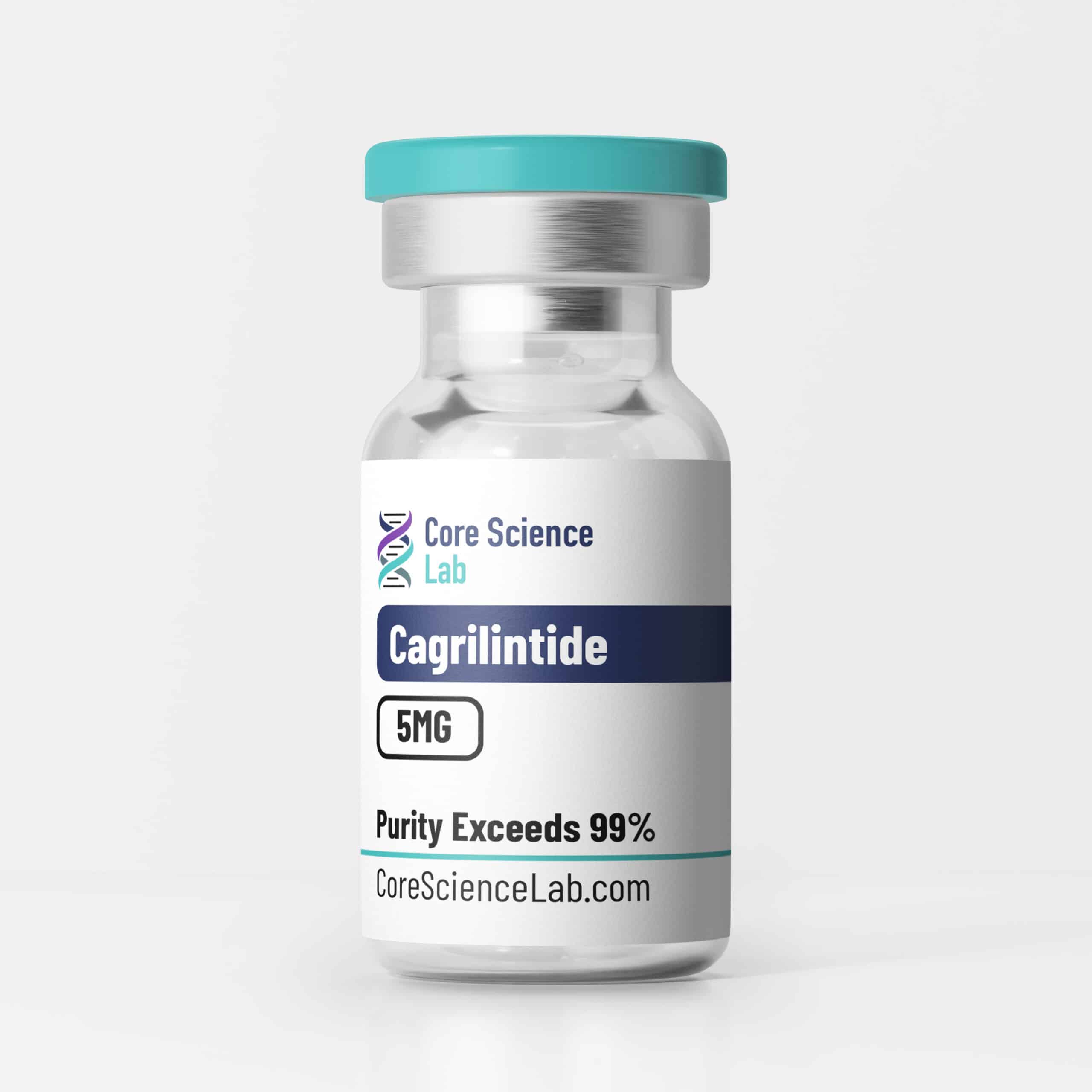
A high-purity, lyophilized long-acting amylin analogue and calcitonin receptor agonist, characterized for research applications involving metabolic homeostasis, satiety signaling pathways, and synergistic efficacy studies with GLP-1 receptor agonists.
Trust & Quality Verification
Purity Standard
Verified Analysis
Available
Shipping
Cagrilintide is a synthetic, long-acting acylated peptide research reagent that functions as a dual agonist of the amylin and calcitonin receptors. Chemically, it is a stable analogue of human amylin (islet amyloid polypeptide), modified to prevent fibril formation and extend half-life in experimental assays. It is used extensively in investigational workflows involving the regulation of energy homeostasis and the delay of gastric emptying in non-human models.
Distinct from native amylin, Cagrilintide is engineered with a specific fatty acid side chain promoting albumin binding. It is widely utilized in laboratory settings to study the downstream effects of amylin receptor activation in the hindbrain (area postrema) and its synergistic potential when co-administered with GLP-1 (e.g., Semaglutide) or GIP receptor agonists in models of metabolic dysfunction and obesity.
Biochemical Characteristics
Chemically, Cagrilintide is characterized by its dual affinity for amylin and calcitonin receptors and its lipophilic modification.
Chemical Properties
| Property | Specification |
| Molecule Name | Cagrilintide |
| Synonyms | AM833; Long-acting Amylin Analogue |
| CAS Number | 1415456-99-3 |
| Molecular Formula | $C_{171}H_{267}N_{43}O_{53}$ (Free base approximation) |
| Molecular Weight | ~3973.4 g/mol |
| Form | Lyophilized Powder |
| Purity | ≥99% (Verified via HPLC) |
| Solubility | Soluble in water and organic solvents (refer to SDS) |
| Documentation | COA available per lot; SDS available |
Cagrilintide is strictly for laboratory research and is commonly employed in the following investigational areas:
Combinatorial Metabolic Research (CagriSema)
Cagrilintide is frequently utilized in combination with Semaglutide (GLP-1 RA) to study the “CagriSema” effect. Researchers utilize this pairing to quantify synergistic reductions in body weight and adipose tissue mass in rodent models, investigating how simultaneous activation of amylin and GLP-1 pathways leads to greater efficacy than mono-agonism.
Amylin/Calcitonin Receptor Balance
In vitro and in vivo studies employ Cagrilintide to dissect the role of receptor specificity. By comparing Cagrilintide with selective amylin or calcitonin agonists (e.g., KBP-336), researchers can determine the metabolic contribution of dual receptor engagement versus single receptor activation regarding glucose tolerance and food intake suppression.
Lipid Metabolism and Adiposity
Experimental models involving obese rats utilize this compound to study changes in lipid profiles and visceral fat reduction. Investigations focus on the mechanisms by which amylin analogues influence lipolysis and energy expenditure independent of incretin pathways.
Multi-Agonist Synergy (Tri-Agonism)
Advanced research protocols combine Cagrilintide with dual GLP-1/GIP agonists (e.g., Tirzepatide). These studies aim to map the complex signaling cross-talk between amylin, GLP-1, and GIP receptors to understand the theoretical limits of pharmacological weight loss in animal models.
Pathway / Mechanistic Context
The primary mechanism of action for Cagrilintide in research settings is the agonism of the amylin/calcitonin receptor complex.
Preclinical Research Summary
Published preclinical literature documents investigations of Cagrilintide across multiple experimental models for pathway characterization and endpoint measurement:
Form & Analytical Testing
This material is produced via robust chemical synthesis and supplied as a lyophilized (freeze-dried) powder.
Referenced Citations
References are provided for informational purposes only and are not clinical claims.
RESEARCH USE ONLY
This product is intended strictly for laboratory research use only. It is not for human or veterinary use. It is not intended for diagnosis, treatment, cure, or prevention of any disease. All purchases are subject to our Terms of Service and Purity Guarantee.
No COAs available for this product.
RESEARCH USE ONLY
This product is intended strictly for laboratory research use only. It is not for human or veterinary use. It is not intended for diagnosis, treatment, cure, or prevention of any disease. All purchases are subject to our Terms of Service and Purity Guarantee.
Reviews
There are no reviews yet.