Description
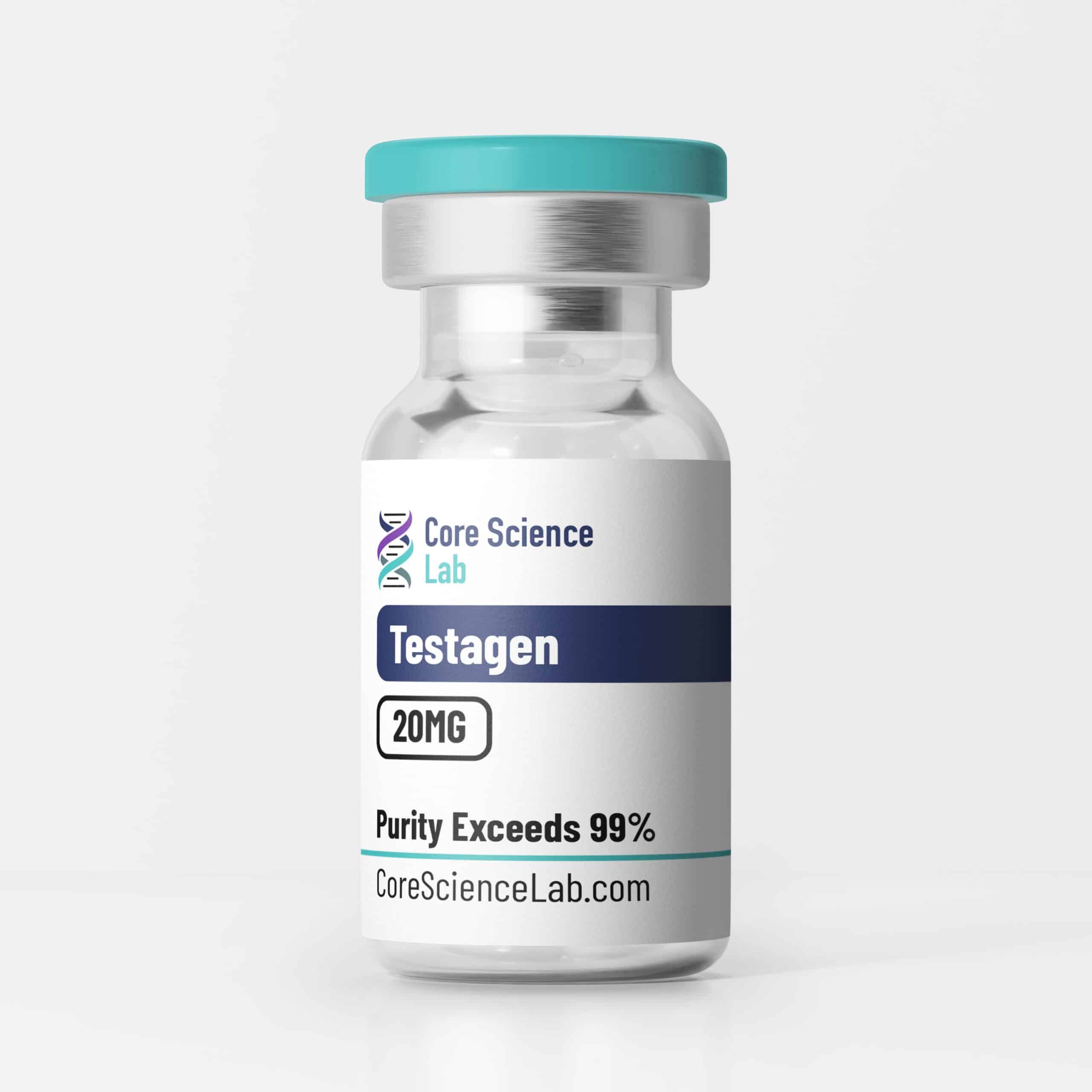
Testagen (KEDG peptide) is a synthetic ultrashort tetrapeptide research reagent. It is chemically distinct for its ability to penetrate cellular membranes and interact directly with nuclear DNA and deoxyribooligonucleotides. Researchers employ this molecule to investigate the targeted epigenetic regulation of the endocrine system, specifically exploring its impact on hormone activity, thyroid gland morphology in hypophyseal models, and its broader capacity to induce the neuronal differentiation of stem cells.
Biochemical Characteristics
- Sequence/Structure: Peptide (4 amino acids); Lys-Glu-Asp-Gly (KEDG).
- Permeability: Demonstrates high cellular and nuclear membrane permeability, actively transported via LAT and PEPT family carriers to reach intracellular targets.
- Stability: Supplied as a lyophilized salt to ensure long-term stability and prevent hydrolytic degradation during storage.
- Specificity: Highly specific intracellular signaling molecule that interacts with chromatin to regulate gene expression and modulate hypophyseal/endocrine axes.
Chemical Properties
| Property |
Specification |
| Molecule Name |
Testagen |
| Synonyms |
KEDG Peptide; H-Lys-Glu-Asp-Gly-OH |
| PubChem CID |
N/A |
| Molecular Formula |
C17H29N5O9 |
| Molecular Weight |
447.44 g/mol |
| Form |
Lyophilized Powder |
| Purity |
$\ge99\%$ (Verified via HPLC) |
| Solubility |
Soluble in water and aqueous buffers (refer to SDS) |
| Documentation |
COA and SDS available per lot |
Testagen is strictly for laboratory research and is commonly employed in the following investigational areas:
Endocrine and Thyroid Regulation
Research models utilize Testagen to evaluate its influence on the endocrine system, particularly the pituitary-thyroid axis. Investigations focus on the peptide’s effects in neonatally and mature hypophysectomized models, quantifying changes in hormone activity, thyroid gland structure, immunity, and hemostasis.
Epigenetics and DNA Interaction
Experimental protocols employ this tetrapeptide to characterize its direct interactions with cellular DNA. Studies assess the penetration of the fluorescence-labeled peptide into the nucleus (e.g., in HeLa cells) and its specific in vitro interactions with deoxyribooligonucleotides to map its role as an epigenetic regulator.
Stem Cell Differentiation
In cellular biology, Testagen and related short peptides are used to study their regulatory impact on stem cell fate. Researchers evaluate the capacity of these bioregulators to induce neuronal differentiation and maintain functional cellular homeostasis in various in vitro models.
Pathway / Mechanistic Context
The primary mechanism of action for Testagen in research settings involves its function as an epigenetic regulator and intracellular signaling molecule.
- Cellular Transport and Nuclear Penetration: Utilizes membrane peptide transport systems (such as the LAT and PEPT families) to bypass the cellular membrane and enter the nucleus.
- Direct DNA/Chromatin Interaction: Interacts structurally with single- and double-stranded DNA as well as histones, functioning as an epigenetic switch to modulate gene promoters.
- Endocrine Transcription Modulation: Influences the transcription of specific genes responsible for endocrine function, restoring biological activity and morphological structure in hypophyseal and related hormone pathways.
Preclinical Research Summary
Published preclinical literature documents investigations of Testagen (KEDG) across diverse experimental models focusing on endocrinology, epigenetics, and cellular differentiation:
- In hypophysectomized avian models, the KEDG peptide was shown to actively regulate hormone activity and restore the morphology and functional output of the thyroid gland.
- In vitro studies utilizing HeLa cells demonstrated that short peptides like Testagen successfully penetrate the nucleus and specifically interact with DNA and oligonucleotides.
- Computational and in vitro research on cellular transport mechanisms confirmed the feasibility of transporting biologically active ultrashort peptides via LAT and PEPT family solute carriers.
- Stem cell assays indicate that the specific sequence of short peptides profoundly regulates cell fate, demonstrating a specific effect on neuronal differentiation pathways.
Form & Analytical Testing
- Solid-Phase Peptide Synthesis
- Lyophilization
- Identity Verification: Mass Spectrometry (MS) to confirm molecular weight and identity.
- Purity Verification: High-Performance Liquid Chromatography (HPLC) is performed to ensure the product meets the purity standard.
Referenced Citations
References are provided for informational purposes only and are not clinical claims.
- V. K. Khavinson, N. S. Linkova, A. I. Rudskoy, and M. G. Petukhov, “Feasibility of Transport of 26 Biologically Active Ultrashort Peptides via LAT and PEPT Family Transporters,” MDPI AG, Mar. 2023. doi: 10.3390/biom13030552. https://doi.org/10.3390/biom13030552
- B. Kuznik, A. V. Pateiuk, N. S. Rusaeva, L. M. Baranchugova, and V. I. Obydenko, “[Effects of hypophyseal Lys-Glu-Asp-Gly and Ala-Glu-Asp-Gly synthetic peptides on immunity, hemostasis, morphology and functions of the thyroid gland in neonatally hypophysectomized chicken and one-year-old birds].,” Patologicheskaia fiziologiia i eksperimental’naia terapiia, vol. 1, pp. 14–8, 2010.
- B. I. Kuznik, A. V. Pateyuk, and N. S. Rusaeva, “Effect of tetrapeptides Lys-Glu-Asp-Gly and Ala-Glu-Asp-Gly on the structure and function of the thyroid gland in neonatally hypophysectomized chickens,” Springer Science and Business Media LLC, Jan. 2008. doi: 10.1007/s10517-008-0033-6. https://doi.org/10.1007/s10517-008-0033-6
- L. I. Fedoreyeva, I. I. Kireev, V. Kh. Khavinson, and B. F. Vanyushin, “Penetration of short fluorescence-labeled peptides into the nucleus in HeLa cells and in vitro specific interaction of the peptides with deoxyribooligonucleotides and DNA,” Pleiades Publishing Ltd, Nov. 2011. doi: 10.1134/s0006297911110022. https://doi.org/10.1134/s0006297911110022
- V. Kh. Khavinson, S. M. Tendler, N. A. Kasyanenko, and S. I. Tarnovskaya, “Tetrapeptide KEDW Interacts with DNA and Regulates Gene Expression,” New World Publishing International, Inc., Jul. 2015. doi: 10.5099/aj150300156. https://doi.org/10.5099/aj150300156
- S. Caputi et al., “Effect of short peptides on neuronal differentiation of stem cells,” SAGE Publications, Jan. 2019. doi: 10.1177/2058738419828613. https://doi.org/10.1177/2058738419828613
- B. I. Kuznik, A. V. Pateyuk, N. S. Rusaeva, L. M. Baranchugova, and V. I. Obydenko, “The effect of Lys-Glu-Asp-Gly and Ala-Glu-Asp-Gly peptides on hormone activity and the thyroid structure in sexually mature and old hypophysectomized birds,” Pleiades Publishing Ltd, Oct. 2011. doi: 10.1134/s2079057011040072. https://doi.org/10.1134/s2079057011040072
RESEARCH USE ONLY
This product is intended strictly for laboratory research use only. It is not for human or veterinary use. It is not intended for diagnosis, treatment, cure, or prevention of any disease. All purchases are subject to our Terms of Service and Purity Guarantee.
No COAs available for this product.


Reviews
There are no reviews yet.