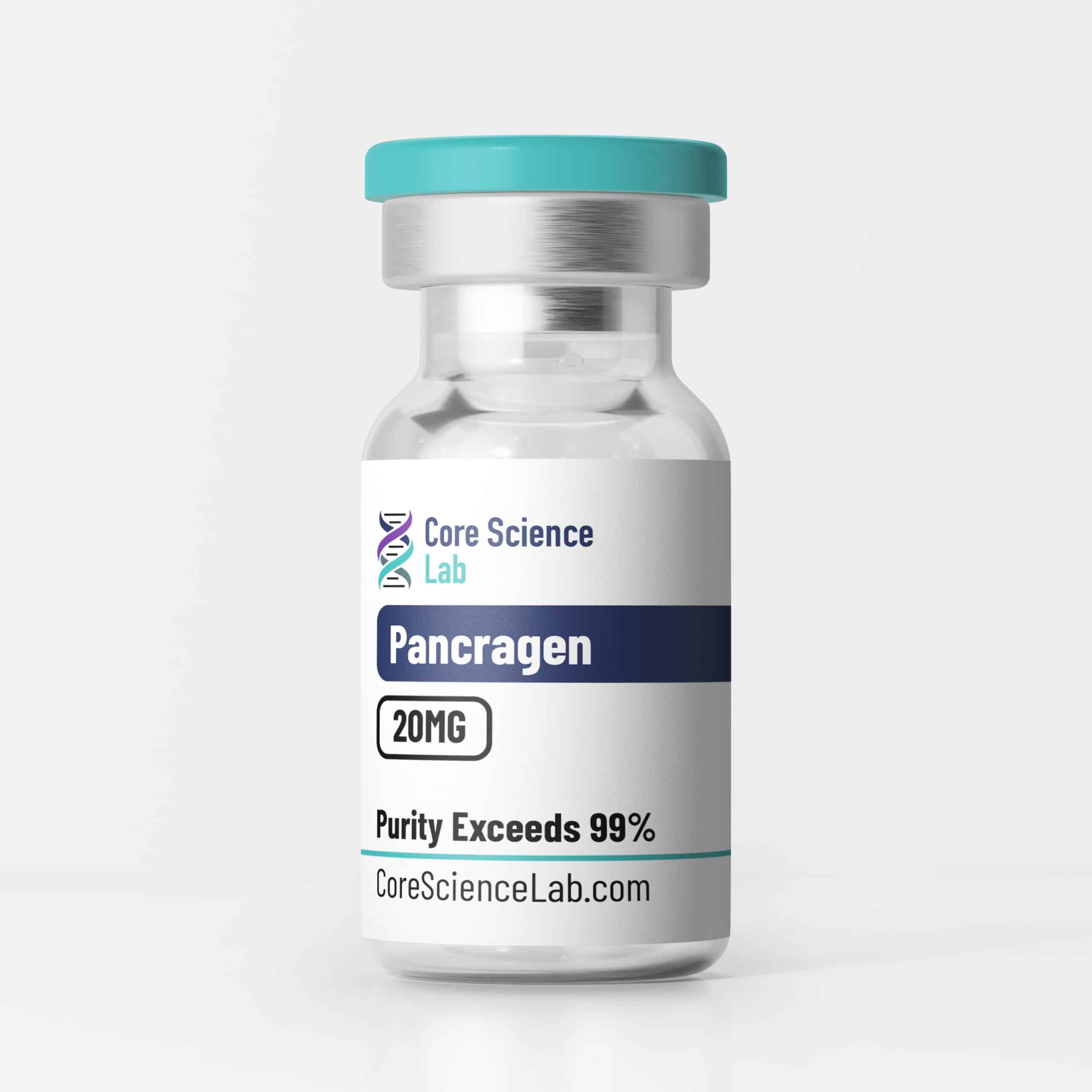
Pancragen (20mg)

A high-purity, lyophilized synthetic tetrapeptide bioregulator (Lys-Glu-Asp-Trp or KEDW) characterized for its targeted epigenetic effects on pancreatic cell differentiation, insulin receptor restoration, and the correction of age-related metabolic disorders.

Trust & Quality Verification

  • Research Use Only. Not for human or veterinary use
  • Verifiable purity via HPLC & Mass Spectrometry
  • Supplied as lyophilized powder for stability during transport and storage
  • Certificate of Analysis (COA) available per lot
  • Safety Data Sheet (SDS) available

Email when stock available

SKU: V-PANC-20MG Category:

99%+

Purity Standard

HPLC

Verified Analysis

COA

Available

Free

Shipping

Description

Pancragen (KEDW peptide) is a synthetic ultrashort tetrapeptide research reagent. It is chemically distinct for its ability to penetrate cellular and nuclear membranes to interact directly with DNA and histones, functioning as an epigenetic switch. Researchers employ this molecule to investigate the molecular mechanisms of tissue-specific bioregulation, specifically exploring its impact on pancreatic endocrine and exocrine function, the modulation of stem cell fate, and the correction of metabolic disorders associated with type 2 diabetes mellitus in elderly models.

Biochemical Characteristics

  • Sequence/Structure: Peptide (4 amino acids); Lys-Glu-Asp-Trp (KEDW).
  • Permeability: Demonstrates high cellular and nuclear membrane permeability, allowing it to act directly within the nucleus as an intracellular signaling molecule.
  • Stability: Supplied as a lyophilized salt to ensure long-term stability and prevent hydrolytic degradation during storage.
  • Specificity: Highly specific epigenetic regulator that selectively modulates the expression of pancreatic differentiation factors (e.g., PDX1, NGN3, PAX6, PAX4) and supports the restoration of cellular insulin receptors.

Chemical Properties

Property Specification
Molecule Name Pancragen
Synonyms KEDW Peptide; L-Lysyl-L-Glutamyl-L-Aspartyl-L-Tryptophan
PubChem CID 68452887
Molecular Formula C26H36N6O9
Molecular Weight 576.6 g/mol
Form Lyophilized Powder
Purity $\ge99\%$ (Verified via HPLC)
Solubility Soluble in water and aqueous buffers (refer to SDS)
Documentation COA and SDS available per lot

Pancragen is strictly for laboratory research and is commonly employed in the following investigational areas:

Pancreatic Function and Diabetes Models

Research models utilize Pancragen to evaluate its efficacy in restoring pancreatic homeostasis. Investigations focus on the peptide’s effects on age-associated type 2 diabetes mellitus, quantifying changes in glucose metabolism, insulin synthesis, and the preservation of endocrine function in elderly subjects.

Stem Cell Fate and Tissue Engineering

Experimental protocols employ this tetrapeptide to characterize its influence on stem cell dynamics. Studies assess how programmable short peptides like KEDW modulate stem cell fate and drive pancreatic cell differentiation, offering insights into regenerative medicine and targeted tissue engineering.

Epigenetics and Gene Expression

In molecular biology research, Pancragen is used to study the direct peptide-DNA interactions that govern cellular aging. Researchers evaluate its capacity to interact with DNA and histones, mapping its role in upregulating specific transcription factors critical for the development and maintenance of pancreatic lineages.

Pathway / Mechanistic Context

The primary mechanism of action for Pancragen in research settings involves its function as an epigenetic regulator of pancreatic tissue.

  • Direct DNA/Chromatin Interaction: Penetrates the nucleus and binds specifically to DNA and histone complexes to alter the chromatin state and transcriptional accessibility.
  • Transcription Factor Upregulation: Stimulates the expression of key differentiation genes (such as PDX1, NGN3, and PAX4) that guide precursor cells toward mature pancreatic β-cell and acinar lineages.
  • Metabolic Homeostasis: Promotes the restoration of insulin receptors and optimizes endocrine signaling pathways to correct insulin resistance and metabolic decline associated with aging.

Preclinical Research Summary

Published preclinical literature documents investigations of Pancragen across diverse experimental models focusing on pancreatic development, metabolism, and aging.

  • In vitro and computational studies demonstrated that the tetrapeptide KEDW interacts directly with DNA to upregulate genes coding for critical pancreatic cell differentiation factors.
  • Cell culture models investigating cellular aging showed that Pancragen effectively stimulates the differentiation of pancreatic cells and maintains their functional phenotype over time.
  • Translational research indicates the efficacy of the Pancragen peptide in experimental models of elderly patients with type 2 diabetes mellitus, significantly correcting metabolic disorders.
  • Broader tissue engineering studies highlight the utility of short programmable peptides like KEDW for successfully modulating stem cell fate toward functional organ lineages.

Form & Analytical Testing

  • Solid-Phase Peptide Synthesis
  • Lyophilization
  • Identity Verification: Mass Spectrometry (MS) to confirm molecular weight and identity.
  • Purity Verification: High-Performance Liquid Chromatography (HPLC) is performed to ensure the product meets the purity standard.

Referenced Citations

References are provided for informational purposes only and are not clinical claims.

  • V. Kh. Khavinson, S. M. Tendler, N. A. Kasyanenko, and S. I. Tarnovskaya, “Tetrapeptide KEDW Interacts with DNA and Regulates Gene Expression,” New World Publishing International, Inc., Jul. 2015. doi: 10.5099/aj150300156. https://doi.org/10.5099/aj150300156
  • O. V. Korkushko, V. B. Shatilo, W. H. Havinson, and I. A. Antonyuk-Shcheglova, “EFFICACY OF PANCRAGEN PEPTIDE IN ELDERLY PATIENTS WITH TYPE 2 DIABETES MELLITUS,” V.Danilevsky Institute for Endocrine Pathology Problems of NAMSU, Oct. 2010. doi: 10.21856/j-pep.2010.3.01. https://doi.org/10.21856/j-pep.2010.3.01
  • R. Vishwanath, A. Biswas, U. Modi, S. Gupta, D. Bhatia, and R. Solanki, “Programmable short peptides for modulating stem cell fate in tissue engineering and regenerative medicine,” Royal Society of Chemistry (RSC), 2025. doi: 10.1039/d4tb02102a. https://doi.org/10.1039/d4tb02102a
  • O. V. Korkushko, V. Kh. Khavinson, V. B. Shatilo, I. A. Antonyk-Sheglova, and E. V. Bondarenko, “Prospects of Using Pancragen for Correction of Metabolic Disorders in Elderly People,” Springer Science and Business Media LLC, Aug. 2011. doi: 10.1007/s10517-011-1354-4. https://doi.org/10.1007/s10517-011-1354-4
  • V. Kh. Khavinson et al., “Effects of Pancragen on The Differentiation of Pancreatic Cells During Their Ageing,” Springer Science and Business Media LLC, Feb. 2013. doi: 10.1007/s10517-013-1987-6. https://doi.org/10.1007/s10517-013-1987-6
  • Stable at room temperature for up to 90 days. For long-term storage, keep at -20°C (-4°F) or colder.
  • Once mixed with a solvent (e.g., bacteriostatic water), the solution must be stored at 4 °C (39°F) and utilized within 30 days. Avoid repeated freeze-thaw cycles, as this degrades the peptide structure.

RESEARCH USE ONLY

This product is intended strictly for laboratory research use only. It is not for human or veterinary use. It is not intended for diagnosis, treatment, cure, or prevention of any disease. All purchases are subject to our Terms of Service and Purity Guarantee.
No COAs available for this product.

Reviews

There are no reviews yet.

Be the first to review “Pancragen (20mg)”

Your email address will not be published. Required fields are marked *

RESEARCH USE ONLY

This product is intended strictly for laboratory research use only. It is not for human or veterinary use. It is not intended for diagnosis, treatment, cure, or prevention of any disease. All purchases are subject to our Terms of Service and Purity Guarantee.
0