
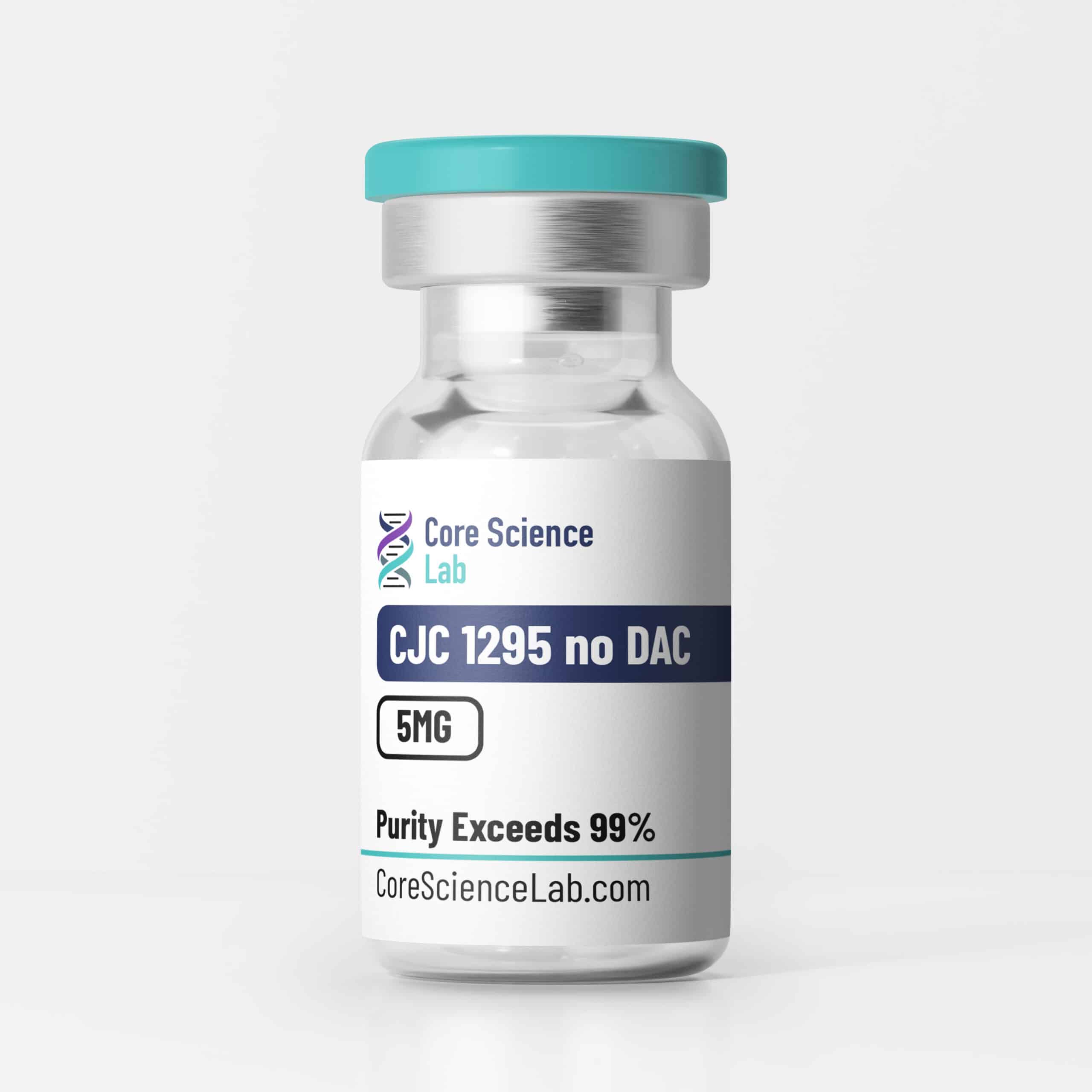
A high-purity, lyophilized synthetic tetrasubstituted peptide analogue of Growth Hormone-Releasing Hormone (GHRH), formally classified in scientific literature as Modified GRF (1-29). Characterized strictly for research applications involving the somatotropic axis, physiological pulsatile growth hormone (GH) secretion, and neuroendocrine receptor signaling.
Trust & Quality Verification
$35.00
Out of stock
Purity Standard
Verified Analysis
Available
Shipping
The nomenclature “CJC-1295 no DAC” is widely utilized within the research community to describe the peptide structurally defined as Modified GRF (1-29). While the native 29-amino-acid sequence of GHRH (Sermorelin) is fully bioactive, it is highly susceptible to rapid enzymatic cleavage by dipeptidyl peptidase-4 (DPP-4), resulting in an in vivo half-life of under 10 minutes.
To overcome this limitation in experimental models, Modified GRF (1-29) incorporates four strategic amino acid substitutions (D-Ala2, Gln8, Ala15, Leu27). These modifications prevent premature enzymatic degradation, successfully extending the peptide’s half-life to approximately 30 minutes. Crucially, because it lacks the Drug Affinity Complex (DAC) found in true CJC-1295 (which binds to serum albumin to extend the half-life to several days), “no DAC” maintains a kinetic profile that mimics the brief, acute, and natural physiological pulsatility of endogenous GH release, preventing the somatotroph receptor desensitization associated with continuous exposure.
Biochemical Characteristics
Chemically, CJC-1295 no DAC functions as an optimized synthetic secretagogue designed to interface directly with specialized G protein-coupled receptors on pituitary cell membranes.
Chemical Properties
| Property | Specification |
| Molecule Name | Modified GRF (1-29) |
| Synonyms | CJC-1295 without DAC; Tetrasubstituted GRF (1-29) |
| Form | Lyophilized Powder |
| Purity | ≥99% (Verified via HPLC) |
| Solubility | Soluble in water and organic solvents (refer to SDS) |
| Documentation | COA available per lot; SDS available |
(Note: Exact Molecular Weights and Formulas should be verified per lot COA/SDS).
CJC-1295 no DAC is strictly for laboratory research and is commonly employed in the following investigational areas:
Episodic Somatotropic Axis Modulation
This compound is extensively utilized as a chemical probe to study the biophysics of pulsatile pituitary receptor activation. Researchers use it to quantify the dose-dependent stimulation of adenylate cyclase and the subsequent exocytosis of GH, focusing on how episodic (rather than continuous) signaling preserves receptor sensitivity in isolated neuroendocrine cellular models.
Cellular Aging and Endocrine Senescence
In experimental models of age-related endocrine decline, Modified GRF (1-29) is investigated for its capacity to restore youthful episodic GH secretion. Assays focus on how re-establishing the episodic GH/IGF-1 axis impacts cellular turnover, oxidative stress markers, and physiological senescence in mammalian tissue lines.
Metabolic Flux & Lipid Mobilization
Because endogenous GH secretion is highly lipolytic, experimental models utilize this compound to study the downstream metabolic consequences of restored GH pulsatility. Researchers quantify changes in lipid metabolism, nitrogen balance, and lean muscle mass preservation to understand the broader role of the targeted GHRH axis in metabolic reprogramming.
Pathway / Mechanistic Context
The primary mechanism of action for CJC-1295 no DAC in research settings revolves around the targeted, acute activation of the GHRH receptor.
Preclinical Research Summary
Published preclinical literature documents investigations of Modified GRF (1-29) across multiple experimental models for pathway characterization:
Form & Analytical Testing
This material is produced via robust chemical synthesis and supplied as a lyophilized (freeze-dried) powder.
Referenced Citations
References are provided for informational purposes only and are not clinical claims.
RESEARCH USE ONLY
This product is intended strictly for laboratory research use only. It is not for human or veterinary use. It is not intended for diagnosis, treatment, cure, or prevention of any disease. All purchases are subject to our Terms of Service and Purity Guarantee.
No COAs available for this product.
RESEARCH USE ONLY
This product is intended strictly for laboratory research use only. It is not for human or veterinary use. It is not intended for diagnosis, treatment, cure, or prevention of any disease. All purchases are subject to our Terms of Service and Purity Guarantee.
Reviews
There are no reviews yet.