
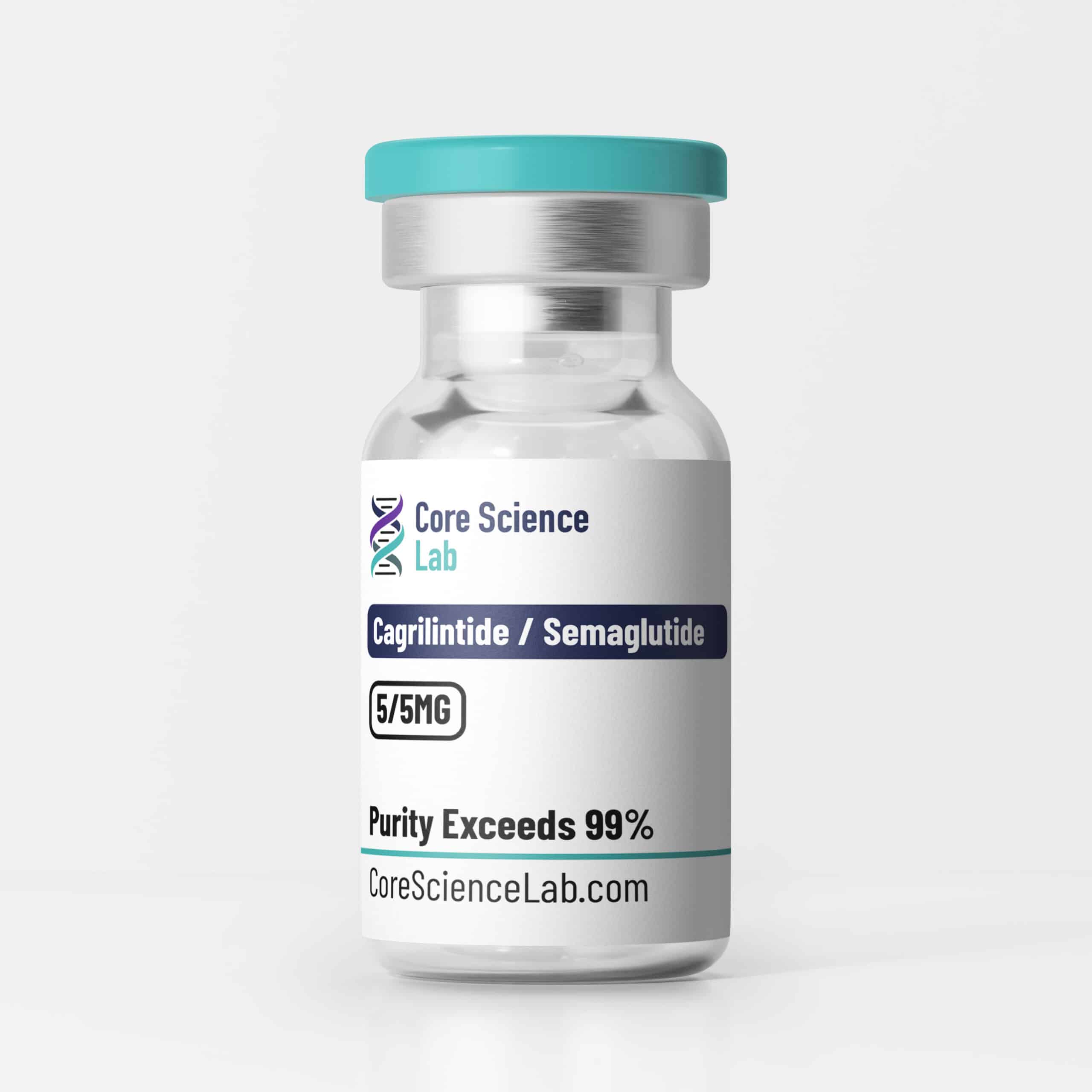
A dual-agonist research blend comprising a long-acting amylin analogue (Cagrilintide) and a GLP-1 receptor agonist (Semaglutide) in a 1:1 mass ratio. This co-formulation is characterized for research applications involving synergistic metabolic regulation, non-overlapping satiety signaling pathways, and enhanced weight loss efficacy studies in obese phenotypes.
Trust & Quality Verification
Purity Standard
Verified Analysis
Available
Shipping
Cagrilintide / Semaglutide (often referred to in literature as “CagriSema”) is a fixed-dose combination research reagent designed to explore the additive and synergistic effects of simultaneous Amylin and GLP-1 receptor activation.
Semaglutide functions as a GLP-1 receptor agonist, primarily targeting the hypothalamus to regulate appetite and insulin secretion. Cagrilintide, a long-acting acylated amylin analogue, targets amylin and calcitonin receptors in the hindbrain (area postrema) to delay gastric emptying and induce satiety.
This blend is widely utilized in laboratory settings to study the “Semaglutide-squared” effect, where the combination has been shown in preclinical and clinical models to produce weight loss and metabolic improvements superior to either monotherapy alone. Researchers employ this compound to map the convergence of hindbrain and hypothalamic signaling pathways in the regulation of energy homeostasis.
Biochemical Characteristics
The combination leverages two distinct peptide backbones modified for extended half-lives and albumin binding.
Chemical Properties
| Property | Semaglutide Specification | Cagrilintide Specification |
| Molecule Name | Semaglutide | Cagrilintide |
| Synonyms | NN9535; GLP-1 RA | AM833; NN9838 |
| CAS Number | 910463-68-2 | 1415456-99-3 |
| Molecular Formula | $C_{187}H_{291}N_{45}O_{59}$ | $C_{171}H_{267}N_{43}O_{53}$ |
| Molecular Weight | ~4113.58 g/mol | ~3973.4 g/mol |
| Form | \multicolumn{2}{c | }{Co-Lyophilized Powder} |
| Purity | \multicolumn{2}{c | }{≥99% (Verified via HPLC)} |
| Solubility | \multicolumn{2}{c | }{Soluble in water and organic solvents (refer to SDS)} |
This combination product is strictly for laboratory research and is commonly employed in the following investigational areas:
Synergistic Weight Loss and Adiposity
The primary research application for the Cagrilintide/Semaglutide blend is the investigation of superior weight loss efficacy. Studies in diet-induced obese (DIO) models utilize this combination to quantify reductions in visceral adipose tissue and body weight that exceed the ceiling of GLP-1 monotherapy, attributed to the additive suppression of food intake.
Glycemic Control and Insulin Sensitivity
Researchers utilize this blend to study the dual regulation of glucose homeostasis. Semaglutide enhances glucose-dependent insulin secretion, while Cagrilintide suppresses postprandial glucagon secretion and slows gastric emptying. This dual mechanism is investigated for its potential to improve HbA1c and time-in-range metrics in models of Type 2 Diabetes.
Mechanisms of Satiety Signaling
This reagent is used as a chemical probe to dissect the cross-talk between the hindbrain (targeted by Cagrilintide) and the hypothalamus (targeted by Semaglutide). Experimental workflows involve mapping neuronal activation (c-Fos expression) in the nucleus of the solitary tract (NTS) and the arcuate nucleus to understand how these distinct pathways converge to regulate satiety.
Pathway / Mechanistic Context
The mechanism of action for the Cagrilintide/Semaglutide blend involves the simultaneous engagement of two distinct nutrient-sensing pathways.
Preclinical & Clinical Context
Published literature documents investigations of the Cagrilintide/Semaglutide combination (CagriSema) across multiple experimental models:
Form & Analytical Testing
This material is produced via robust chemical synthesis and supplied as a lyophilized (freeze-dried) powder.
Referenced Citations
References are provided for informational purposes only and are not clinical claims.
RESEARCH USE ONLY
This product is intended strictly for laboratory research use only. It is not for human or veterinary use. It is not intended for diagnosis, treatment, cure, or prevention of any disease. All purchases are subject to our Terms of Service and Purity Guarantee.
No COAs available for this product.
RESEARCH USE ONLY
This product is intended strictly for laboratory research use only. It is not for human or veterinary use. It is not intended for diagnosis, treatment, cure, or prevention of any disease. All purchases are subject to our Terms of Service and Purity Guarantee.
Reviews
There are no reviews yet.