
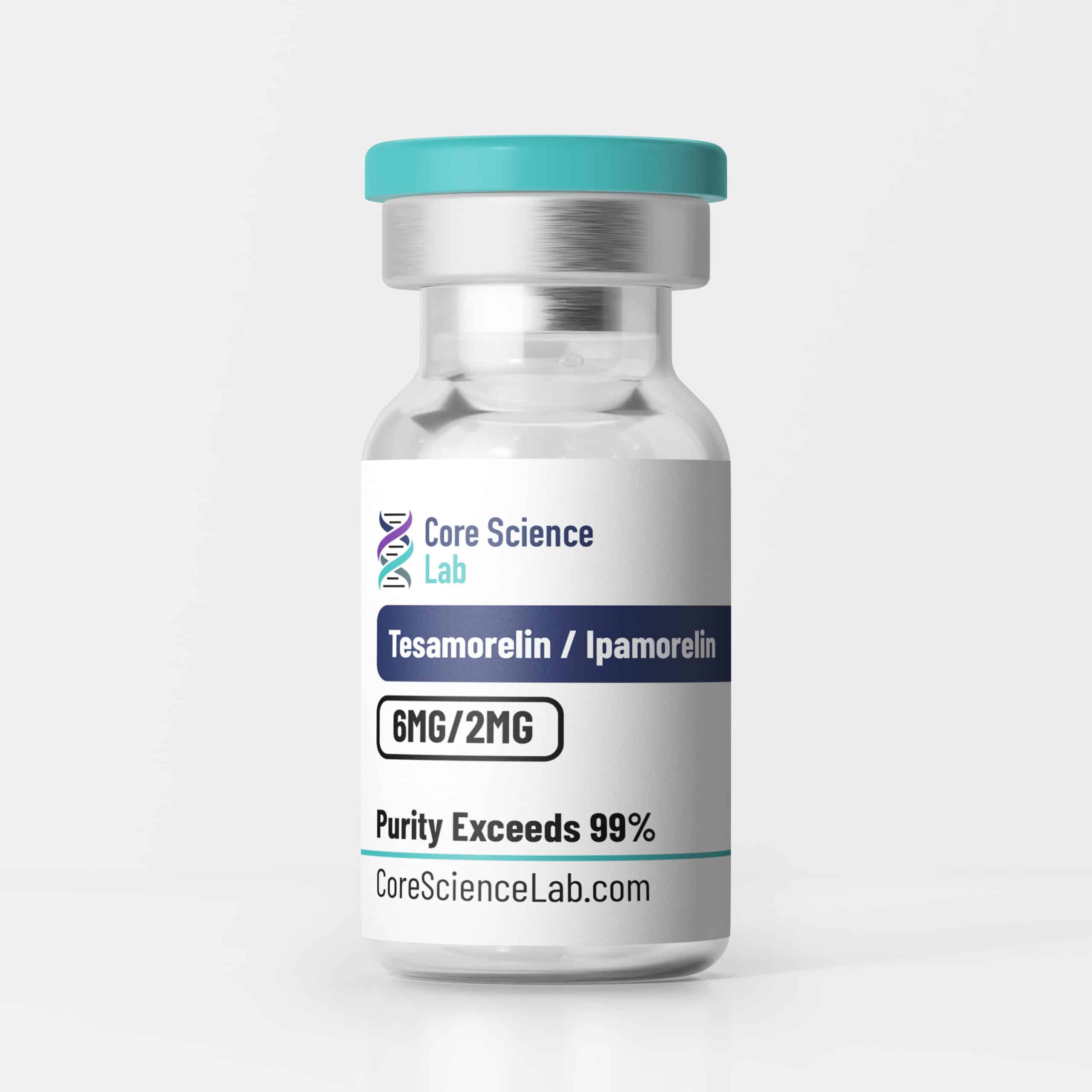
A high-purity, lyophilized synthetic peptide blend combining a growth hormone-releasing hormone (GHRH) analog (Tesamorelin) and a selective growth hormone secretagogue/ghrelin mimetic (Ipamorelin). It is utilized in research to investigate dual-pathway synergistic effects on endogenous growth hormone pulsatility, visceral adiposity reduction, and musculoskeletal homeostasis.
Trust & Quality Verification
Purity Standard
Verified Analysis
Available
Shipping
Tesamorelin / Ipamorelin (6mg/2mg) is a synergistic synthetic peptide combination research reagent. It is chemically distinct as it blends a 44-amino acid GHRH analog with a targeted pentapeptide ghrelin receptor agonist, utilized in laboratory settings to investigate the dual-pathway stimulation of the hypothalamic-pituitary-somatotropic axis. Researchers employ this combination to study amplified endogenous growth hormone secretion and its specific downstream metabolic endpoints, such as the reduction of visceral fat in lipodystrophy models, positive muscle tissue remodeling, and the counteraction of glucocorticoid-induced bone loss.
Biochemical Characteristics
Chemical Properties
| Property | Specification |
| Molecule Name | Tesamorelin / Ipamorelin |
| Synonyms | TH9507 (Tesamorelin); NNC 26-0161 (Ipamorelin) |
| PubChem CID | 16137828 (Tesamorelin) / 9831024 (Ipamorelin) |
| Molecular Formula | C221H366N72O67S / C38H49N9O5 |
| Molecular Weight | 5135.9 g/mol / 711.9 g/mol |
| Form | Lyophilized Powder |
| Purity | $\ge99\%$ (Verified via HPLC) |
| Solubility | Soluble in water and aqueous buffers (refer to SDS) |
| Documentation | COA and SDS available per lot |
Tesamorelin / Ipamorelin is strictly for laboratory research and is commonly employed in the following investigational areas:
Metabolic Regulation and Lipodystrophy
Research models utilize this peptide combination to evaluate its effects on endogenous GH pulsatility and insulin sensitivity. Investigations focus on assessing its efficacy in visceral fat reduction and the associated improvement of liver enzymes, particularly in models of HIV-associated lipodystrophy.
Musculoskeletal Homeostasis and Remodeling
Experimental protocols employ these secretagogues to characterize their impact on body composition. Studies assess the ability of the peptides to decrease muscle fat and increase muscle area, as well as quantify their capacity to increase bone mineral content and counteract glucocorticoid-induced decreases in bone formation.
Gastrointestinal Motility
In gastroenterological research, ghrelin mimetics like Ipamorelin are used to study their selective stimulatory effects on the gastrointestinal tract. Researchers evaluate their efficacy in accelerating transit times in rodent models of postoperative ileus.
Pathway / Mechanistic Context
The primary mechanism of action for the Tesamorelin / Ipamorelin combination in research settings involves the synergistic dual-pathway activation of the somatotropic axis.
Preclinical Research Summary
Published preclinical and clinical-translational literature documents the extensive investigation of Tesamorelin and Ipamorelin across diverse metabolic and musculoskeletal models.
Form & Analytical Testing
Referenced Citations
References are provided for informational purposes only and are not clinical claims.
RESEARCH USE ONLY
This product is intended strictly for laboratory research use only. It is not for human or veterinary use. It is not intended for diagnosis, treatment, cure, or prevention of any disease. All purchases are subject to our Terms of Service and Purity Guarantee.
No COAs available for this product.
RESEARCH USE ONLY
This product is intended strictly for laboratory research use only. It is not for human or veterinary use. It is not intended for diagnosis, treatment, cure, or prevention of any disease. All purchases are subject to our Terms of Service and Purity Guarantee.
Reviews
There are no reviews yet.