
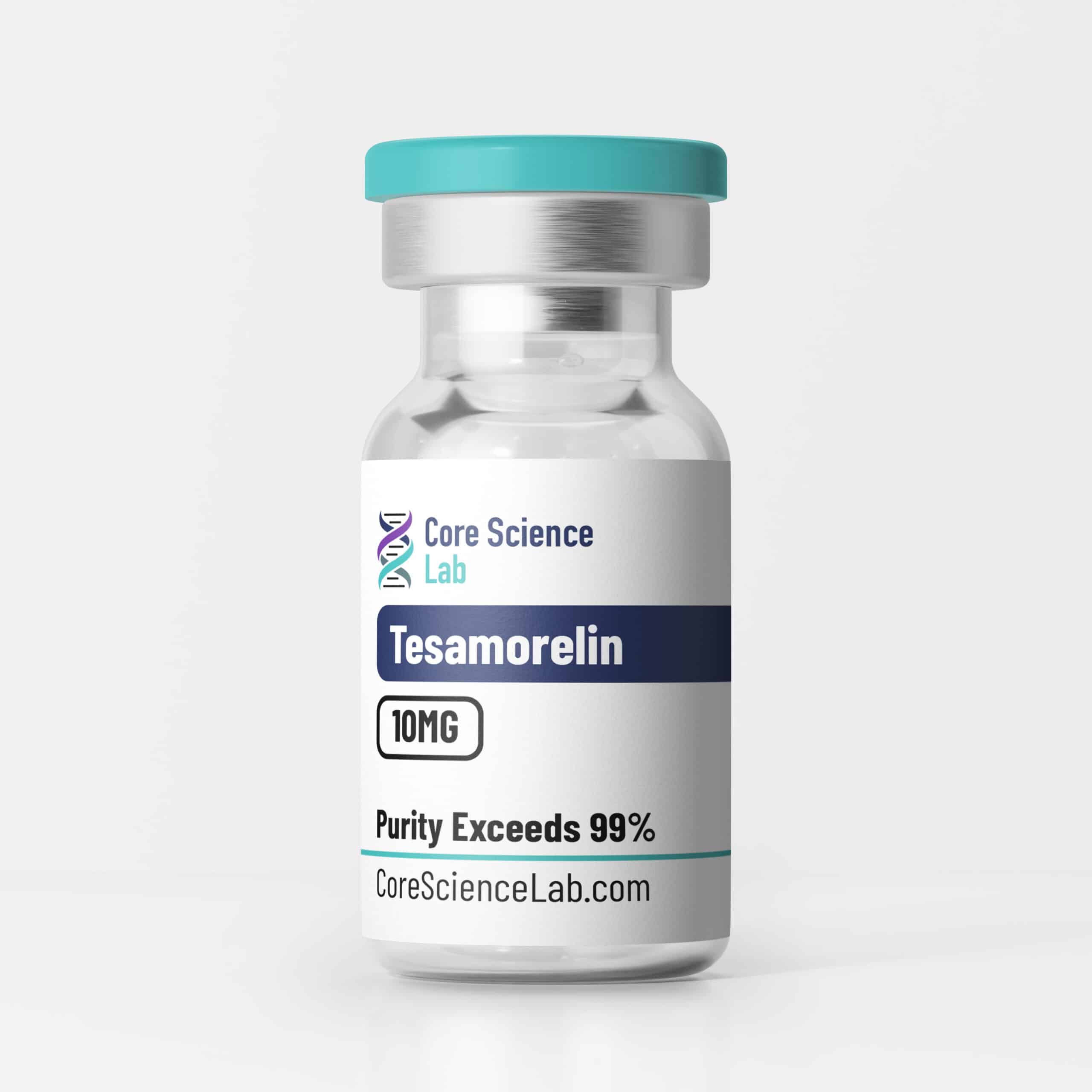
High-purity, stabilized synthetic analogue of Growth Hormone-Releasing Hormone (GHRH) characterized for research applications involving pulsatile growth hormone stimulation, lipolysis, and hepatic lipid metabolism.
Trust & Quality Verification
Purity Standard
Verified Analysis
Available
Shipping
Tesamorelin (trans-3-hexenoyl-GHRH(1-44) amide) is a synthetic peptide. It is chemically distinct due to an N-terminal modification that increases resistance to enzymatic degradation, extending its half-life relative to endogenous GHRH.
Researchers utilize this molecule to investigate the regulation of the somatotropic axis, specifically quantifying the downstream effects of Growth Hormone-Releasing Hormone Receptor (GHRHR) activation on insulin-like growth factor 1 (IGF-1) levels, visceral adipose tissue (VAT) dynamics, and hepatic lipid content.
Chemically, Tesamorelin is characterized by a 44-amino acid sequence with a trans-3-hexenoic acid group attached to the N-terminal tyrosine residue, a structural modification designed to enhance stability against dipeptidyl peptidase-4 (DPP-4) cleavage.
| Property | Specification |
| Molecule Name | Tesamorelin |
| Synonyms | TH9507; Egrifta (active moiety); trans-3-hexenoyl-GHRH(1–44) |
| PubChem CID | 16137828 |
| Molecular Formula | C221H366N72O67S |
| Molecular Weight | 5135.78 g/mol |
| Form | Lyophilized Powder |
| Purity | ≥99% (Verified via HPLC) |
| Solubility | Soluble in water and aqueous buffers (refer to SDS) |
| Documentation | COA and SDS available per lot |
Tesamorelin is strictly for laboratory research and is commonly employed in the following investigational areas:
Visceral Adiposity and Lipolysis
Research models utilize Tesamorelin to evaluate the mechanisms of lipolysis in visceral adipose tissue (VAT). Investigations focus on quantifying changes in VAT cross-sectional area and density, assessing how GHRH agonism influences fat distribution patterns independent of overall weight change.
Hepatic Lipid Metabolism
In metabolic research, Tesamorelin is used to study hepatic steatosis and non-alcoholic fatty liver disease (NAFLD) pathways. Researchers measure endpoints such as hepatic fat fraction (HFF) and analyze transcriptomic signatures related to oxidative phosphorylation and inflammation in liver tissue models.
Cardiovascular and Metabolic Risk
Experimental protocols employ this peptide to characterize the relationship between the GH/IGF-1 axis and cardiovascular risk markers. Studies quantify changes in lipid profiles (specifically triglycerides and VAT density) and evaluate cardiovascular disease risk prediction scores in metabolic dysfunction models.
Neurocognitive Function
Recent investigations have utilized Tesamorelin to explore the role of the somatotropic axis in cognitive health. Researchers assess neurocognitive performance domains, including executive function and memory, to determine if visceral adiposity reduction correlates with changes in cognitive impairment markers.
The primary mechanistic context for Tesamorelin in research settings is the agonism of the GHRH receptor on the anterior pituitary.
Published literature documents investigations of Tesamorelin across various experimental models for pathway characterization and endpoint measurement:
This material is produced via solid-phase peptide synthesis and supplied as a lyophilized (freeze-dried) powder.
Stable at room temperature for up to 90 days. For long-term storage, keep at -20C (-4F) or colder.
Once mixed with a solvent (e.g., bacteriostatic water), the solution must be stored at 4C (39F) and utilized within 30 days. Avoid repeated freeze-thaw cycles, as this degrades the peptide structure.
References are provided for informational purposes only and are not clinical claims.
RESEARCH USE ONLY
This product is intended strictly for laboratory research use only. It is not for human or veterinary use. It is not intended for diagnosis, treatment, cure, or prevention of any disease. All purchases are subject to our Terms of Service and Purity Guarantee.
No COAs available for this product.
RESEARCH USE ONLY
This product is intended strictly for laboratory research use only. It is not for human or veterinary use. It is not intended for diagnosis, treatment, cure, or prevention of any disease. All purchases are subject to our Terms of Service and Purity Guarantee.
Reviews
There are no reviews yet.