Description
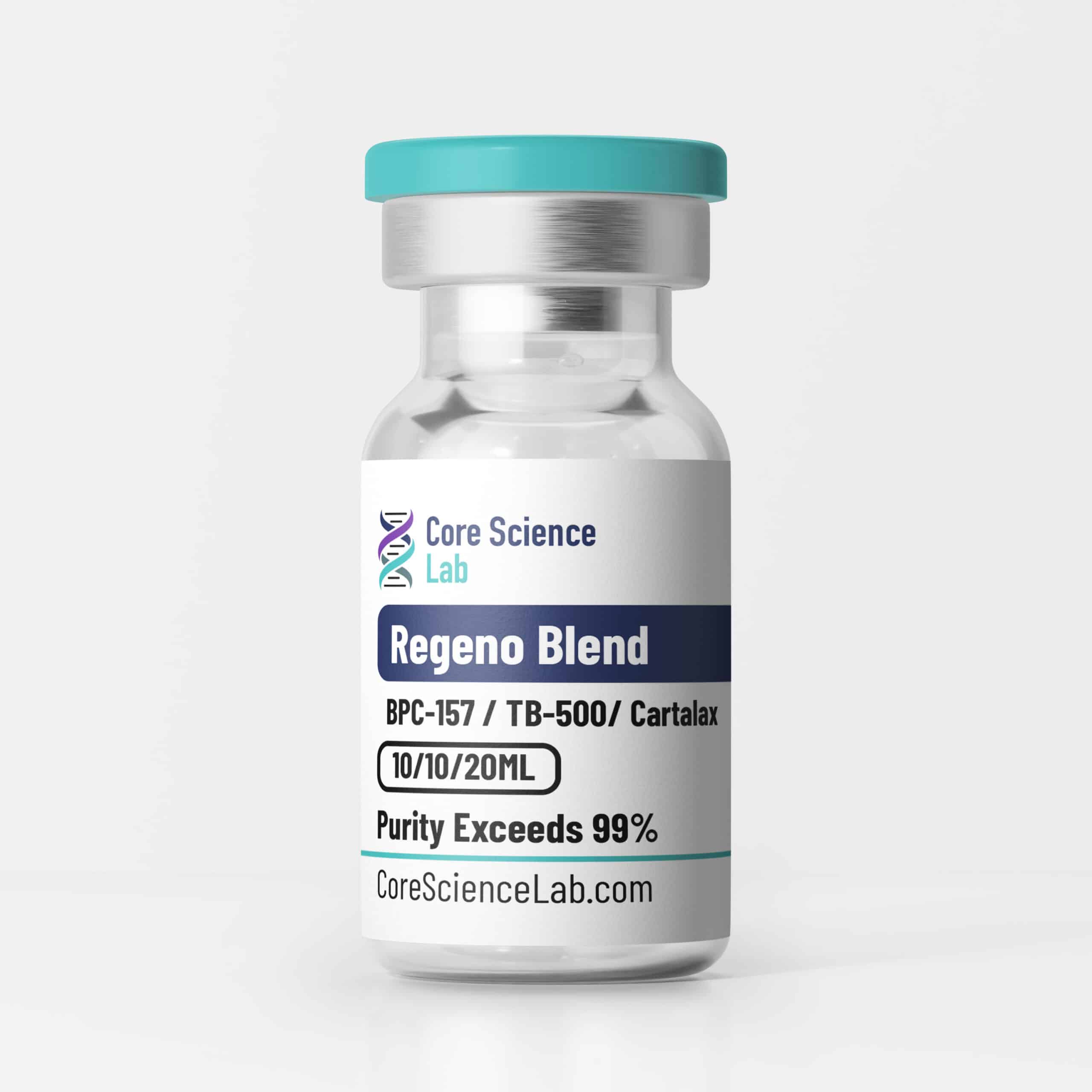
The Regeno Blend is a specialized research reagent containing three distinct synthetic peptides, designed to facilitate advanced in vitro and ex vivo investigations into musculoskeletal, dermal, and articular repair mechanisms. BPC-157 (Body Protection Compound-157) is a 15-amino-acid peptide widely researched for its role in modulating vascular stabilization and nitric oxide (NO) signaling. TB-500 is a synthetic functional analogue of Thymosin β-4, an endogenous protein critical for actin polymerization and progenitor cell recruitment. Cartalax (Ala-Glu-Asp) is a highly membrane-permeable tripeptide bioregulator investigated for its capacity to interact directly with DNA and histone proteins to regulate gene expression related to cartilage and collagen synthesis.
In experimental models, the concurrent administration of these three peptides allows researchers to observe multi-tiered healing responses. By merging the vascular-stabilizing properties of BPC-157 with the migratory support of TB-500 and the chondrogenic gene-modulating effects of Cartalax, this blend acts as a robust chemical probe for studying accelerated tissue scaffold integration and cellular hypertrophy under stress or mechanical overload.
Biochemical Characteristics
- Sequence/Structure: A proprietary blend of three distinct peptide structures. BPC-157 (15 amino acids); TB-500 (synthetic Tβ4 sequence); Cartalax (tripeptide sequence: Ala-Glu-Asp).
- Receptor Affinity & Binding: Simultaneously targets VEGFR2 activation (BPC-157), G-actin monomer sequestration (TB-500), and intracellular epigenetic regulation markers linked to chondrocyte differentiation (Cartalax).
- Stability: Supplied as a co-lyophilized salt to prevent hydrolytic degradation and ensure the structural integrity of all three peptide chains during long-term storage.
- Specificity: Designed to competitively stimulate localized vascular, cytoskeletal, and structural repair mechanisms while minimizing off-target systemic inflammation in isolated cellular assays.
Chemical Properties
| Property |
Specification |
| Molecule Name |
Regeno Blend (BPC-157 / TB-500 / Cartalax) |
| Synonyms |
Pentadecapeptide / Thymosin β-4 / AED Tripeptide |
| Molecular Formula |
BPC-157: C62H98N16O22
TB-500: C212H350N56O78S
Cartalax: C12H19N3O8 |
| Molecular Weight |
BPC-157: 1419.5 g/mol
TB-500: 4963.4 g/mol
Cartalax: 333.3 g/mol |
| Form |
Lyophilized Powder |
| Purity |
≥99% (Verified via HPLC for all components) |
| Solubility |
Soluble in water and aqueous buffers (refer to SDS) |
| Documentation |
COA and SDS available per lot |
The Regeno Blend is strictly for laboratory research and is commonly employed in the following investigational areas:
Angiogenesis and Vascular Repair
BPC-157 and TB-500 are heavily utilized in endothelial cell cultures to map the biophysics of new blood vessel formation. Researchers use this blend to quantify the dose-dependent activation of the Akt-eNOS pathway and observe the subsequent microvascular sprouting dynamics critical for delivering oxygen to ischemic tissue constructs.
Cellular Migration and Cytoskeletal Dynamics
In vitro wound-scratch assays employ this blend to observe cellular motility. Investigations focus on how TB-500 upregulates actin dynamics and focal adhesion kinase (FAK) complexes, allowing fibroblasts and progenitor cells to rapidly migrate into damaged zones and anchor to provisional matrix scaffolds.
Chondrocyte Proliferation and Cartilage Homeostasis
The inclusion of the Cartalax tripeptide directs research toward localized articular repair. Experimental models evaluate the blend’s potential to stimulate chondrocyte proliferation, upregulate Type II collagen and glycosaminoglycan deposition, and delay the expression of cellular senescence markers in aging joint tissue explants.
Pathway / Mechanistic Context
The primary mechanism of action for this blend involves the integration of three distinct cellular signaling pathways:
- VEGFR2 & NO Modulation (BPC-157): Binds to VEGFR2 receptors on endothelial cells, triggering the Akt-eNOS cascade. This increases nitric oxide production, stabilizing vascular networks and promoting immediate angiogenesis.
- Actin Polymerization (TB-500): Functions as a primary actin-sequestering molecule. By maintaining a dynamic pool of G-actin monomers, it rapidly reorganizes the cellular cytoskeleton, driving cellular migration and minimizing fibrotic scar tissue formation via TGF-β modulation.
- Epigenetic Gene Expression (Cartalax): The highly cationic nature of the AED tripeptide allows it to penetrate the nuclear membrane, where it binds to specific promoter regions of DNA. This directly upregulates the transcription of structural extracellular matrix proteins and telomere-protecting enzymes.
Preclinical Research Summary
Published preclinical literature documents investigations of these constituent peptides across multiple experimental models:
- Soft Tissue Engineering: Studies demonstrate that BPC-157 significantly enhances the biomechanical strength and structural organization of repairing Achilles tendon and ligament models via accelerated collagen remodeling.
- Dermal and Vascular Regeneration: In vitro data suggests that TB-500 accelerates keratinocyte migration and increases wound contracture in delayed-healing models, acting as a potent stimulus for new capillary formation.
- Neuromuscular Junctions: Models of myotendinous junction injuries demonstrate that pentadecapeptide administration counteracts oxidative stress and NO-levels, leading to full functional recovery and the counteraction of muscle atrophy.
- Geroprotection and Cartilage: Research confirms that the short Ala-Glu-Asp (Cartalax) peptide reduces the expression of senescence markers (such as p16 and p21) in mesenchymal stem cells and skin fibroblasts, acting as a profound geroprotector to maintain cellular renewal processes in aging tissues.
Form & Analytical Testing
- Synthesis: Solid-Phase Peptide Synthesis (SPPS) for all constituent peptides.
- Lyophilization: Removes water content under vacuum to maintain compound integrity and extend shelf-life.
- Identity Verification: Mass Spectrometry (MS) to confirm the molecular weight and identity of each respective peptide in the blend.
- Purity Verification: High-Performance Liquid Chromatography (HPLC) is performed to ensure the combined product meets the ≥99% purity standard required for reproducible research data.
Referenced Citations
References are provided for informational purposes only and are not clinical claims.
- Sikiric, P., Skrtic, A., Gojkovic, S., et al. (2024). The Stable Gastric Pentadecapeptide BPC 157 Pleiotropic Beneficial Activity and Its Possible Relations with Neurotransmitter Activity. Pharmaceuticals, 17(4), 461. https://doi.org/10.3390/ph17040461
- Chang, C. H., Tsai, W. C., Lin, M. S., et al. (2011). The promoting effect of pentadecapeptide BPC 157 on tendon healing involves tendon outgrowth, cell survival, and cell migration. Journal of Applied Physiology, 110(3), 774-780. https://doi.org/10.1152/japplphysiol.00945.2010
- Seiwerth, S., Milkovic, P., Vukojevic, J., et al. (2021). Stable Gastric Pentadecapeptide BPC 157 and Wound Healing. Frontiers in Pharmacology, 12, 627533. https://doi.org/10.3389/fphar.2021.627533
- Japjec, M., Horvat Omerzu, V., Francetic, I., et al. (2021). Stable Gastric Pentadecapeptide BPC 157 as a Therapy for the Disable Myotendinous Junctions in Rats. Biomedicines, 9(11), 1547. https://doi.org/10.3390/biomedicines9111547
- Xue, X. C., Wu, Y. J., Gao, M. T., et al. (2022). Pharmacokinetics, distribution, metabolism, and excretion of body-protective compound 157, a potential drug for treating various wounds, in rats and dogs. Frontiers in Pharmacology, 13, 1026182. https://doi.org/10.3389/fphar.2022.1026182
- Philp, D., Goldstein, A. L., & Kleinman, H. K. (2004). Thymosin beta4 promotes angiogenesis, wound healing, and hair follicle development. Mechanisms of Ageing and Development, 125(2), 113-115. https://doi.org/10.1016/j.mad.2003.11.005
- Xing, Y., Ye, Y., Zuo, H., & Li, Y. (2021). Progress on the Function and Application of Thymosin β4. Frontiers in Endocrinology, 12, 767785. https://doi.org/10.3389/fendo.2021.767785
- Kumar, S., Gupta, S., & Wang, J. M. (2011). Thymosin Beta 4 Prevents Oxidative Stress by Targeting Antioxidant and Anti-Apoptotic Genes in Cardiac Fibroblasts. PLOS One, 6(10), e26912. https://doi.org/10.1371/journal.pone.0026912
- Smart, N., Risebro, C. A., Melville, A. A., et al. (2012). Essential Role for Thymosin β4 in Regulating Vascular Smooth Muscle Cell Development and Vessel Wall Stability. Circulation Research, 110(6), 812-822. https://doi.org/10.1161/CIRCRESAHA.111.259846
- Hinkel, R., El-Aouni, C., Hofmann, T., et al. (2008). Thymosin beta4 is an essential paracrine factor of endothelial cells promoting myocardial angiogenesis. Nature Medicine, 14(3), 287-294.https://pubmed.ncbi.nlm.nih.gov/18427126/
- Khavinson, V. K., Lin’kova, N. S., & Tarnovskaya, S. I. (2016). Short Peptides Regulate Gene Expression. Bulletin of Experimental Biology and Medicine, 162(2), 288–292. https://doi.org/10.1007/s10517-016-3596-7
- Myakisheva, S. N., Linkova, N. S., Kozhevnikova, E. O., et al. (2023). Peptides Prevent the Forming of Secretory Phenotype of Chondrocytes Associated with the Aging. Advances in Gerontology, 36(2), 234-238.https://pubmed.ncbi.nlm.nih.gov/18427126/
- Khavinson, V., Popovich, I., Linkova, N., Mironova, V., & Ilina, A. (2021). Peptide Regulation of Gene Expression: A Systematic Review. Molecules, 26(22), 7053. https://doi.org/10.3390/molecules26227053
RESEARCH USE ONLY
This product is intended strictly for laboratory research use only. It is not for human or veterinary use. It is not intended for diagnosis, treatment, cure, or prevention of any disease. All purchases are subject to our Terms of Service and Purity Guarantee.
No COAs available for this product.

Reviews
There are no reviews yet.