
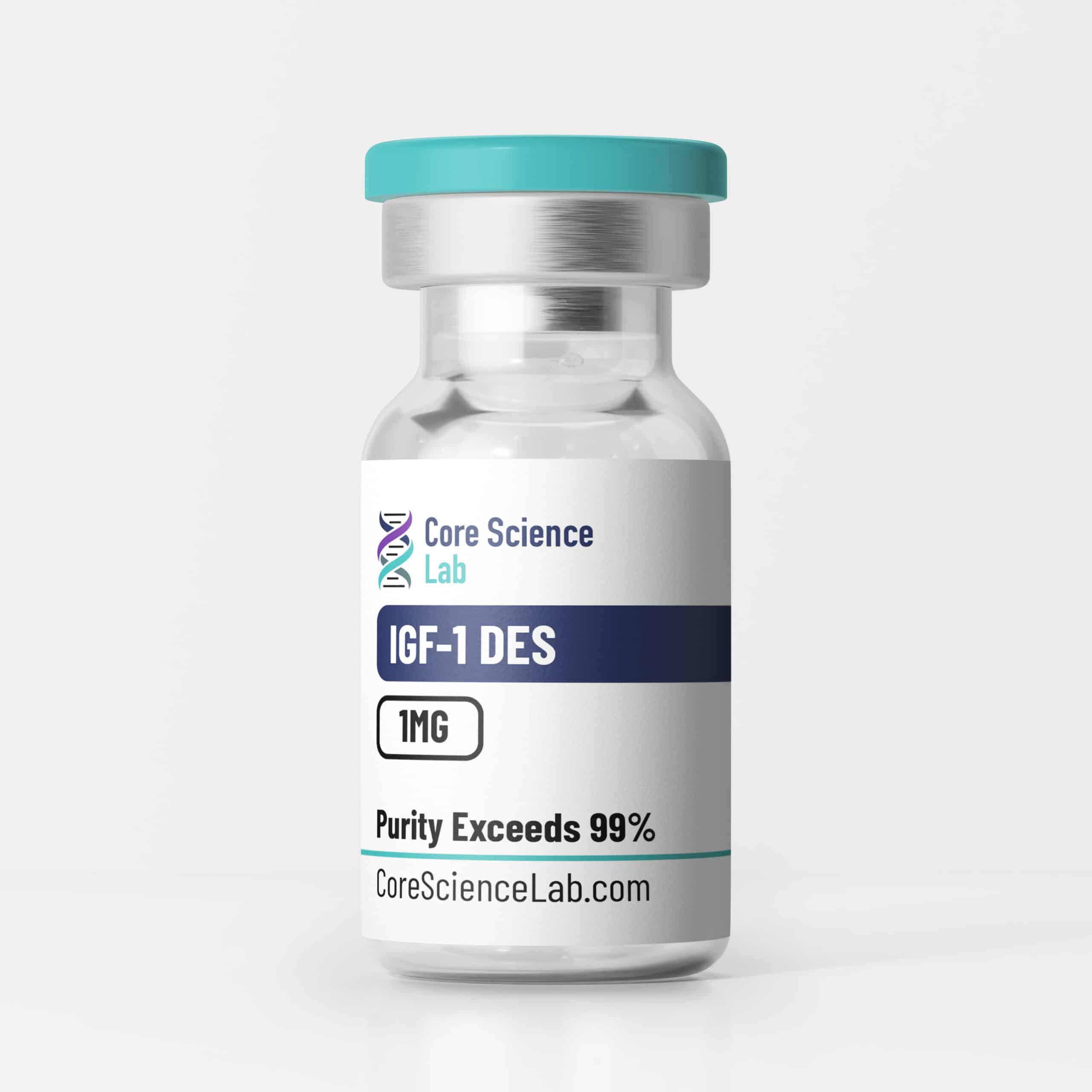
A high-purity, lyophilized synthetic truncated analogue of Insulin-like Growth Factor-1 (IGF-1), lacking the N-terminal tripeptide (Gly-Pro-Glu). Characterized for research applications involving acute localized cellular proliferation, myoblast differentiation, and targeted activation of the IGF-1 receptor (IGF-1R) without interference from Insulin-like Growth Factor Binding Proteins (IGFBPs).
Trust & Quality Verification
Purity Standard
Verified Analysis
Available
Shipping
IGF-1 DES (also known as Des(1-3)IGF-1) is a synthetic, 67-amino acid analogue of the endogenous 70-amino acid human IGF-1 peptide. Native IGF-1 serves as a primary mediator of the somatotropic axis; however, its biological activity is heavily regulated and suppressed in physiological settings by a family of carrier proteins known as IGFBPs.
To overcome this regulatory mechanism in experimental models, IGF-1 DES is structurally truncated to remove the first three amino acids (glycine, proline, and glutamic acid) at the N-terminus. This specific modification drastically reduces the peptide’s binding affinity for secreted IGFBPs. Consequently, IGF-1 DES exhibits vastly increased unbound bioavailability and accelerated receptor binding kinetics compared to native IGF-1. It is widely utilized in laboratory settings to investigate acute, localized tissue regeneration, satellite cell activation, and hypertrophic cellular adaptations.
Biochemical Characteristics
Chemically, IGF-1 DES functions as an unbound agonist engineered for immediate, uninhibited receptor interaction.
Chemical Properties
| Property | Specification |
| Molecule Name | IGF-1 DES |
| Synonyms | Des(1-3)IGF-1; Truncated IGF-1 |
| Molecular Weight | ~7365.5 g/mol |
| Form | Lyophilized Powder |
| Purity | ≥99% (Verified via HPLC) |
| Solubility | Soluble in water and organic solvents (refer to SDS) |
| Documentation | COA available per lot; SDS available |
(Note: Exact Molecular Weights and Formulas should be verified per lot COA/SDS).
IGF-1 DES is strictly for laboratory research and is commonly employed in the following investigational areas:
Myoblast Proliferation & Acute Hypertrophy Models
IGF-1 DES is utilized as a highly potent mitogen in skeletal muscle models. Because it remains unbound by IGFBPs that are heavily secreted by damaged or inflamed tissues, researchers employ it to study the rapid activation and proliferation of satellite cells (myoblasts) following mechanically induced microlesions.
Cellular Bioavailability Assays
In vitro studies utilize IGF-1 DES to map the inhibitory role of endogenous IGFBPs. By comparing the cellular growth response of native IGF-1 against the unbound DES analogue in various cell lines (such as gastric cancer cells), researchers can quantify the specific regulatory impact of carrier proteins on tissue expansion.
Neuroprotection and Neuromodulation
Research investigating central nervous system (CNS) dynamics employs IGF-1 DES to study transport kinetics and neuroprotective pathways across the blood-brain barrier (BBB). Assays assess its ability to stimulate synaptic maturation markers independent of peripheral binding proteins.
Pathway / Mechanistic Context
The primary mechanism of action for IGF-1 DES in research settings revolves around the acute, uninhibited activation of the IGF-1 receptor.
Preclinical Research Summary
Published preclinical literature documents investigations of IGF-1 DES across multiple experimental models:
Form & Analytical Testing
This material is produced via robust chemical synthesis and supplied as a lyophilized (freeze-dried) powder.
Referenced Citations
References are provided for informational purposes only and are not clinical claims.
RESEARCH USE ONLY
This product is intended strictly for laboratory research use only. It is not for human or veterinary use. It is not intended for diagnosis, treatment, cure, or prevention of any disease. All purchases are subject to our Terms of Service and Purity Guarantee.
No COAs available for this product.
RESEARCH USE ONLY
This product is intended strictly for laboratory research use only. It is not for human or veterinary use. It is not intended for diagnosis, treatment, cure, or prevention of any disease. All purchases are subject to our Terms of Service and Purity Guarantee.
Reviews
There are no reviews yet.