
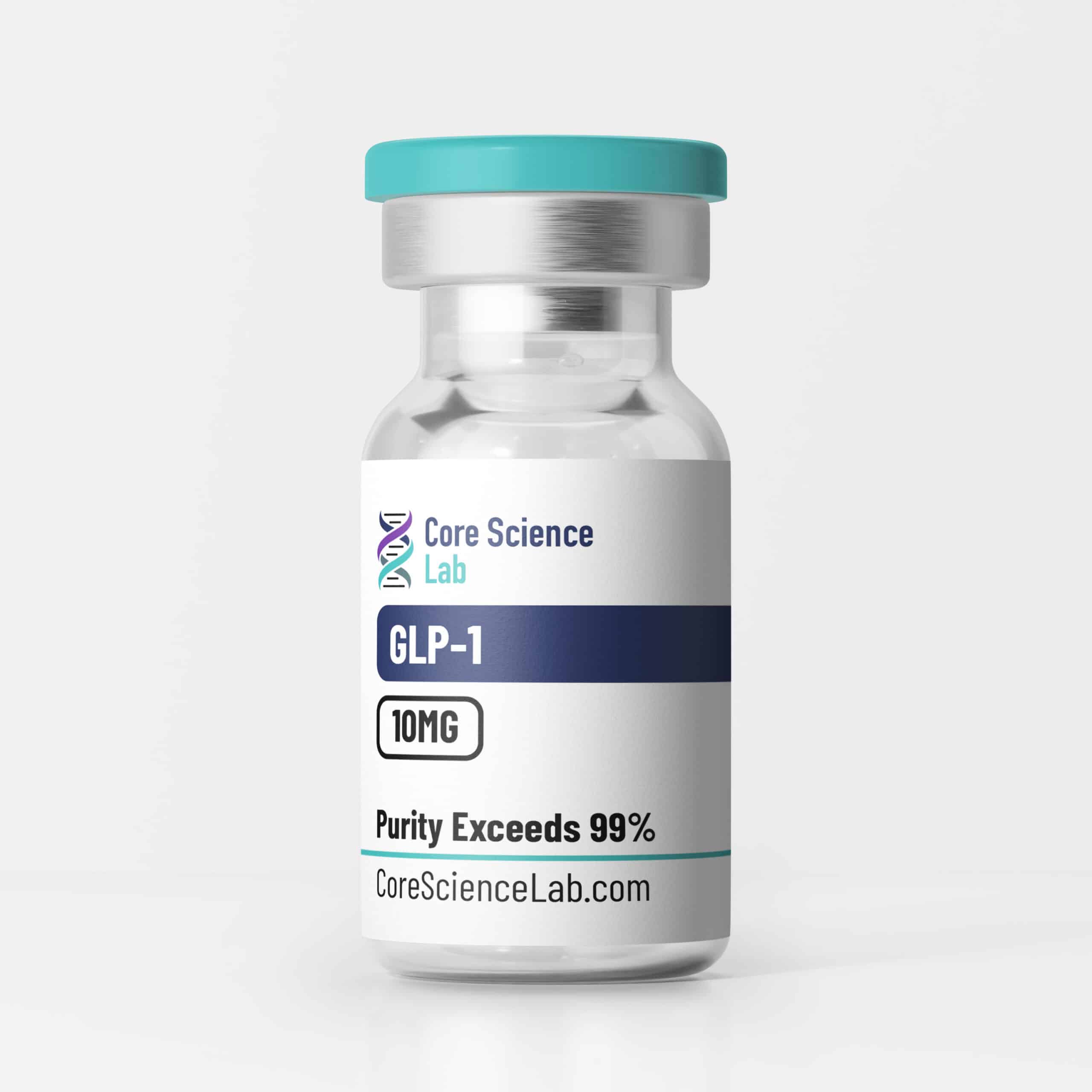
A high-purity, lyophilized synthetic peptide analogue of the endogenous incretin hormone glucagon-like peptide-1 (GLP-1). Characterized strictly for research applications involving incretin receptor modulation, glucose-dependent insulinotropic signaling, and pancreatic beta-cell function.
Trust & Quality Verification
Purity Standard
Verified Analysis
Available
Shipping
GLP-1 is a highly conserved peptide hormone endogenously secreted by intestinal enteroendocrine L-cells in response to nutrient ingestion. In experimental models, synthetic GLP-1 analogues are utilized to investigate the structural and functional dynamics of the GLP-1 receptor (GLP-1R), a widely expressed G protein-coupled receptor (GPCR) critically involved in energy homeostasis and metabolic regulation.
This compound is widely utilized in laboratory settings to map the downstream effects of elevated intracellular cyclic AMP (cAMP) levels, particularly regarding the enhancement of glucose-stimulated insulin secretion (GSIS), the promotion of beta-cell proliferation, and the mitigation of cellular apoptosis under lipotoxic and endoplasmic reticulum (ER) stress.
Biochemical Characteristics
Chemically, GLP-1 functions as a synthetic polypeptide characterized by an amino acid sequence engineered to interface with cell-surface incretin receptors.
Chemical Properties
| Property | Specification |
| Molecule Name | GLP-1 |
| Synonyms | Glucagon-Like Peptide-1 Analogue |
| Form | Lyophilized Powder |
| Purity | ≥99% (Verified via HPLC) |
| Solubility | Soluble in water and organic solvents (refer to SDS) |
| Documentation | COA available per lot; SDS available |
(Note: Exact Molecular Weights and Formulas should be verified per lot COA/SDS).
GLP-1 is strictly for laboratory research and is commonly employed in the following investigational areas:
Incretin Pathway & Metabolic Flux
GLP-1 is utilized as a chemical probe to study the biophysics of incretin receptor activation. Researchers employ this peptide to quantify the dose-dependent stimulation of adenylate cyclase and the subsequent enhancement of glucose-dependent insulin secretion pathways in isolated cellular models.
Pancreatic Beta-Cell Survival & Apoptosis
In vitro studies utilizing immortalized pancreatic beta-cell lines and primary islets employ GLP-1 to observe its cytoprotective impact. Investigations focus on how GLP-1 receptor activation significantly reduces biochemical markers of ER stress, attenuates the downregulation of insulin translation, and promotes beta-cell adaptation and survival.
Neurometabolic & Extra-Pancreatic Signaling
Because GLP-1 receptors are expressed in multiple extra-pancreatic tissues, including the central nervous system, GLP-1 is used in neurobiological research to study its role as a neuropeptide. Assays investigate its potential neuroprotective effects, reduction of neuroinflammation, and regulation of metabolic homeostasis via the gut-brain axis.
Pathway / Mechanistic Context
The primary mechanism of action for GLP-1 in research settings involves the targeted activation of the GLP-1 receptor.
Preclinical Research Summary
Published preclinical literature documents investigations of GLP-1 across multiple experimental models for pathway characterization:
Form & Analytical Testing
This material is produced via robust chemical synthesis and supplied as a lyophilized (freeze-dried) powder.
Referenced Citations
References are provided for informational purposes only and are not clinical claims.
RESEARCH USE ONLY
This product is intended strictly for laboratory research use only. It is not for human or veterinary use. It is not intended for diagnosis, treatment, cure, or prevention of any disease. All purchases are subject to our Terms of Service and Purity Guarantee.
No COAs available for this product.
RESEARCH USE ONLY
This product is intended strictly for laboratory research use only. It is not for human or veterinary use. It is not intended for diagnosis, treatment, cure, or prevention of any disease. All purchases are subject to our Terms of Service and Purity Guarantee.



Reviews
There are no reviews yet.