Description
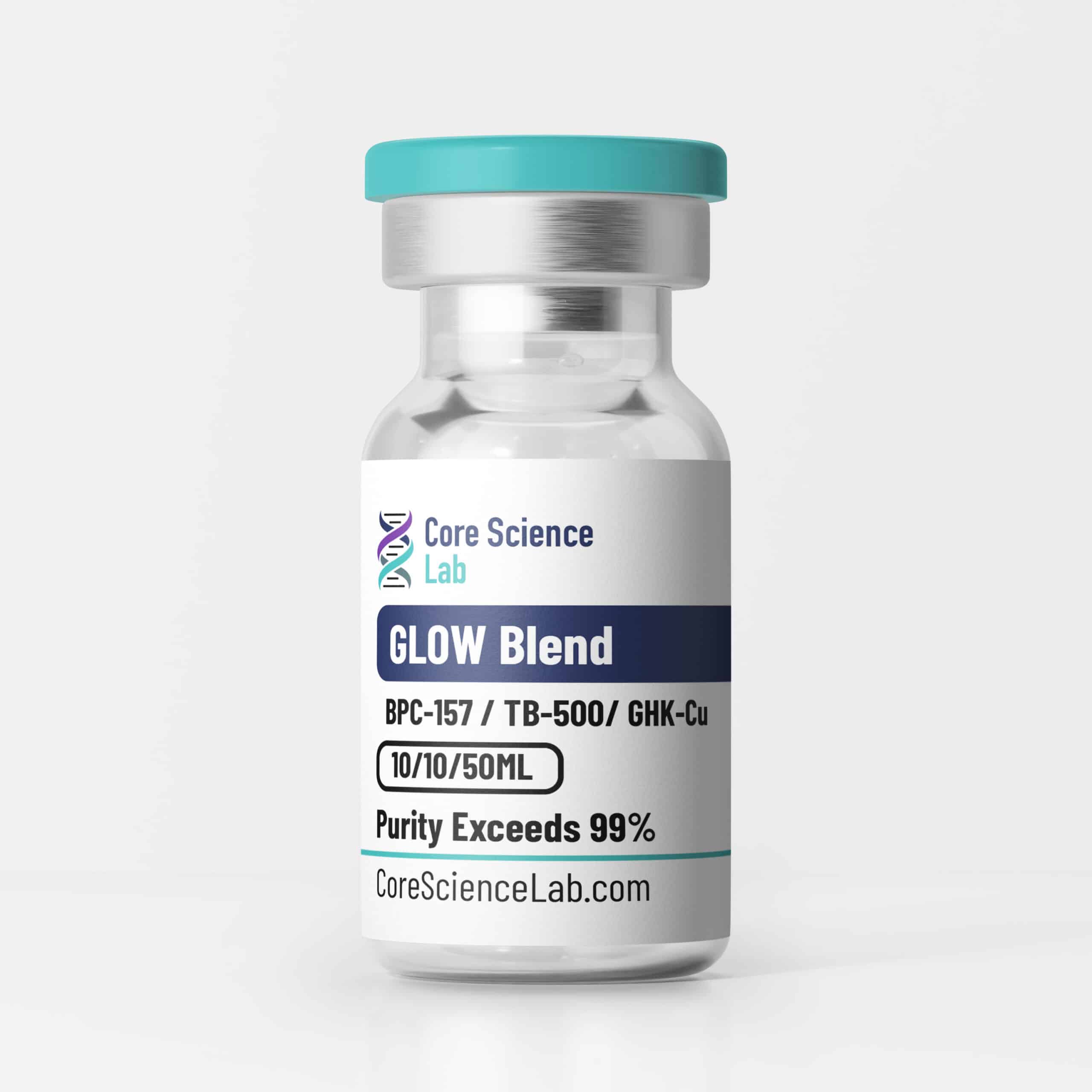
The GLOW Blend is a specialized peptide formulation. It combines three distinct signaling molecules: GHK-Cu (Glycyl-L-Histidyl-L-Lysine copper complex), BPC-157 (Body Protection Compound-157), and TB-500 (synthetic Thymosin Beta-4). Researchers utilize this blend to investigate the intersection of extracellular matrix (ECM) regulation, vascular development, and cellular migration pathways.
Experimental workflows employ this combination to quantify effects on fibroblast proliferation, collagen type I/III deposition, and endothelial tube formation. Unlike single-molecule controls, this blend allows for the assessment of synergistic mechanisms involving copper transport, the nitric oxide (NO) system, and actin polymerization regulators in complex tissue engineering and wound repair models.
Biochemical Characteristics
Chemically, this reagent represents a mixture of a high-affinity copper-binding tripeptide (GHK-Cu), a gastric pentadecapeptide (BPC-157), and a 43-amino acid actin-sequestering peptide (TB-500).
- Sequence/Structure: Heterogeneous mixture of GHK-Cu (Tripeptide-Copper Complex), BPC-157 (15 amino acids), and Thymosin Beta-4 (43 amino acids).
- Permeability: Components exhibit distinct interaction profiles; GHK-Cu utilizes copper transport channels (CTR1), while TB-500 interacts with intracellular actin pools.
- Stability: Supplied as a co-lyophilized salt to ensure long-term stability and prevent hydrolytic degradation during storage.
- Specificity: Designed to probe multiple targets: fibroblast activation (GHK-Cu), VEGFR2/NO pathways (BPC-157), and G-actin sequestration sites (TB-500).
Chemical Properties
| Property |
Specification |
| Molecule Name |
GLOW Blend (GHK-Cu, BPC-157, TB-500) |
| Synonyms |
Copper Tripeptide-1; Bepecin; Thymosin Beta-4 |
| PubChem CID |
73587 (GHK); 9941957 (BPC); 16132341 (TB-4) |
| Molecular Formula |
Mixture (C14H22CuN6O4 / C62H98N16O22 / C212H350N56O78S) |
| Molecular Weight |
~340.5 g/mol (GHK-Cu) / 1419.5 g/mol (BPC) / 4963.5 g/mol (TB-500) |
| Form |
Lyophilized Powder |
| Purity |
>=99% (Verified via HPLC) |
| Solubility |
Soluble in water and aqueous buffers (refer to SDS) |
| Documentation |
COA available per lot; SDS available |
The GLOW Blend is strictly for laboratory research and is commonly employed in the following investigational areas:
Extracellular Matrix (ECM) Remodeling
Research utilizes this blend to study the modulation of collagen and elastin synthesis in fibroblast cultures. Studies focus on measuring the expression of metalloproteinases (MMPs) and tissue inhibitors of metalloproteinases (TIMPs) to evaluate how GHK-Cu influences dermal architecture and structural integrity.
Angiogenesis and Vascular Repair
In vitro models employ this blend to characterize “angiomodulatory” effects. Investigators quantify the rate of endothelial cell proliferation and tube formation, examining how BPC-157 and GHK-Cu synergistically influence Vascular Endothelial Growth Factor (VEGF) expression and the nitric oxide system.
Cytoskeletal Organization and Cell Migration
The TB-500 component is utilized to investigate actin sequestration. Researchers measure the ratio of F-actin to G-actin in motile cells to determine how upregulation of Thymosin Beta-4 influences cytoskeletal reorganization, a critical step in cellular migration and re-epithelialization assays.
Pathway / Mechanistic Context
The primary mechanistic context for the GLOW Blend in research settings involves the multi-target modulation of tissue regeneration signaling.
- Copper transport & ECM Regulation: GHK-Cu facilitates the cellular uptake of copper, a cofactor required for the enzyme lysyl oxidase, which is essential for collagen cross-linking and maturation.
- VEGFR2 Activation: BPC-157 is investigated for its ability to activate Vascular Endothelial Growth Factor Receptor 2 (VEGFR2), potentially stimulating vessel formation and repair cascades.
- Actin Sequestration: TB-500 acts by binding to monomeric G-actin, preventing its polymerization into F-actin filaments. This “buffering” mechanism maintains a pool of actin monomers available for rapid polymerization during cell migration.
Preclinical Research Summary
Published preclinical literature documents investigations of these peptides across experimental models for pathway characterization and endpoint measurement:
- Dermal Fibroblast Assays: Research indicates that GHK-Cu treatment can significantly stimulate collagen synthesis and fibroblast proliferation, crucial endpoints in aging and wound healing models.
- Ischemic & Scald Models: Extensive studies on BPC-157 and GHK-Cu highlight their role in accelerating defect closure. Data suggests enhanced angiogenesis and reduced oxidative stress markers in tissues subjected to thermal or ischemic injury.
- Migration Assays: Investigations into Thymosin Beta-4 demonstrate increased directional migration of endothelial cells, characterized by enhanced repair potency in scratch-test assays.
Form & Analytical Testing
This material is produced via solid-phase peptide synthesis (SPPS) and complexation, supplied as a sterile-filtered lyophilized powder.
- Lyophilization: Removes water content under vacuum to maintain compound integrity and extend shelf-life.
- Identity Verification: Each lot undergoes Mass Spectrometry (MS) to confirm the presence and molecular weight of all three peptide components.
- Purity Verification: High-Performance Liquid Chromatography (HPLC) is performed to ensure the product meets the >=99% purity standard required for reproducible research data.
Storage & Handling
- Stable at room temperature for up to 90 days. For long-term storage, keep at -20C (-4F) or colder.
- Once mixed with a solvent (e.g., bacteriostatic water), the solution must be stored at 4C (39F) and utilized within 30 days.
- Avoid repeated freeze-thaw cycles, as this degrades the peptide structure.
Referenced Citations
References are provided for informational purposes only and are not clinical claims.
- Hsieh, M.-J. et al. (2016). Therapeutic potential of pro-angiogenic BPC157 is associated with VEGFR2 activation and up-regulation. Journal of Molecular Medicine. https://doi.org/10.1007/s00109-016-1488-y
- Dou, Y., Lee, A., Zhu, L., Morton, J., & Ladiges, W. (2020). The potential of GHK as an anti-aging peptide. Aging Pathobiology and Therapeutics. https://doi.org/10.31491/apt.2020.03.014
- Wang, X. et al. (2017). GHK‐Cu‐liposomes accelerate scald wound healing in mice by promoting cell proliferation and angiogenesis. Wound Repair and Regeneration. https://doi.org/10.1111/wrr.12520
- Malinda, K. M., Goldstein, A. L., & Kueinman, H. K. (1997). Thymosin beta 4 stimulates directional migration of human umbilical vein endothelial cells. FASEB Journal. https://doi.org/10.1096/fasebj.11.6.9194528
- Pickart, L. & Margolina, A. (2018). Regenerative and Protective Actions of the GHK-Cu Peptide in the Light of the New Gene Data. International Journal of Molecular Sciences. https://doi.org/10.3390/ijms19071987
- Chang, C.-H. et al. (2011). The promoting effect of pentadecapeptide BPC 157 on tendon healing involves tendon outgrowth, cell survival, and cell migration. Journal of Applied Physiology. https://doi.org/10.1152/japplphysiol.00945.2010
- Xue, B., Leyrat, C., Grimes, J. M., & Robinson, R. C. (2014). Structural basis of thymosin-beta4/profilin exchange leading to actin filament polymerization. Proceedings of the National Academy of Sciences. https://doi.org/10.1073/pnas.1412271111
- Maquart, F.-X. et al. (1988). Stimulation of collagen synthesis in fibroblast cultures by the tripeptide-copper complex glycyl-L-histidyl-L-lysine-Cu2+. FEBS Letters. https://doi.org/10.1016/0014-5793(88)80509-x
- Seiwerth, S. et al. (2021). Stable Gastric Pentadecapeptide BPC 157 and Wound Healing. Frontiers in Pharmacology. https://doi.org/10.3389/fphar.2021.627533
- Malinda, K. M. et al. (1999). Thymosin beta4 accelerates wound healing. Journal of Investigative Dermatology.
- Demirtaş, H. et al. (2025). Protective Effects of BPC 157 on Liver, Kidney, and Lung Distant Organ Damage in Rats with Experimental Lower-Extremity Ischemia-Reperfusion Injury. Medicina. https://doi.org/10.3390/medicina61020291
- Evans, M. A. et al. (2013). Thymosin beta4-sulfoxide attenuates inflammatory cell infiltration and promotes cardiac wound healing. Nature Communications. https://doi.org/10.1038/ncomms3081
- Pickart, L., Vasquez-Soltero, J. M., & Margolina, A. (2012). The Human Tripeptide GHK-Cu in Prevention of Oxidative Stress and Degenerative Conditions of Aging: Implications for Cognitive Health. Oxidative Medicine and Cellular Longevity. https://doi.org/10.1155/2012/324832
- Vukojevic, J. et al. (2022). Pentadecapeptide BPC 157 and the central nervous system. Neural Regeneration Research. https://doi.org/10.4103/1673-5374.320969
- Kim, S., Choi, J., & Kwon, J. (2023). Thymosin Beta 4 Protects Hippocampal Neuronal Cells against PrP (106-126) via Neurotrophic Factor Signaling. Molecules. https://doi.org/10.3390/molecules28093920
- Pickart, L., Vasquez-Soltero, J. M., & Margolina, A. (2015). GHK Peptide as a Natural Modulator of Multiple Cellular Pathways in Skin Regeneration. BioMed Research International. https://doi.org/10.1155/2015/648108
- Huang, T. et al. (2015). Body protective compound-157 enhances alkali-burn wound healing in vivo and promotes proliferation, migration, and angiogenesis in vitro. Drug Design, Development and Therapy. https://doi.org/10.2147/dddt.s82030
- Sharma, S. et al. (2019). In Vitro and in Vivo Studies of pH-Sensitive GHK-Cu-Incorporated Polyaspartic and Polyacrylic Acid Superabsorbent Polymer. ACS Omega. https://doi.org/10.1021/acsomega.9b00655
RESEARCH USE ONLY
This product is intended strictly for laboratory research use only. It is not for human or veterinary use. It is not intended for diagnosis, treatment, cure, or prevention of any disease. All purchases are subject to our Terms of Service and Purity Guarantee.
No COAs available for this product.

Reviews
There are no reviews yet.