Description
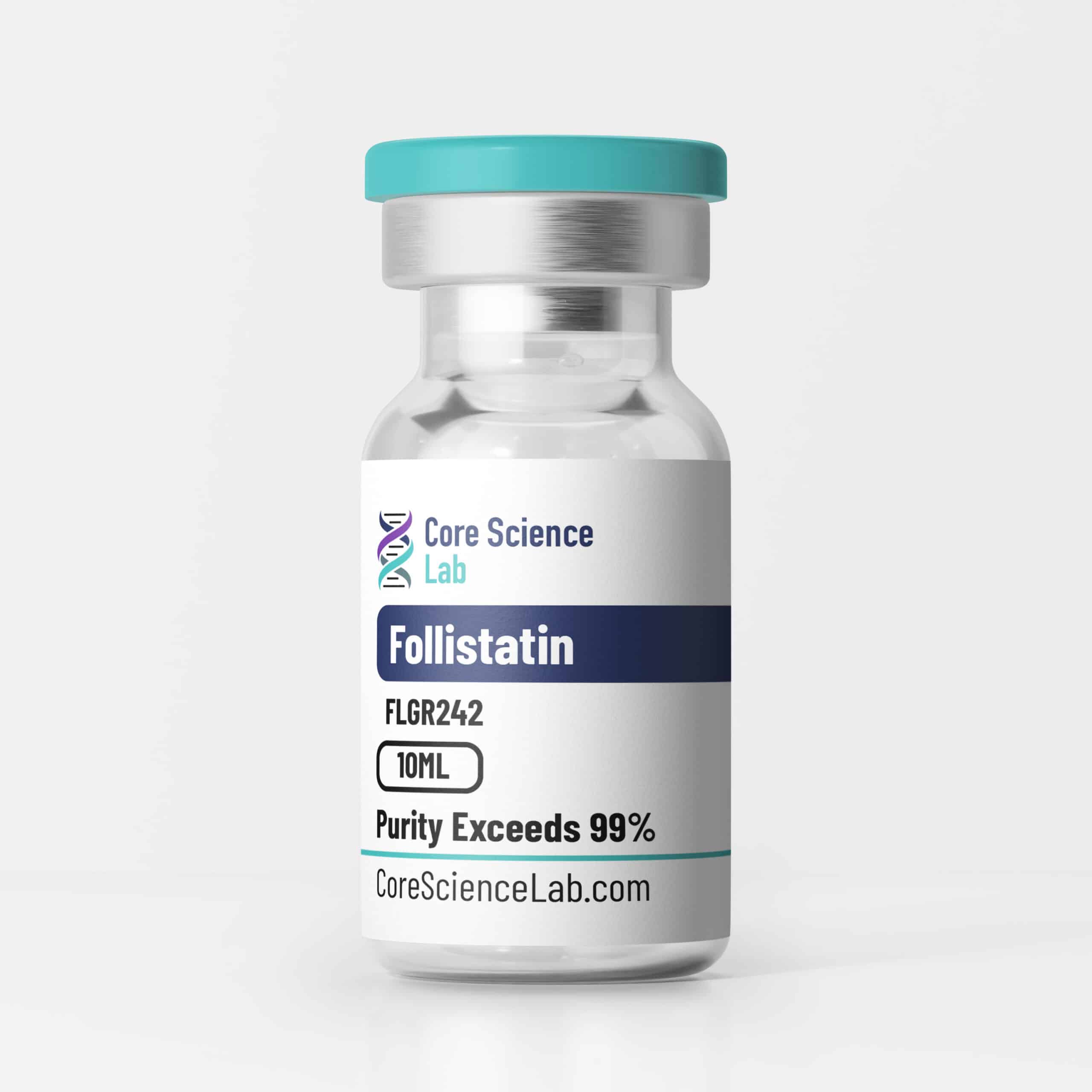
Follistatin (FLGR242) is an autocrine glycoprotein that functions as a natural inhibitor of members of the Transforming Growth Factor-beta (TGF-$\beta$) superfamily. Its primary biological mechanism involves high-affinity binding to activin and myostatin, neutralizing their ability to bind to their respective receptors.
In laboratory settings, Follistatin is a critical tool for studying the “double-muscling” phenotype and the molecular pathways governing muscle mass regulation. Beyond hypertrophy, it is increasingly investigated for its pleiotropic effects on metabolic homeostasis, including the “browning” of white adipose tissue, the improvement of hepatic insulin sensitivity, and the promotion of revascularization in ischemic tissues.
Biochemical Characteristics
Chemically, Follistatin is a cysteine-rich glycoprotein. In research applications, it acts as a localized “activin-sink,” preventing the downstream phosphorylation of Smad proteins.
- Sequence/Structure: Recombinant Glycoprotein (Isoform specific).
- Binding Affinity: Exhibits nearly irreversible binding to Activin A and Myostatin.
- Specificity: Investigated for its ability to block the Smad2/3 signaling cascade while potentially activating the mTOR/Akt pathway.
- Stability: Supplied as a lyophilized powder to ensure structural integrity and biological activity in culture.
Chemical Properties
| Property |
Specification |
| Molecule Name |
Follistatin (Recombinant) |
| Synonyms |
FST; FS; Activin-binding protein |
| Form |
Lyophilized Powder |
| Purity |
95% (Verified via SDS-PAGE/HPLC) |
| Source |
Recombinant (typically E. coli or mammalian cell expression) |
| Solubility |
Soluble in water and aqueous buffers (refer to SDS) |
| Documentation |
COA available per lot; SDS available |
Follistatin is strictly for laboratory research and is commonly employed in the following investigational areas:
Skeletal Muscle Hypertrophy and Myogenesis
Follistatin is the primary reagent used to induce muscle growth in murine models by neutralizing myostatin. Researchers utilize it to quantify changes in muscle fiber cross-sectional area and to study the upregulation of myogenic regulatory factors (MRFs).
Adipocyte Differentiation and Metabolic Flux
Studies investigate Follistatin’s role in energy metabolism, specifically its ability to promote the “browning” of adipocytes (increasing thermogenesis) and reduce visceral fat accumulation. It is also used in models of hepatic steatosis to examine its protective effects against diet-induced obesity and insulin resistance.
Tissue Repair and Fibrosis
Experimental models of injury employ Follistatin to study its regenerative capacity. It is observed to improve skeletal muscle healing by limiting fibrosis and promoting angiogenesis (new blood vessel formation) via a nitric oxide synthase-dependent mechanism.
Reproductive and Endocrine Signaling
Follistatin was originally identified in ovarian fluid. Research continues to explore its role in ovary organogenesis and the regulation of follicle-stimulating hormone (FSH) secretion via the pituitary-gonadal axis.
Pathway / Mechanistic Context
The primary mechanism of action for Follistatin in research settings involves ligand sequestration.
- Ligand Neutralization: Follistatin binds to Myostatin and Activin A in the extracellular space, preventing them from interacting with the Activin Type IIB receptor (ActRIIB).
- Signal Blockade: This binding inhibits the phosphorylation of Smad2 and Smad3 transcription factors, which are negative regulators of muscle growth.
- mTOR Activation: By relieving the inhibition on the Akt/mTOR pathway, Follistatin indirectly promotes protein synthesis and cell growth.
Preclinical Research Summary
Published preclinical literature documents investigations of Follistatin across multiple experimental models:
- Muscle Mass Increase: Systemic administration in mice resulted in significant increases in lean muscle mass and concomitant reductions in fat accumulation.
- Hepatic Protection: In models of Non-Alcoholic Fatty Liver Disease (NAFLD), Follistatin alleviated hepatic steatosis via the mTOR-dependent pathway.
- Wound Healing: Research indicates that keratinocyte-derived Follistatin is essential for epidermal homeostasis and wound repair.
- Ischemic Recovery: In rat models of stroke (MCAO), Follistatin-like 1 attenuated apoptosis and provided neuroprotection via the Akt pathway.
Form & Analytical Testing
This material is produced via recombinant DNA technology and supplied as a lyophilized (freeze-dried) powder.
- Lyophilization: Removes water content to maintain protein structure and extend shelf-life.
- Identity Verification: Verified via SDS-PAGE to confirm molecular weight.
- Purity Verification: HPLC is performed to ensure the product meets the purity standard required for reproducible research data
Referenced Citations
References are provided for informational purposes only and are not clinical claims.
- Lee, S. J., et al. (2010). Regulation of Muscle Mass by Follistatin and Activins. The Endocrine Society. https://doi.org/10.1210/me.2010-0127
- Gangopadhyay, S. S. (2013). Systemic administration of Follistatin288 increases muscle mass and reduces fat accumulation in mice. Scientific Reports. https://doi.org/10.1038/srep02441
- Zhu, J., et al. (2011). Follistatin Improves Skeletal Muscle Healing after Injury and Disease through an Interaction with Muscle Regeneration, Angiogenesis, and Fibrosis. American Journal of Pathology. https://doi.org/10.1016/j.ajpath.2011.04.008
- Pisconti, A., et al. (2013). Follistatin induction by nitric oxide through cyclic GMP: a tightly regulated signaling pathway that controls myoblast fusion. Journal of Cell Biology. https://doi.org/10.1083/jcb.2005070832003r
- Braga, M., et al. (2014). Follistatin promotes adipocyte differentiation, browning, and energy metabolism. Journal of Lipid Research. https://doi.org/10.1194/jlr.m039719
- Pervin, S., Reddy, S. T., & Singh, R. (2021). Novel Roles of Follistatin/Myostatin in Transforming Growth Factor-beta Signaling and Adipose Browning. Frontiers in Endocrinology. https://doi.org/10.3389/fendo.2021.653179
- Han, X., et al. (2019). Mechanisms involved in follistatin-induced hypertrophy and increased insulin action in skeletal muscle. Journal of Cachexia, Sarcopenia and Muscle. https://doi.org/10.1002/jcsm.12474
- Tao, R., et al. (2023). Hepatic follistatin increases basal metabolic rate and attenuates diet-induced obesity during hepatic insulin resistance. Molecular Metabolism. https://doi.org/10.1016/j.molmet.2023.101703
- Antsiferova, M., et al. (2009). Keratinocyte-derived follistatin regulates epidermal homeostasis and wound repair. Laboratory Investigation. https://doi.org/10.1038/labinvest.2008.120
- Ouchi, N., et al. (2008). Follistatin-like 1, a Secreted Muscle Protein, Promotes Endothelial Cell Function and Revascularization in Ischemic Tissue through a Nitric-oxide Synthase-dependent Mechanism. Journal of Biological Chemistry. https://doi.org/10.1074/jbc.m803440200
- Fahmy-Garcia, S., et al. (2019). Follistatin Effects in Migration, Vascularization, and Osteogenesis in vitro and Bone Repair in vivo. Frontiers in Bioengineering and Biotechnology. https://doi.org/10.3389/fbioe.2019.00038
- Oshima, Y., et al. (2008). Follistatin-Like 1 Is an Akt-Regulated Cardioprotective Factor That Is Secreted by the Heart. Circulation. https://doi.org/10.1161/circulationaha.108.767673
- Yao, H. H. C., et al. (2004). Follistatin operates downstream of Wnt4 in mammalian ovary organogenesis. Developmental Dynamics. https://doi.org/10.1002/dvdy.20042
- Kirk, S. E., et al. (1994). Gonadotropin-releasing hormone pulse frequency regulates expression of pituitary follistatin messenger ribonucleic acid. Endocrinology. https://doi.org/10.1210/endo.135.3.8070381
- Tong, J., et al. (2022). Follistatin Alleviates Hepatic Steatosis in NAFLD via the mTOR Dependent Pathway. Diabetes, Metabolic Syndrome and Obesity. https://doi.org/10.2147/dmso.s380053
- Schumann, C., et al. (2018). Increasing lean muscle mass in mice via nanoparticle-mediated hepatic delivery of follistatin mRNA. Theranostics. https://doi.org/10.7150/thno.27847
- Liang, X., et al. (2014). Follistatin-Like 1 Attenuates Apoptosis via Disco-Interacting Protein 2 Homolog A/Akt Pathway After Middle Cerebral Artery Occlusion in Rats. Stroke. https://doi.org/10.1161/strokeaha.114.006092
RESEARCH USE ONLY
This product is intended strictly for laboratory research use only. It is not for human or veterinary use. It is not intended for diagnosis, treatment, cure, or prevention of any disease. All purchases are subject to our Terms of Service and Purity Guarantee.
No COAs available for this product.

Reviews
There are no reviews yet.