
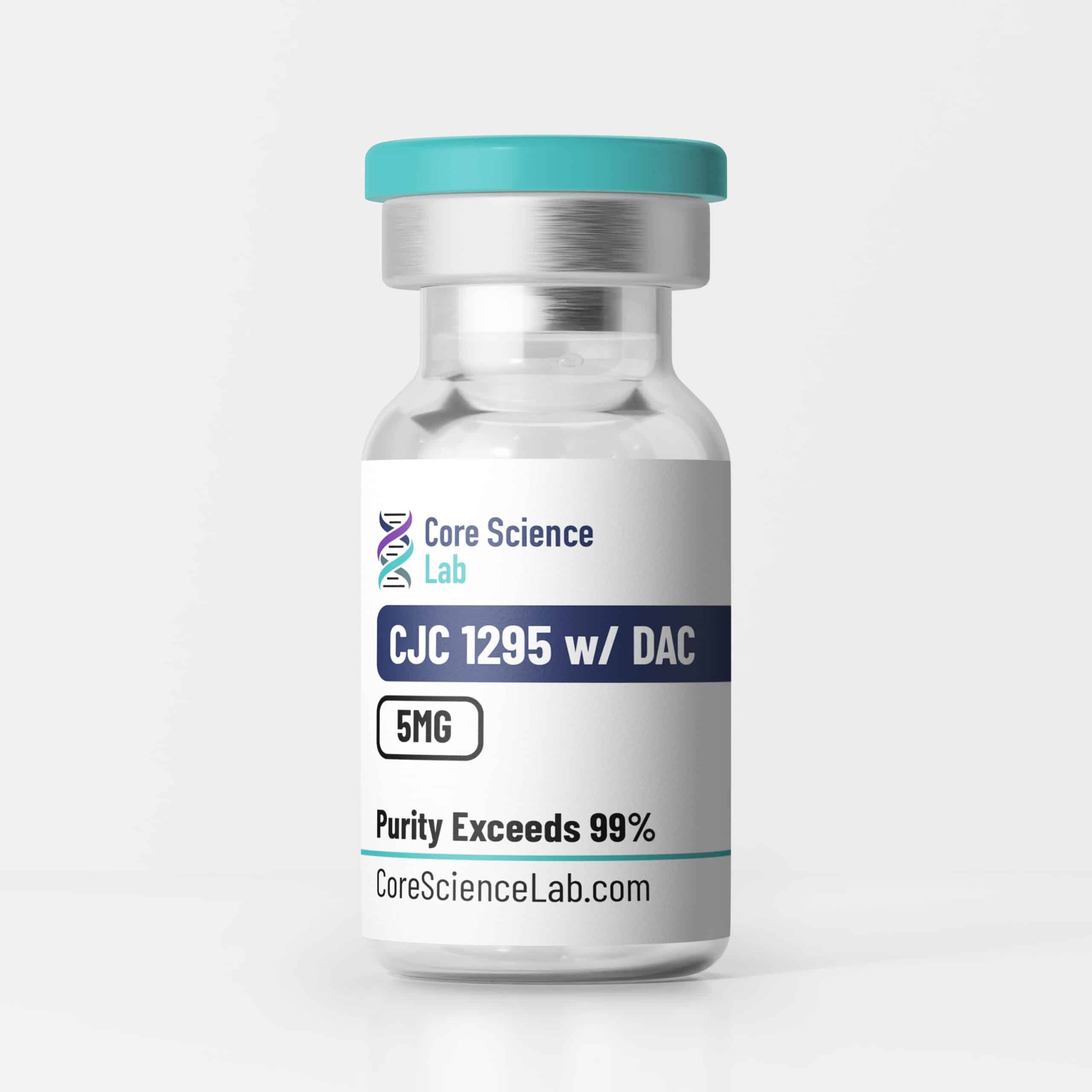
A high-purity, lyophilized synthetic long-acting peptide analogue of Growth Hormone-Releasing Hormone (GHRH), modified with a C-terminal Drug Affinity Complex (DAC). It is widely investigated in research models for its ability to covalently bind to serum albumin, resulting in sustained somatotropic axis stimulation, continuous GH/IGF-1 elevation, and prolonged metabolic flux.
Trust & Quality Verification
Purity Standard
Verified Analysis
Available
Shipping
CJC 1295 w/ DAC is a synthetically modified tetrasubstituted research reagent derived from the endogenous 29-amino-acid sequence of Growth Hormone-Releasing Hormone (GHRH). It is chemically distinct from short-acting GHRH analogues due to the addition of a C-terminal maleimidopropionamide moiety, known as a Drug Affinity Complex (DAC). This modification is designed to resist enzymatic degradation by dipeptidyl peptidase-4 (DPP-4) and covalently bond to endogenous serum albumin, significantly enhancing its circulatory half-life. Researchers utilize this molecule to investigate the sustained activation of the anterior pituitary, the metabolic consequences of chronically elevated basal growth hormone (GH) and Insulin-like Growth Factor 1 (IGF-1) levels, and the preservation of natural neuroendocrine pulsatility under continuous receptor stimulation.
Biochemical Characteristics
Chemical Properties
| Property | Specification |
| Molecule Name | CJC 1295 w/ DAC |
| Synonyms | DAC-GRF; CJC-1295; Tetrasubstituted GRF (1-29) with DAC |
| Molecular Formula | $C_{152}H_{252}N_{44}O_{42}$ |
| Molecular Weight | $3367.97~g/mol$ |
| Form | Lyophilized Powder |
| Purity | 99% (Verified via HPLC) |
| Solubility | Soluble in water and aqueous buffers (refer to SDS) |
| Documentation | COA and SDS available per lot |
CJC 1295 w/ DAC is strictly for laboratory research and is commonly employed in the following investigational areas:
Sustained Somatotropic Activation
Research models utilize this modified peptide to evaluate continuous GHRHR activation. Investigations focus on the dose-dependent, prolonged increase in GH and IGF-1 area-under-the-curve (AUC) over multi-day periods, eliminating the variable peaks and valleys associated with short-acting secretagogue administration.
Pulsatility and Trough Dynamics
Experimental protocols employ the molecule to characterize its effects on neuroendocrine rhythms. Studies assess how continuous receptor stimulation impacts physiological GH pulsatility, mapping the phenomenon where basal (trough) GH levels are markedly elevated while the natural frequency and amplitude of GH secretory pulses remain preserved.
Metabolic Flux and Lipolysis
In physiological research, CJC 1295 w/ DAC is used to study the metabolic impact of chronic GH elevation. Researchers evaluate its effects on cellular energy homeostasis, specifically measuring its ability to drive lipid droplet mobilization, nitrogen balance, and whole-body energy expenditure during prolonged periods of elevated IGF-1.
Pathway / Mechanistic Context
The primary mechanism of action for CJC 1295 w/ DAC in research settings involves its ability to form an active bioconjugate in systemic circulation and provide continuous somatotropic stimulation.
Preclinical Research Summary
Published preclinical literature documents the extensive investigation of CJC-1295 w/ DAC across diverse experimental models focusing on pharmacokinetics, neuroendocrinology, and metabolic flux.
Form & Analytical Testing
Referenced Citations
References are provided for informational purposes only and are not clinical claims.
RESEARCH USE ONLY
This product is intended strictly for laboratory research use only. It is not for human or veterinary use. It is not intended for diagnosis, treatment, cure, or prevention of any disease. All purchases are subject to our Terms of Service and Purity Guarantee.
No COAs available for this product.
RESEARCH USE ONLY
This product is intended strictly for laboratory research use only. It is not for human or veterinary use. It is not intended for diagnosis, treatment, cure, or prevention of any disease. All purchases are subject to our Terms of Service and Purity Guarantee.
Reviews
There are no reviews yet.