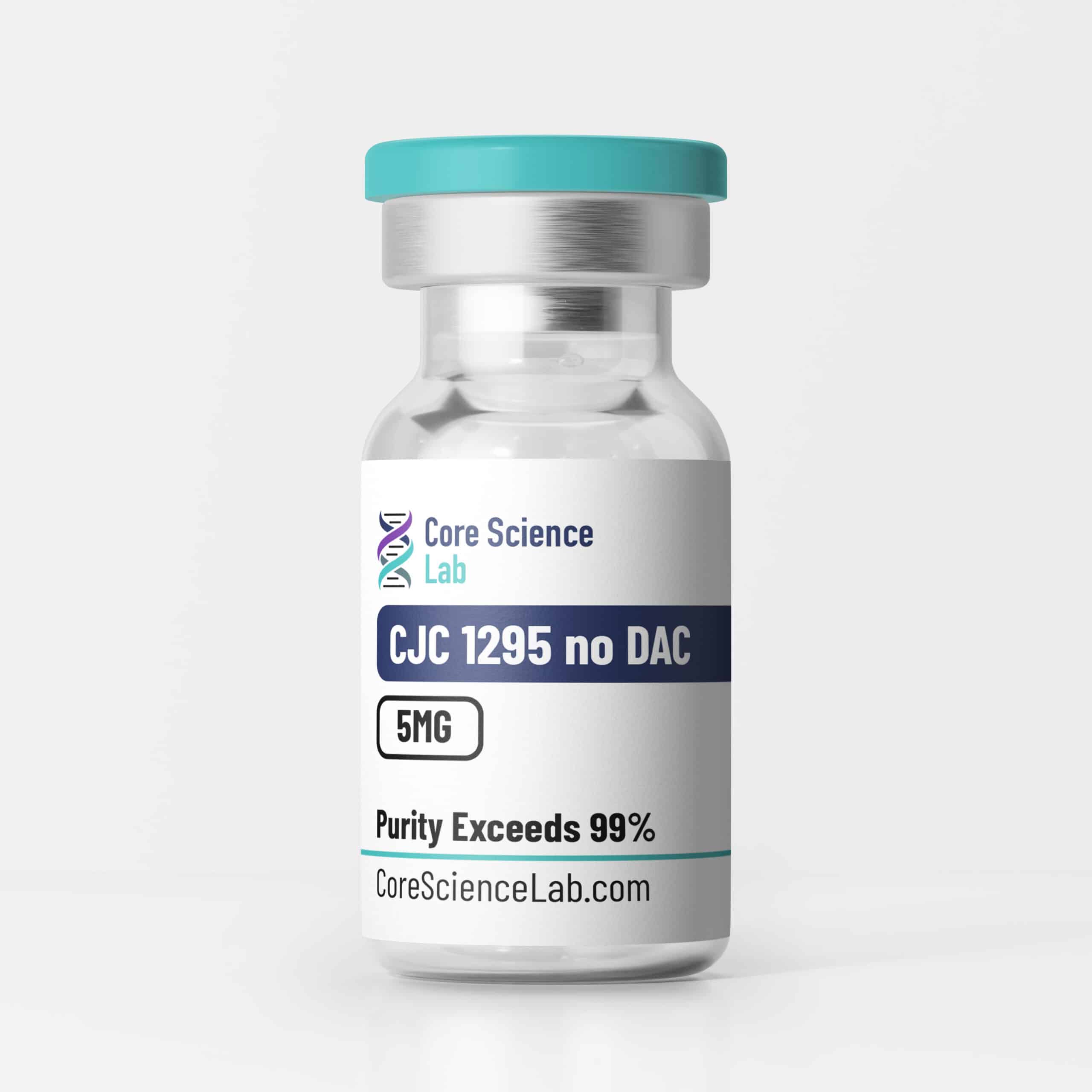
CJC 1295 (No DAC) & Ipamorelin Blend (10mg)

A combined lyophilized research reagent containing a tetrasubstituted Growth Hormone-Releasing Hormone (GHRH) analog and a selective Growth Hormone Secretagogue (GHS). This blend is designed for research applications aiming to investigate the synergistic stimulation of the somatotropic axis through simultaneous activation of GHRH and ghrelin receptors.

Trust & Quality Verification

  • Research Use Only. Not for human or veterinary use.
  • 99% Purity Replacement Guarantee
  • Verifiable purity via HPLC & Mass Spectrometry
  • Supplied as lyophilized powder for stability during transport and storage
  • Certificate of Analysis (COA) available per lot
  • Safety Data Sheet (SDS) available

Email when stock available

SKU: V-CJC-ND-5MG Category:

99%+

Purity Standard

HPLC

Verified Analysis

COA

Available

Free

Shipping

Description

The CJC 1295 (No DAC) & Ipamorelin Blend is a dual-action research tool utilized to study the coordinated regulation of growth hormone (GH) secretion.

  • CJC 1295 (No DAC): Also known as Modified GRF 1-29, this component is a synthetic modification of the endogenous GHRH (1-29) fragment. It lacks the Drug Affinity Complex (DAC), resulting in a pharmacokinetic profile that mimics the natural, pulsatile release of GHRH, unlike the prolonged action of its DAC-conjugated counterpart.
  • Ipamorelin: A pentapeptide and selective agonist of the ghrelin/growth hormone secretagogue receptor (GHS-R1a). It is distinguished by its high specificity, stimulating GH release without significantly impacting cortisol or prolactin levels in experimental models.

In laboratory settings, this blend is employed to maximize intracellular signaling for GH synthesis and release. The combination allows researchers to observe the “multiplier effect” where the concurrent activation of the GHRH receptor (by CJC 1295) and the GHS receptor (by Ipamorelin) results in a GH secretory pulse that exceeds the sum of individual administrations.

Biochemical Characteristics

This product combines two distinct peptide classes to target separate receptors on the pituitary somatotroph.

  • Sequence/Structure:
    • CJC 1295 (No DAC): A 29-amino acid peptide substituted at four positions to enhance resistance to cleavage by the enzyme DPP-IV.
    • Ipamorelin: A short-chain pentapeptide (5 amino acids) containing the non-natural amino acids Aib (aminoisobutyric acid) and 2-Nal (2-naphthylalanine).
  • Signaling Synergy: The blend is designed to investigate the coupling of the cAMP/PKA pathway (via GHRH receptor) and the PLC/IP3 pathway (via GHS receptor), providing a comprehensive model for pituitary activation.
  • Selectivity: Ipamorelin is chosen for this blend due to its lack of cholinergic activity and minimal off-target effects on ACTH or cortisol pathways compared to other secretagogues.

Chemical Properties

Property Specification (CJC 1295 No DAC) Specification (Ipamorelin)
Molecule Name Mod GRF 1-29; Tetrasubstituted GRF 1-29 Ipamorelin
Sequence Tyr-D-Ala-Asp-Ala-Ile-Phe-Thr-Gln-Ser-Tyr-Arg-Lys-Val-Leu-Ala-Gln-Leu-Ser-Ala-Arg-Lys-Leu-Leu-Gln-Asp-Ile-Leu-Ser-Arg-NH2 Aib-His-D-2-Nal-D-Phe-Lys-NH2
CAS Number 863288-34-0 170851-70-4
Molecular Formula C152H252N44O42 C38H49N9O5
Molecular Weight 3367.9 g/mol 711.85 g/mol
Purity ≥99% (Verified via HPLC) ≥99% (Verified via HPLC)
Form Lyophilized Powder (Blend) Lyophilized Powder (Blend)

The CJC 1295 (No DAC) & Ipamorelin blend is strictly for laboratory research and is commonly employed in the following areas:

Pulsatile Secretion Analysis

Researchers use this blend to replicate physiological growth hormone spikes. The “No DAC” variant of CJC 1295 has a short half-life (approx. 30 minutes in some models), allowing for the study of acute, episodic secretion events rather than constitutive elevation.

Bone Growth and Density

Ipamorelin has been specifically investigated for its ability to induce longitudinal bone growth in rodent models. This blend is used to determine if synergistic stimulation can enhance osteoblast activity and mineralization rates beyond baseline metrics.

Metabolic Flux and Composition

Studies utilize this combination to examine the downstream effects of GH signaling on lipolysis and nitrogen retention. It serves as a tool to explore how the somatotropic axis influences body composition and energy substrate utilization without the confounding variables of elevated cortisol.

Pathway / Mechanistic Context

The mechanism of action involves a dual-receptor trigger on the pituitary somatotroph membrane:

  • GHRH Receptor Activation: CJC 1295 binds to the GHRH receptor, increasing intracellular cAMP levels. This potentiates the cell, making it more responsive to secretagogues and increasing the quantity of GH available for release.
  • GHS Receptor Activation: Ipamorelin binds to the GHS-R1a (ghrelin receptor), initiating membrane depolarization and calcium influx. This triggers the release mechanism of stored GH vesicles.
  • Synergy: When applied together, the increased cAMP and Calcium influx create a coordinated release event that is significantly larger than either peptide could produce alone.

Preclinical Research Summary

Published preclinical literature documents investigations of these peptides in various models:

  • Growth Normalization: Studies in GHRH knockout mice have demonstrated that administration of CJC-1295 analogs can normalize growth velocity, validating the peptide’s ability to functionally replace endogenous GHRH.
  • Prolonged vs. Pulsatile: While some studies (Teichman et al.) explored the prolonged effects of the DAC-conjugated variant, the “No DAC” version included in this blend is utilized in research requiring precise temporal control over GH spikes.
  • Specific Secretagogue Activity: Ipamorelin was identified as the first selective secretagogue, with data showing it releases GH with potency and efficacy similar to GHRP-6 but without the side effect profile (e.g., ACTH/cortisol release).
  • Pharmacokinetics: Modeling studies in volunteers have characterized the interface between Ipamorelin concentration and GH response, establishing the dose-dependent nature of the secretagogue effect.

Form & Analytical Testing

This material is produced via robust chemical synthesis and supplied as a lyophilized (freeze-dried) powder.

  • Lyophilization: Removes water content under vacuum to maintain compound integrity and extend shelf-life.
  • Identity Verification: Each lot undergoes Mass Spectrometry (MS) to confirm the molecular weights of both components.
  • Purity Verification: High-Performance Liquid Chromatography (HPLC) is performed to ensure the blend meets the ≥99% purity standard.

Storage & Handling

Stable at room temperature for up to 90 days. For long-term storage, keep at -20°C (-4°F) or colder. Once reconstituted with a solvent (e.g., bacteriostatic water), the solution must be stored at 4°C (39°F) and utilized within 30 days. Avoid repeated freeze-thaw cycles.

Referenced Citations

References are provided for informational purposes only and are not clinical claims.

  • Alba, M., Fintini, D., Sagazio, A., Lawrence, B., Castaigne, J., Frohman, L., & Salvatori, R. (2006). Once-daily administration of CJC-1295, a long-acting growth hormone-releasing hormone (GHRH) analog, normalizes growth in the GHRH knockout mouse. American Journal of Physiology – Endocrinology and Metabolism. https://doi.org/10.1152/AJPENDO.00201.2006
  • Teichman, S., Neale, A., Lawrence, B., Gagnon, C., Castaigne, J., & Frohman, L. (2006). Prolonged stimulation of growth hormone (GH) and insulin-like growth factor I secretion by CJC-1295, a long-acting analog of GH-releasing hormone, in healthy adults. The Journal of Clinical Endocrinology & Metabolism. https://doi.org/10.1210/JC.2005-1536
  • Raun, K., Hansen, B., Johansen, N., Thøgersen, H., Madsen, K., Ankersen, M., & Andersen, P. (1998). Ipamorelin, the first selective growth hormone secretagogue. European Journal of Endocrinology. https://doi.org/10.1530/EJE.0.1390552
  • Johansen, P., Nowak, J., Skjaerbaek, C., Flyvbjerg, A., Andreassen, T., Wilken, M., & Orskov, H. (1999). Ipamorelin, a new growth-hormone-releasing peptide, induces longitudinal bone growth in rats. Growth Hormone & IGF Research. https://doi.org/10.1054/GHIR.1999.9998
  • Gobburu, J., Agersø, H., Jusko, W., & Ynddal, L. (1999). Pharmacokinetic-Pharmacodynamic Modeling of Ipamorelin, a Growth Hormone Releasing Peptide, in Human Volunteers. Pharmaceutical Research. https://doi.org/10.1023/A:1018955126402
  • Stable at room temperature for up to 90 days. For long-term storage, keep at -20°C (-4°F) or colder.
  • Once mixed with a solvent (e.g., bacteriostatic water), the solution must be stored at 4 °C (39°F) and utilized within 30 days. Avoid repeated freeze-thaw cycles, as this degrades the peptide structure.

RESEARCH USE ONLY

This product is intended strictly for laboratory research use only. It is not for human or veterinary use. It is not intended for diagnosis, treatment, cure, or prevention of any disease. All purchases are subject to our Terms of Service and Purity Guarantee.
No COAs available for this product.

Reviews

There are no reviews yet.

Be the first to review “CJC 1295 (No DAC) & Ipamorelin Blend (10mg)”

Your email address will not be published. Required fields are marked *

RESEARCH USE ONLY

This product is intended strictly for laboratory research use only. It is not for human or veterinary use. It is not intended for diagnosis, treatment, cure, or prevention of any disease. All purchases are subject to our Terms of Service and Purity Guarantee.
0