
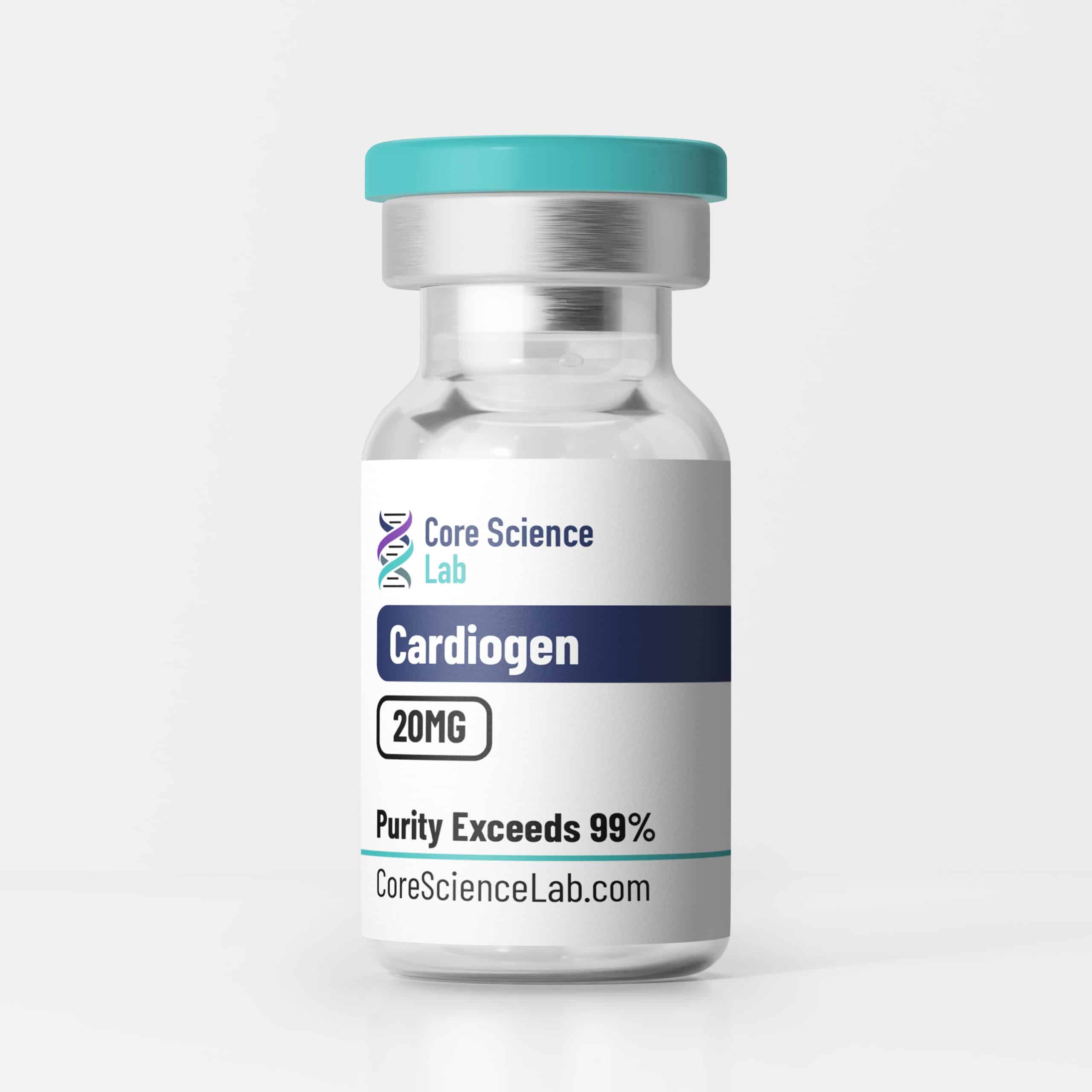
A synthetic tetrapeptide (Ala-Glu-Asp-Arg) bioregulator characterized for research applications involving myocardial tissue regeneration, fibroblast proliferation modulation, and the regulation of apoptosis in senescent cardiac models.
Trust & Quality Verification
Purity Standard
Verified Analysis
Available
Shipping
Cardiogen is a synthetic peptide bioregulator comprised of four amino acids (Alanine, Glutamic Acid, Aspartic Acid, Arginine). It is chemically distinct due to its specific affinity for cardiac fibroblasts and cardiomyocytes. Research suggests it functions by stimulating the proliferation of cardiomyocytes while regulating the differentiation and activity of fibroblasts, potentially shifting tissue repair mechanisms away from scar formation and toward functional regeneration.
Unlike general growth factors, Cardiogen is investigated for its ability to penetrate the cell membrane and nuclear envelope, where it may interact with DNA-associated proteins to modulate the expression of genes related to the cytoskeleton and cell cycle. It is widely utilized in laboratory settings to study the downstream effects of p53 downregulation and the upregulation of cytoskeletal proteins such as actin, vimentin, and tubulin in aging cell lines.
Biochemical Characteristics
Chemically, Cardiogen is characterized by its short tetrameric sequence and bioregulatory potential in specific tissue types.
Chemical Properties
| Property | Specification |
| Molecule Name | Cardiogen |
| Sequence | Ala-Glu-Asp-Arg (AEDR) |
| CAS Number | N/A (Research Peptide) |
| Molecular Formula | C18H31N7O9 (Free base) |
| Molecular Weight | ~489.5 g/mol |
| Form | Lyophilized Powder |
| Purity | ≥99% (Verified via HPLC) |
| Solubility | Soluble in water and organic solvents (refer to SDS) |
| Documentation | COA available per lot; SDS available |
Cardiogen is strictly for laboratory research and is commonly employed in the following investigational areas:
Myocardial Tissue Regeneration
Cardiogen is utilized as a chemical probe to investigate the stimulation of cardiomyocyte proliferation in both young and senescent tissue models. Researchers employ this reagent to quantify changes in cell cycle progression and the preservation of myocardial structure following induced stress or injury.
Fibroblast Differentiation and Scarring
In vitro studies utilizing cardiac fibroblasts employ Cardiogen to observe its impact on the balance between functional tissue repair and fibrotic scarring. Investigations focus on how the peptide alters the expression of signaling factors related to differentiation, potentially reducing the formation of non-functional scar tissue.
Apoptosis and Cell Survival
Experimental models utilize this compound to study the regulation of programmed cell death (apoptosis). Researchers quantify changes in p53 protein expression and the activation of anti-apoptotic pathways to understand the role of Cardiogen in preserving cell viability under conditions of oxidative stress or aging.
Oncology and Tumor Metabolism
Cardiogen is used in specific oncology research models, such as M-1 sarcoma, to determine its differential effects on tumor cells versus healthy tissue. Studies investigate the “tumor-modifying” effect, where the peptide may induce apoptosis in transformed cells while protecting normal cardiomyocytes.
Pathway / Mechanistic Context
The primary mechanism of action for Cardiogen in research settings is the modulation of gene expression and protein synthesis via nuclear interaction.
Preclinical Research Summary
Published preclinical literature documents investigations of Cardiogen across multiple experimental models:
Form & Analytical Testing
This material is produced via robust chemical synthesis and supplied as a lyophilized (freeze-dried) powder.
Referenced Citations
References are provided for informational purposes only and are not clinical claims.
RESEARCH USE ONLY
This product is intended strictly for laboratory research use only. It is not for human or veterinary use. It is not intended for diagnosis, treatment, cure, or prevention of any disease. All purchases are subject to our Terms of Service and Purity Guarantee.
No COAs available for this product.
RESEARCH USE ONLY
This product is intended strictly for laboratory research use only. It is not for human or veterinary use. It is not intended for diagnosis, treatment, cure, or prevention of any disease. All purchases are subject to our Terms of Service and Purity Guarantee.
Reviews
There are no reviews yet.