
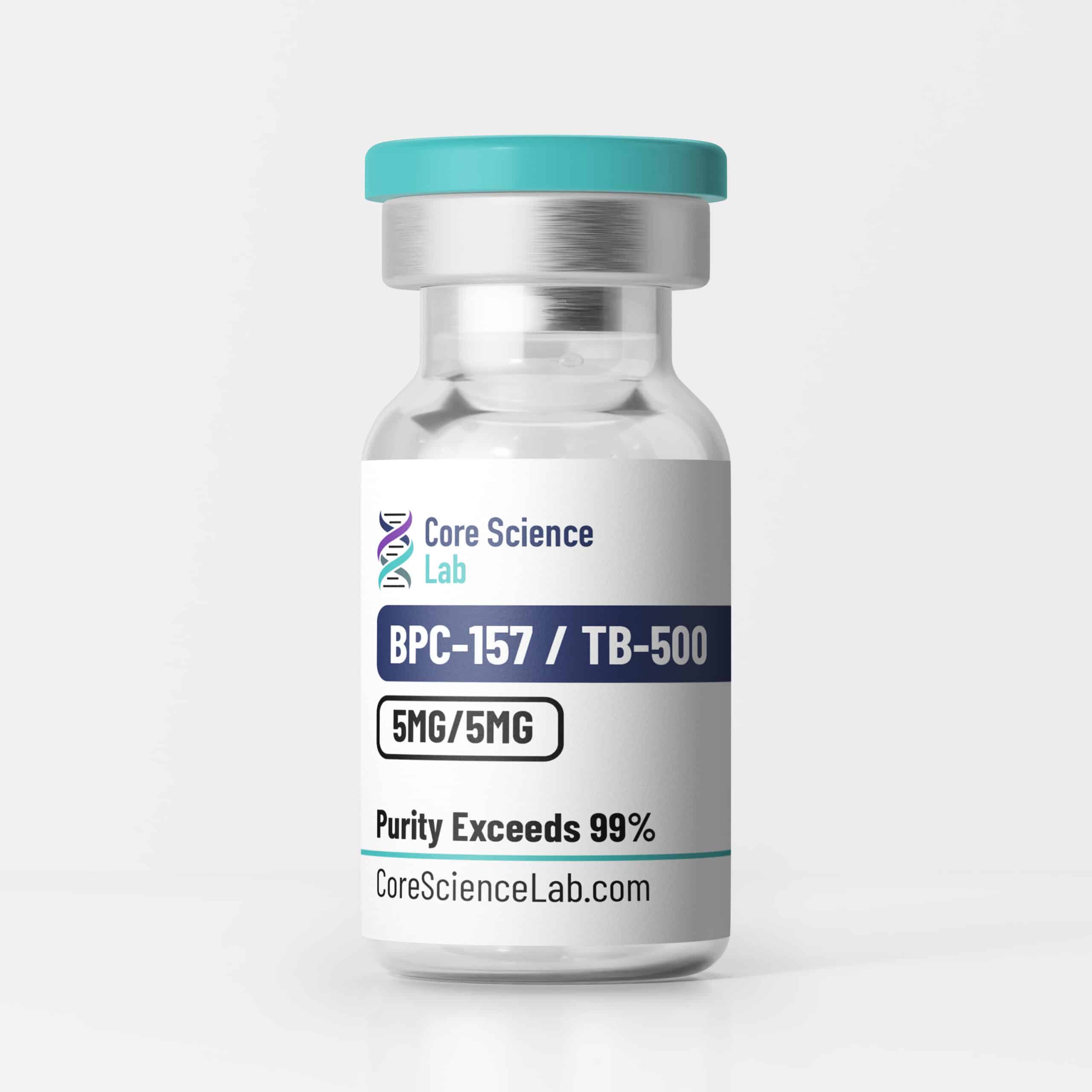
A dual-peptide research reagent combining the stable gastric pentadecapeptide BPC-157 with the actin-sequestering peptide Thymosin Beta-4 (TB-500), characterized for synergistic applications in endothelial differentiation, cytoskeletal organization, and tissue repair signaling.
Trust & Quality Verification
Purity Standard
Verified Analysis
Available
Shipping
The BPC-157 / TB-500 Blend is a composite peptide formulation. It combines two distinct synthetic peptides: BPC-157 (Body Protection Compound-157), a partial sequence of a human gastric protein, and TB-500, a synthetic analogue of the naturally occurring protein Thymosin Beta-4.
Researchers utilize this blend to investigate the intersection of multiple regenerative pathways simultaneously. Specifically, experimental workflows employ this combination to quantify effects on angiogenesis, actin polymerization dynamics, and the migration of endothelial or stromal cells in complex tissue engineering models. Unlike single-molecule controls, this blend allows for the assessment of potential synergistic mechanisms involving the nitric oxide (NO) system and cytoskeletal motility regulators.
Chemically, this reagent represents a mixture of a pentadecapeptide (BPC-157) lacking a distinct tertiary structure, and a 43-amino acid peptide (Thymosin Beta-4) known for its flexible, unfolded nature in solution which facilitates actin binding.
| Property | Specification |
| Molecule Name | BPC-157 / TB-500 Blend |
| Synonyms | Bepecin; PL 14736 / Thymosin Beta-4; Tβ4 |
| PubChem CID | 9941957 (BPC-157); 16132341 (TB-4) |
| Molecular Formula | Mixture (C62H98N16O22 / C212H350N56O78S) |
| Molecular Weight | 1419.5 g/mol (BPC-157) / 4963.5 g/mol (TB-500) |
| Form | Lyophilized Powder |
| Purity | ≥99% (Verified via HPLC) |
| Solubility | Soluble in water and aqueous buffers (refer to SDS) |
| Documentation | COA and SDS available per lot |
BPC-157 / TB-500 Blend is strictly for laboratory research and is commonly employed in the following investigational areas:
Endothelial Function and Angiogenesis
Research utilizes this blend to study the differentiation and proliferation of endothelial cells. Studies focus on measuring the expression of angiogenic factors and tube formation capacity, particularly in models involving induced pluripotent stem cells (iPSCs) derived from diabetic patients, where reparative potency is often compromised.
Tissue Repair and Wound Healing Dynamics
In vitro and in vivo models employ BPC-157 to characterize the “angiomodulatory” effect on granulation tissue. Investigators quantify the rate of defect closure and the tensile strength of tissues, examining how the peptide influences the nitric oxide system to modulate inflammatory infiltrates and collagen deposition.
Cytoskeletal Organization and Cell Migration
The TB-500 component is utilized to investigate actin sequestration. Researchers measure the ratio of F-actin to G-actin in motile cells to determine how upregulation of Thymosin Beta-4 influences cytoskeletal reorganization, a critical step in cellular migration and wound re-epithelialization.
The primary mechanistic context for this blend in research settings involves the dual modulation of vascular signaling and cytoskeletal plasticity.
Published preclinical literature documents investigations of BPC-157 and Thymosin Beta-4 across experimental models for pathway characterization and endpoint measurement:
This material is produced via solid-phase peptide synthesis (SPPS) and supplied as a lyophilized (freeze-dried) powder.
Stable at room temperature for up to 90 days. For long-term storage, keep at -20C (-4F) or colder.
Once mixed with a solvent (e.g., bacteriostatic water), the solution must be stored at 4C (39F) and utilized within 30 days. Avoid repeated freeze-thaw cycles, as this degrades the peptide structure.
References are provided for informational purposes only and are not clinical claims.
RESEARCH USE ONLY
This product is intended strictly for laboratory research use only. It is not for human or veterinary use. It is not intended for diagnosis, treatment, cure, or prevention of any disease. All purchases are subject to our Terms of Service and Purity Guarantee.
No COAs available for this product.
RESEARCH USE ONLY
This product is intended strictly for laboratory research use only. It is not for human or veterinary use. It is not intended for diagnosis, treatment, cure, or prevention of any disease. All purchases are subject to our Terms of Service and Purity Guarantee.
Reviews
There are no reviews yet.