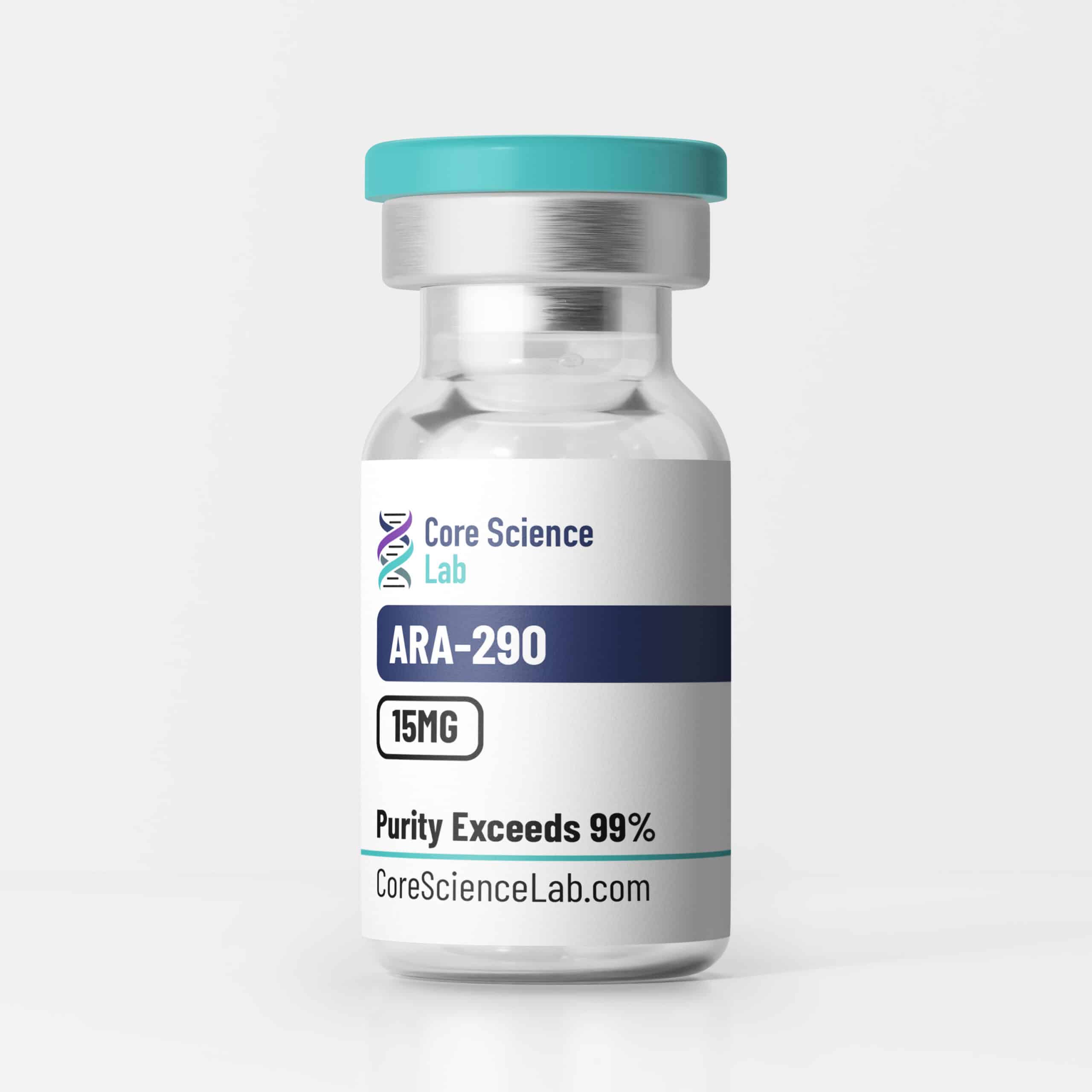
ARA-290 (15mg)

High-purity, non-erythropoietic peptide engineered from erythropoietin, characterized for research applications involving innate repair receptor (IRR) agonism, small fiber neuropathy, and immunomodulation.

Trust & Quality Verification

  • Research Use Only. Not for human or veterinary use.
  • Verifiable purity via HPLC & Mass Spectrometry
  • Supplied as lyophilized powder for stability during transport and storage
  • Certificate of Analysis (COA) available per lot
  • Safety Data Sheet (SDS) available

Email when stock available

SKU: V-ARA-15MG Category:

99%+

Purity Standard

HPLC

Verified Analysis

COA

Available

Free

Shipping

Description

ARA-290 (Cibinetide) is a synthetic 11-amino acid research peptide. It is chemically distinct as a non-erythropoietic analogue of erythropoietin (EPO), specifically designed to selectively interact with the Innate Repair Receptor (IRR) without stimulating hematopoiesis (red blood cell production).

Researchers utilize this molecule to investigate tissue protection and repair pathways, specifically quantifying the downstream effects of IRR activation on inflammation, neuropathic pain signaling, and metabolic control. Unlike native EPO, ARA-290 allows for the study of cytoprotection in experimental models without the confounding variable of increased blood viscosity or thrombosis risk.

Biochemical Characteristics

Chemically, ARA-290 is characterized by a linear peptide sequence derived from the aqueous face of the helix B domain of erythropoietin. This structural configuration facilitates high-affinity binding to the IRR heterocomplex while avoiding engagement with the homodimeric EPO receptor responsible for erythropoiesis.

  • Sequence/Structure: Peptide (11 amino acids); Pyroglutamate-Glu-Gln-Leu-Glu-Arg-Ala-Leu-Asn-Ser-Ser.
  • Permeability: Exhibits blood-brain barrier permeability in specific CNS research models.
  • Stability: Supplied as a lyophilized salt to ensure long-term stability and prevent hydrolytic degradation during storage.
  • Specificity: Selective agonist for the Innate Repair Receptor (heterocomplex of EPOR and CD131/$\beta$cR).

Chemical Properties

Property Specification
Molecule Name ARA-290
Synonyms Cibinetide; EPO-derived peptide; pyroglutamate helix B surface peptide
PubChem CID 91810664
Molecular Formula C51H84N16O21
Molecular Weight 1257.31 g/mol
Form Lyophilized Powder
Purity ≥99% (Verified via HPLC)
Solubility Soluble in water and aqueous buffers (refer to SDS)
Documentation COA and SDS available per lot

ARA-290 is strictly for laboratory research and is commonly employed in the following investigational areas:

Neuropathy and Pain Signaling

Research models utilize ARA-290 to evaluate the mechanisms of neuropathic pain relief and nerve fiber regeneration. Investigations focus on quantifying corneal nerve fiber density (CNFD) and assessing the modulation of nociception via pathways such as the TRPV1 channel and small fiber restoration in sarcoidosis and diabetes models.

Immunomodulation and Inflammation

In immunological research, ARA-290 is used to study the suppression of pro-inflammatory cytokines and the modulation of immune cell phenotypes. Studies measure the impact of peptide administration on monocyte modulation and inflammation suppression in experimental autoimmune neuritis and Alzheimer’s-like pathology.

Metabolic Control

Experimental protocols employ this peptide to characterize metabolic regulation in type 2 diabetes models. Researchers quantify changes in hemoglobin A1c (HbA1c) and lipid profiles to understand the role of the innate repair receptor in systemic metabolic control.

Tissue Ischemia and Cytoprotection

ARA-290 is utilized in ischemia models to assess tissue-protective effects. Investigations involve measuring cell survival and functional recovery in skeletal muscle ischemia assays, providing data on the peptide’s ability to mitigate ischemic injury.

Pathway / Mechanistic Context

The primary mechanistic context for ARA-290 in research settings is the agonism of the Innate Repair Receptor (IRR).

  • Receptor Interaction: Selectively binds to the IRR, a heterocomplex consisting of the erythropoietin receptor (EPOR) and the $\beta$-common receptor (CD131).
  • Anti-Inflammatory Signaling: Activation of the IRR triggers intracellular signaling pathways that downregulate nuclear factor-kappa B (NF-$\kappa$B), reducing the production of pro-inflammatory cytokines such as TNF-$\alpha$.
  • Nociceptive Modulation: Research indicates integration between the immune system and nociception, where ARA-290 targeting of the IRR relieves pathophysiological pain, potentially via modulation of the TRPV1 channel.

Preclinical Research Summary

Published preclinical literature documents investigations of ARA-290 across multiple experimental models:

  • Alzheimer’s Disease Models: Studies in AD-like pathology models report that early monocyte modulation by ARA-290 decelerates pathology progression.
  • Type 2 Diabetes: Research indicates that ARA-290 administration in diabetic models is associated with improved metabolic control and alleviation of neuropathic symptoms.
  • Autoimmune Neuritis: In experimental autoimmune neuritis models, ARA-290 is reported to ameliorate disease severity through inflammation suppression and tissue protection.
  • Sarcoidosis-Associated Neuropathy: Clinical research models (pilot studies) have utilized ARA-290 to evaluate safety and efficacy in sarcoidosis patients with symptoms of small fiber neuropathy.

Form & Analytical Testing

This material is produced via solid-phase peptide synthesis and supplied as a lyophilized (freeze-dried) powder.

  • Lyophilization: Removes water content under vacuum to maintain compound integrity and extend shelf-life.
  • Identity Verification: Each lot undergoes Mass Spectrometry (MS) to confirm molecular weight and identity.
  • Purity Verification: High-Performance Liquid Chromatography (HPLC) is performed to ensure the product meets the $\ge99\%$ purity standard required for reproducible research data.

Storage & Handling

Stable at room temperature for up to 90 days. For long-term storage, keep at -20C (-4F) or colder.

Once mixed with a solvent (e.g., bacteriostatic water), the solution must be stored at 4C (39F) and utilized within 30 days. Avoid repeated freeze-thaw cycles, as this degrades the peptide structure.

Referenced Citations

References are provided for informational purposes only and are not clinical claims.

  • Al-Onaizi, M., Thériault, P., Lecordier, S., Rivest, S., & ElAli, A. (2021). Early monocyte modulation by the non-erythropoietic peptide ARA 290 decelerates AD-like pathology progression. Brain, Behavior, and Immunity, 99, 363-382. https://doi.org/10.1016/j.bbi.2021.07.016
  • Brines, M., Dunne, A., Van Velzen, M., Proto, P., Ostenson, C., Kirk, R., Petropoulos, I., Javed, S., Malik, R., Cerami, A., & Dahan, A. (2015). ARA 290, a Nonerythropoietic Peptide Engineered from Erythropoietin, Improves Metabolic Control and Neuropathic Symptoms in Patients with Type 2 Diabetes. Molecular Medicine, 20, 658-666. https://doi.org/10.2119/molmed.2014.00215
  • Heij, L., Niesters, M., Swartjes, M., Hoitsma, E., Drent, M., Dunne, A., Grutters, J., Vogels, O., Brines, M., Cerami, A., & Dahan, A. (2012). Safety and Efficacy of ARA 290 in Sarcoidosis Patients with Symptoms of Small Fiber Neuropathy: A Randomized, Double-Blind Pilot Study. Molecular Medicine, 18, 1430-1436. https://doi.org/10.2119/molmed.2012.00332
  • Zhang, W., Yu, G., & Zhang, M. (2016). ARA 290 relieves pathophysiological pain by targeting TRPV1 channel: Integration between immune system and nociception. Peptides, 76, 73-79. https://doi.org/10.1016/j.peptides.2016.01.003
  • Liu, Y., Luo, B., Han, F., Li, X., Xiong, J., Jiang, M., Yang, X., Wu, Y., & Zhang, Z. (2014). Erythropoietin-Derived Nonerythropoietic Peptide Ameliorates Experimental Autoimmune Neuritis by Inflammation Suppression and Tissue Protection. PLoS ONE, 9. https://doi.org/10.1371/journal.pone.0090942
  • Yu, R., Baker, D., Abraham, D., & Tsui, J. (2014). Abstract 44: Tissue-Protective Effects of an Erythropoietin Derivative in in vitro and in vivo Models of Skeletal Muscle Ischemia. Arteriosclerosis, Thrombosis, and Vascular Biology. https://doi.org/10.1161/atvb.34.suppl_1.44
  • Stable at room temperature for up to 90 days. For long-term storage, keep at -20°C (-4°F) or colder.
  • Once mixed with a solvent (e.g., bacteriostatic water), the solution must be stored at 4 °C (39°F) and utilized within 30 days. Avoid repeated freeze-thaw cycles, as this degrades the peptide structure.

RESEARCH USE ONLY

This product is intended strictly for laboratory research use only. It is not for human or veterinary use. It is not intended for diagnosis, treatment, cure, or prevention of any disease. All purchases are subject to our Terms of Service and Purity Guarantee.
No COAs available for this product.

Reviews

There are no reviews yet.

Be the first to review “ARA-290 (15mg)”

Your email address will not be published. Required fields are marked *

RESEARCH USE ONLY

This product is intended strictly for laboratory research use only. It is not for human or veterinary use. It is not intended for diagnosis, treatment, cure, or prevention of any disease. All purchases are subject to our Terms of Service and Purity Guarantee.
0