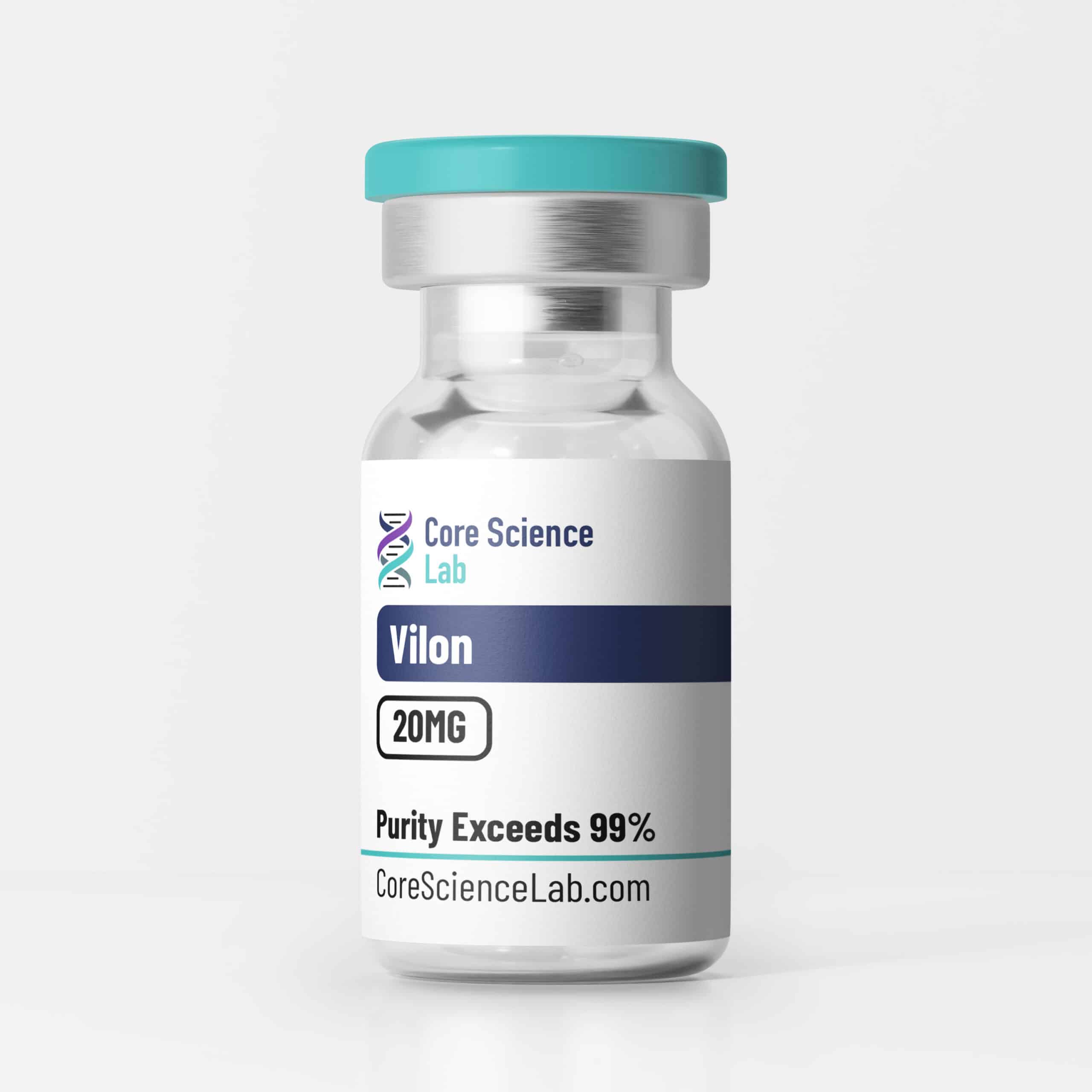
Vilon (20mg)

A synthetic dipeptide bioregulator (Lys-Glu) characterized for its ability to induce chromatin decondensation, reactivate ribosomal genes, and modulate immune cell differentiation in aging and immunodeficiency models.

Trust & Quality Verification

  • Research Use Only. Not for human or veterinary use.
  • 99% Purity Replacement Guarantee
  • Verifiable purity via HPLC & Mass Spectrometry
  • Supplied as lyophilized powder for maximum stability during transport and storage
  • Certificate of Analysis (COA) available per lot
  • Safety Data Sheet (SDS) available

Email when stock available

SKU: V-VILON-20MG Category:

99%+

Purity Standard

HPLC

Verified Analysis

COA

Available

Free

Shipping

Description

Vilon (Lysylglutamic acid) is a synthetic dipeptide. It is a “bioregulator” peptide used in investigational workflows involving epigenetic regulation, chromatin remodeling, and immunosenescence.

Researchers utilize Vilon to characterize the mechanisms of “deheterochromatinization” (unrolling of condensed chromatin) and its subsequent effect on gene expression. Unlike complex protein factors, Vilon’s minimal dipeptide structure allows for precise probing of peptide-DNA interactions and nucleolus organizer region (NOR) activity without the confounding variables of larger molecules.

Biochemical Characteristics

Chemically, Vilon is the dipeptide L-Lysyl-L-glutamic acid, identified as a thymomimetic candidate that influences transcriptional activity by increasing the accessibility of euchromatin.

  • Sequence/Structure: Lys-Glu (KE); a dipeptide composed of L-lysine and L-glutamic acid.
  • Permeability: Small molecular weight (~275 Da) facilitates nuclear entry and interaction with histone-DNA complexes.
  • Specificity: Investigated for its specific capacity to decondense facultative heterochromatin and reactivate silenced ribosomal genes in senescent cell models.

Chemical Properties

Property Specification
Molecule Name Vilon
Synonyms Lysylglutamic acid; L-Lysyl-L-glutamic acid; H-Lys-Glu-OH; KE Dipeptide
CAS Number 45234-02-4
Molecular Formula C11H21N3O5
Molecular Weight 275.3 g/mol
Form Lyophilized Powder
Purity ≥99% (Verified via HPLC)
Solubility Soluble in water and aqueous buffers
Documentation COA and SDS available per lot

Vilon is strictly for laboratory research and is commonly employed in the following investigational areas:

Chromatin Remodeling and Epigenetics

Research utilizes Vilon to study the structural organization of chromatin in lymphocytes. Assays measure the “unrolling” of total heterochromatin and the release of repressed genes, particularly in models derived from aged subjects where chromatin condensation is pathologically elevated.

Immunomodulation and Differentiation

In vitro models employ Vilon to quantify the expression of differentiation markers such as CD4 and CD5 on T-cells. Investigators evaluate how the peptide influences the maturation of thymocytes and the normalization of cytokine synthesis (e.g., IL-2) under stress conditions.

Geroprotection and Cellular Aging

Vilon is a standard control in gerontological research for evaluating peptide-induced lifespan extension. Studies characterize its effects on tumor incidence, spontaneous neoplasms, and the preservation of physiological resources in long-term rodent models.

Pathway / Mechanistic Context

The primary mechanistic context for Vilon in research settings involves the epigenetic regulation of transcriptional accessibility.

  • Deheterochromatinization: Vilon is characterized for its ability to induce the unfolding of facultative heterochromatin, thereby converting it into transcriptionally active euchromatin.
  • Ribosomal Gene Activation: The peptide acts on Nucleolus Organizer Regions (NORs), reactivating ribosomal genes that are critical for protein synthesis and cell viability.
  • Gene Expression Modulation: Vilon is investigated for its downstream effects on the expression of genes related to aging and immunity, including IGF1, FOXO1, and TERT.

Preclinical Research Summary

Published preclinical literature documents investigations of Vilon across experimental models for pathway characterization and endpoint measurement:

  • Senescent Lymphocytes: Research indicates that Vilon exposure leads to a statistically significant decrease in intracellular heterochromatin and an increase in ribosomal gene activity, countering age-related chromatin condensation.
  • Aging Murine Models: Extensive studies document that Vilon administration in mice is associated with reduced tumor incidence and increased mean lifespan, with endpoints including preserved estrous function and reduced free radical processes.
  • Infectious Disease Models: Data suggests Vilon helps normalize hemostasis and immune cell counts in complex infection models, potentially by modulating the expression of inflammatory cytokines.

Form & Analytical Testing

This material is produced via solid-phase peptide synthesis (SPPS) and supplied as a lyophilized (freeze-dried) powder.

  • Lyophilization: Removes water content under vacuum to maintain compound integrity and extend shelf-life.
  • Identity Verification: Each lot undergoes Mass Spectrometry (MS) to confirm the presence and molecular weight of the dipeptide.
  • Purity Verification: High-Performance Liquid Chromatography (HPLC) is performed to ensure the product meets the ≥99% purity standard required for reproducible research data.

Referenced Citations

References are provided for informational purposes only and are not clinical claims.

  • Linkova, N., et al. (2023). The Influence of KE and EW Dipeptides in the Composition of the Thymalin Drug on Gene Expression and Protein Synthesis Involved in the Pathogenesis of COVID-19. International Journal of Molecular Sciences, 24(17), 13377. https://doi.org/10.3390/ijms241713377
  • Khavinson, V. Kh., Linkova, N. S., Chalisova, N. I., & Ivko, O. M. (2021). The Use of Thymalin for Immunocorrection and Molecular Aspects of Biological Activity. Advances in Gerontology, 11(3), 256–262. https://doi.org/10.1134/s2079086421040046
  • Lezhava, T., et al. (2004). Bioregulator Vilon-induced reactivation of chromatin in cultured lymphocytes from old people. Biogerontology, 5(2), 73–79.
  • Stable at room temperature for up to 90 days. For long-term storage, keep at -20°C (-4°F) or colder.
  • Once mixed with a solvent (e.g., bacteriostatic water), the solution must be stored at 4 °C (39°F) and utilized within 30 days. Avoid repeated freeze-thaw cycles, as this degrades the peptide structure.

RESEARCH USE ONLY

This product is intended strictly for laboratory research use only. It is not for human or veterinary use. It is not intended for diagnosis, treatment, cure, or prevention of any disease. All purchases are subject to our Terms of Service and Purity Guarantee.
No COAs available for this product.

Reviews

There are no reviews yet.

Be the first to review “Vilon (20mg)”

Your email address will not be published. Required fields are marked *

RESEARCH USE ONLY

This product is intended strictly for laboratory research use only. It is not for human or veterinary use. It is not intended for diagnosis, treatment, cure, or prevention of any disease. All purchases are subject to our Terms of Service and Purity Guarantee.
0