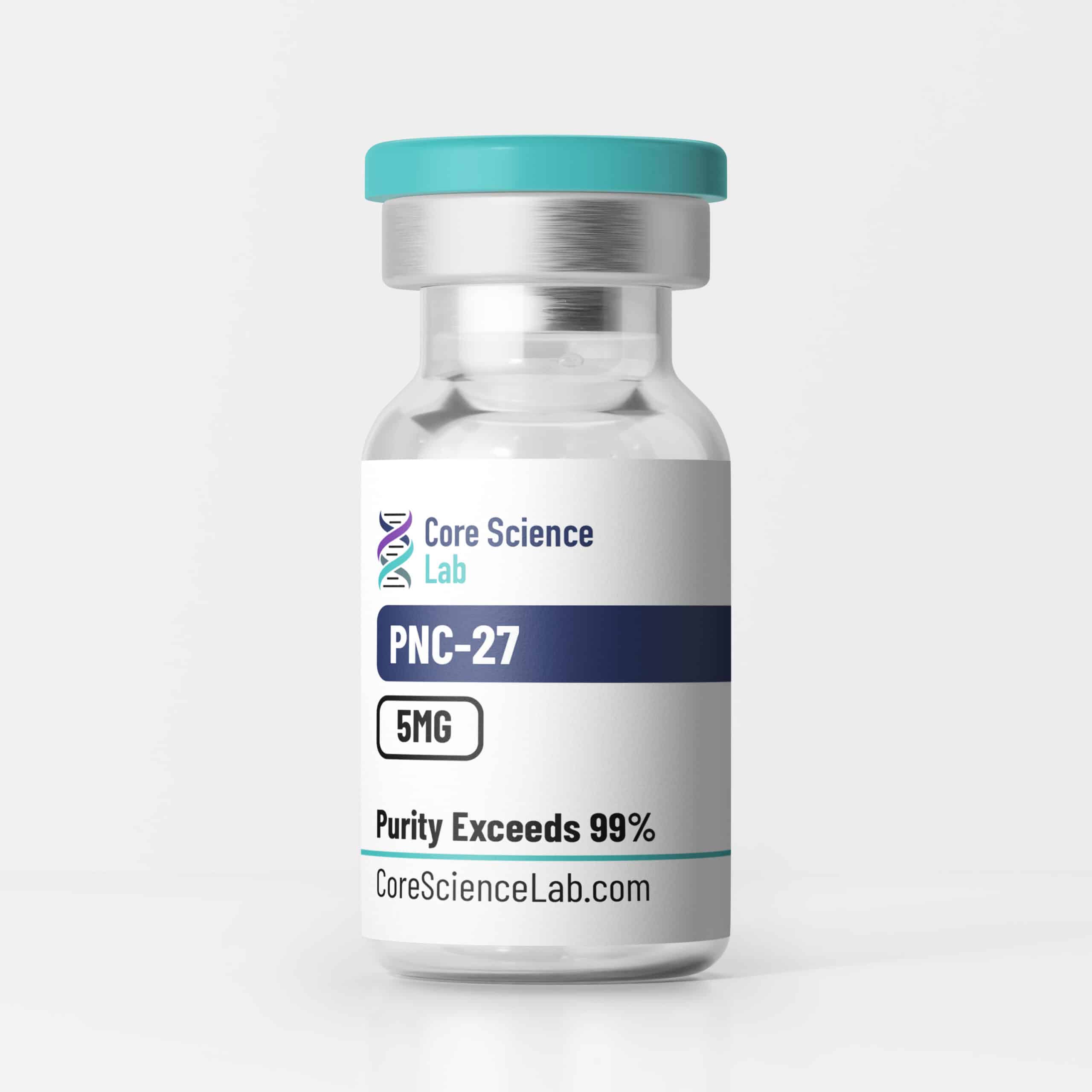
PNC-27 (5mg)

A high-purity, lyophilized synthetic chimeric peptide designed for advanced oncological research. PNC-27 is uniquely characterized for its ability to bind to cell-membrane-expressed HDM-2 (MDM2), inducing targeted transmembrane pore formation and rapid, p53-independent tumor cell necrosis while sparing healthy cells.

Trust & Quality Verification

  • Research Use Only. Not for human or veterinary use.
  • 99% Purity Replacement Guarantee
  • Verifiable purity via HPLC & Mass Spectrometry
  • Supplied as lyophilized powder for stability during transport and storage
  • Certificate of Analysis (COA) available per lot
  • Safety Data Sheet (SDS) available

SKU: V-PNC27-5MG Category:

99%+

Purity Standard

HPLC

Verified Analysis

COA

Available

Free

Shipping

Description

PNC-27 is a highly targeted, 32-amino acid synthetic peptide mimetic engineered as a potent oncolytic research reagent. It is a chimeric molecule composed of the HDM-2-binding domain of the endogenous p53 tumor suppressor protein (residues 12-26) conjugated to a cell-penetrating sequence (penetratin) derived from the Drosophila antennapedia homeodomain.

In experimental oncology, PNC-27 is heavily utilized to investigate membrane-targeted cell death pathways. Unlike classical p53-reactivating agents that operate within the nucleus, PNC-27 targets HDM-2 (Human Double Minute 2), which is aberrantly expressed on the plasma membrane of a wide variety of human cancer cells. By binding to membrane-bound HDM-2, the peptide undergoes a conformational shift that inserts it into the lipid bilayer, leading to the formation of lethal pores. Because healthy cells do not express significant levels of HDM-2 on their outer membranes, PNC-27 provides a precise chemical probe for studying targeted membranolysis and tumor-specific necrosis.

Biochemical Characteristics

Chemically, PNC-27 is an amphipathic peptide whose secondary structure relies on targeted protein-protein interactions to drive lipid bilayer disruption.

  • Sequence/Structure: 32-amino acid chimeric polypeptide combining a p53-derived HDM-2-binding sequence and a basic penetratin sequence.
  • Receptor Affinity: Binds directly and specifically to the HDM-2 (MDM2) protein complex localized on the extracellular face of cancer cell membranes.
  • Stability: Supplied as a lyophilized salt to ensure structural integrity. Its sequence is optimized to retain amphipathic alpha-helical structures upon binding, necessary for its mechanism of action.
  • Specificity: Exhibits extreme specificity for malignant phenotypes. The peptide requires membrane-bound HDM-2 to induce pore formation, effectively sparing non-cancerous cells from cytolytic destruction in co-culture assays.

Chemical Properties

Property Specification
Molecule Name PNC-27
Synonyms Anti-cancer peptide PNC-27; p53-penetratin chimeric peptide
Molecular Formula C188H293N53O44S
Molecular Weight 4111.8 g/mol
Form Lyophilized Powder
Purity ≥99% (Verified via HPLC)
Solubility Soluble in water and aqueous buffers (refer to SDS)
Documentation COA available per lot; SDS available

PNC-27 is strictly for laboratory research and is commonly employed in the following investigational areas:

Targeted Oncolytic and Membranolysis Assays

PNC-27 is utilized in cellular models of various malignancies (including breast, pancreatic, and leukemia cell lines) to quantify targeted necrosis. Researchers employ the peptide to map the kinetics of transmembrane pore formation, measuring the rapid release of intracellular contents and the collapse of cellular gradients.

HDM-2 (MDM2) Membrane Expression Profiling

Because PNC-27 requires membrane-bound HDM-2 to function, it is used as an investigational probe to study the aberrant localization of this protein. Assays focus on quantifying HDM-2 translocation from the nucleus to the plasma membrane during malignant transformation.

p53-Independent Cell Death Pathways

Experimental models use PNC-27 to study tumor necrosis pathways that bypass classical tumor suppressor mutations. Because the peptide kills cells via physical membrane disruption rather than transcriptional regulation, it is used to evaluate efficacy in p53-null, p53-mutated, and chemo-resistant cell lines.

Peptide Carrier and Penetratin Mechanics

The inclusion of the antennapedia-derived penetratin sequence allows researchers to study the biophysics of cellular binding and insertion. Studies focus on how highly cationic peptide domains interact with specific lipid raft microdomains in malignant cell membranes.

Pathway / Mechanistic Context

The primary mechanism of action for PNC-27 in research settings is heavily dependent on specific extracellular binding rather than intracellular signaling cascades.

  • HDM-2 Binding: PNC-27 selectively binds to the HDM-2 protein complex located on the plasma membrane of malignant cells.
  • Conformational Shift & Insertion: Upon binding to HDM-2, the penetratin domain of PNC-27 shifts into an alpha-helical conformation, driving the peptide into the lipid bilayer of the cell membrane.
  • Membranolysis: The insertion of multiple peptide molecules leads to the physical formation of transmembrane pores. This destroys the structural integrity of the cell membrane, resulting in rapid osmotic imbalance, the influx of extracellular fluid, and sudden, profound tumor cell necrosis.
  • Non-Apoptotic Pathway: Unlike conventional agents that trigger the caspase cascade, PNC-27 kills cells via necrosis, completely independent of the cell’s native p53 status or intrinsic apoptotic resistance mechanisms.

Preclinical Research Summary

Published preclinical literature documents investigations of PNC-27 across multiple experimental models:

  • Solid Tumor Eradication: In xenograft models of human breast and pancreatic cancers, exogenous administration of PNC-27 successfully induced massive tumor necrosis and significantly reduced tumor volume without observable damage to surrounding healthy tissue.
  • p53-Mutant Efficacy: Cellular assays demonstrate that PNC-27 is equally cytotoxic to cancer cell lines possessing wild-type p53, mutated p53, or completely deleted p53, confirming its entirely p53-independent mechanism.
  • Target Specificity: Co-culture studies utilizing both malignant cells and healthy fibroblasts or endothelial cells confirm that PNC-27 selectively targets and kills only the cancer cells, corresponding directly to the presence of membrane-bound HDM-2.
  • Synergistic Applications: Recent in vitro investigations highlight that the targeted membranolysis induced by PNC-27 can act synergistically with other chemotherapeutic agents by compromising the barrier function of multidrug-resistant tumor cells.

Form & Analytical Testing

This material is produced via robust solid-phase chemical synthesis and supplied as a lyophilized (freeze-dried) powder.

  • Lyophilization: Removes water content under vacuum to maintain compound integrity and extend shelf-life.
  • Identity Verification: Each lot undergoes Mass Spectrometry (MS) to confirm molecular weight and sequence identity.
  • Purity Verification: High-Performance Liquid Chromatography (HPLC) is performed to ensure the product meets the ≥99% purity standard required for reproducible research data.

Referenced Citations

References are provided for informational purposes only and are not clinical claims.

  • Kanovsky, M., Raffo, A., Drew, L., Rosal, R., Do, T., Gil, J., … & Pincus, M. R. (2001). Peptides from the amino terminal mdm-2-binding domain of p53, designed from conformational analysis, are selectively cytotoxic to transformed cells. Proceedings of the National Academy of Sciences, 98(22), 12438-12443.https://pubmed.ncbi.nlm.nih.gov/11606716/
  • Bowne, P. Z., Michaelson, J. S., Sarafraz-Yazdi, E., Shen, J., Leonova, K., Thul, M., … & Pincus, M. R. (2008). Injections of the p53-derived peptide PNC-27 elicit complete tumor necrosis in a syngeneic rat model of pancreatic cancer. Annals of Surgical Oncology, 15(12), 3588-3600.https://pubmed.ncbi.nlm.nih.gov/20182728/
  • Mich, J. T., Brandt-Rauf, P. W., Pincus, M. R., & Wang, X. (2006). A p53-derived peptide, PNC-28, induces tumor cell necrosis, whereas its penetratin-derived carrier peptide induces apoptosis. Cancer Research, 66(8), 4309-4315.https://pubmed.ncbi.nlm.nih.gov/16688716/
  • Sarafraz-Yazdi, E., Bowne, P. Z., Apfelbaum, F. W., Obom, K. M., Pehlivan, M., Pehlivan, S., … & Pincus, M. R. (2010). Anticancer peptide PNC-27 adopts an HDM-2-binding conformation and kills cancer cells by binding to HDM-2 in their membranes. Molecular Cancer Therapeutics, 9(4), 1065-1077.https://pubmed.ncbi.nlm.nih.gov/20080680/
  • Rosenthal, D. S., Velena, A., Chou, F. P., Schlegel, R., Ray, R., & Benton, B. (2009). A targeted p53-derived peptide rapidly kills melanoma cells. PLoS One, 4(7), e7264. https://doi.org/10.1371/journal.pone.0007264
  • Wang, Y., Zhu, Y., Gao, C., & Wang, H. (2014). PNC-27, a chimeric p53-penetratin peptide, selectively targets cancer cells over normal cells. International Journal of Oncology, 45(6), 2372-2380. https://doi.org/10.3892/ijo.2014.2372
  • Stable at room temperature for up to 90 days. For long-term storage, keep at -20°C (-4°F) or colder.
  • Once mixed with a solvent (e.g., bacteriostatic water), the solution must be stored at 4 °C (39°F) and utilized within 30 days. Avoid repeated freeze-thaw cycles, as this degrades the peptide structure.

RESEARCH USE ONLY

This product is intended strictly for laboratory research use only. It is not for human or veterinary use. It is not intended for diagnosis, treatment, cure, or prevention of any disease. All purchases are subject to our Terms of Service and Purity Guarantee.
No COAs available for this product.

Reviews

There are no reviews yet.

Be the first to review “PNC-27 (5mg)”

Your email address will not be published. Required fields are marked *

RESEARCH USE ONLY

This product is intended strictly for laboratory research use only. It is not for human or veterinary use. It is not intended for diagnosis, treatment, cure, or prevention of any disease. All purchases are subject to our Terms of Service and Purity Guarantee.
0