
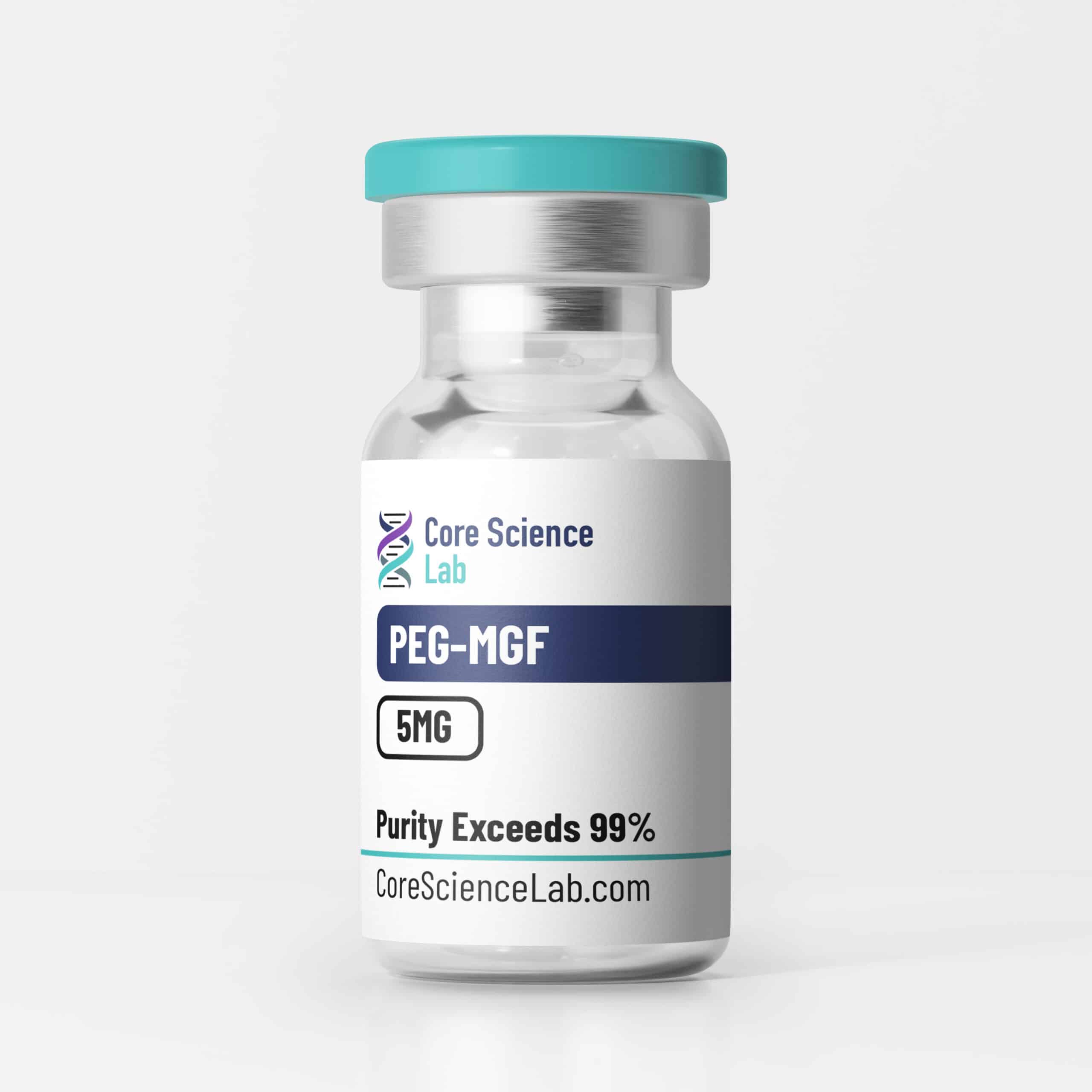
A high-purity, lyophilized pegylated synthetic peptide derivative of the IGF-1 splice variant Mechano Growth Factor (MGF). It is extensively utilized in research to investigate its extended half-life and its potent regulatory effects on muscle progenitor cell activation, tissue regeneration, and cellular protection.
Trust & Quality Verification
$45.00
Out of stock
Purity Standard
Verified Analysis
Available
Shipping
PEG-MGF (Pegylated Mechano Growth Factor) is a synthetic peptide research reagent corresponding to the E-domain of the IGF-1 Ec splice variant. It is chemically distinct due to the addition of a polyethylene glycol (PEG) molecule, which significantly increases its stability and systemic half-life in experimental settings compared to endogenous MGF. Researchers employ this molecule to investigate its targeted capacity to activate stem cell populations, specifically exploring its role in skeletal muscle hypertrophy, myocardial infarction recovery, bone defect healing, and neuroprotection during ischemic events.
Biochemical Characteristics
Chemical Properties
| Property | Specification |
| Molecule Name | PEG-MGF |
| Synonyms | Pegylated Mechano Growth Factor; PEG-IGF-1 Ec |
| PubChem CID | N/A |
| Molecular Formula | C121H200N42O39 (Core Peptide) |
| Molecular Weight | ~2888.2 g/mol (Core Peptide) |
| Form | Lyophilized Powder |
| Purity | 99% (Verified via HPLC) |
| Solubility | Soluble in water and aqueous buffers (refer to SDS) |
| Documentation | COA and SDS available per lot |
PEG-MGF is strictly for laboratory research and is commonly employed in the following investigational areas:
Musculoskeletal Regeneration and Hypertrophy
Research models utilize PEG-MGF to evaluate its profound impact on tissue repair. Investigations focus on the peptide’s ability to activate human muscle progenitor cells and increase their fusion potential. Additional studies assess its capacity to enhance articular hyaline cartilage regeneration when functionalized in scaffolds and to promote the proliferation, differentiation, and mineralization of osteoblast models for bone defect healing.
Stem Cell Migration and Differentiation
Experimental protocols employ this pegylated peptide to characterize its influence on stem cell dynamics. Studies assess how the MGF E-domain regulates the targeted migration and differentiation of bone marrow mesenchymal stem cells to sites of injury.
Cardiac and Neuroprotective Modeling
In cardiovascular and neurological research, PEG-MGF is used to study cellular protection following severe ischemic events. Researchers evaluate its efficacy in improving cardiac function and preserving myocardium following induced myocardial infarction, as well as its strong autonomous neuroprotective effects in models of brain ischemia.
Pathway / Mechanistic Context
The primary mechanism of action for PEG-MGF in research settings involves its function as a localized tissue repair factor, acting independently of the mature IGF-1 receptor pathway.
Preclinical Research Summary
Published preclinical literature documents investigations of MGF and its pegylated derivatives across diverse experimental models focusing on tissue repair and cellular protection.
Form & Analytical Testing
Referenced Citations
References are provided for informational purposes only and are not clinical claims.
RESEARCH USE ONLY
This product is intended strictly for laboratory research use only. It is not for human or veterinary use. It is not intended for diagnosis, treatment, cure, or prevention of any disease. All purchases are subject to our Terms of Service and Purity Guarantee.
No COAs available for this product.
RESEARCH USE ONLY
This product is intended strictly for laboratory research use only. It is not for human or veterinary use. It is not intended for diagnosis, treatment, cure, or prevention of any disease. All purchases are subject to our Terms of Service and Purity Guarantee.


Reviews
There are no reviews yet.