
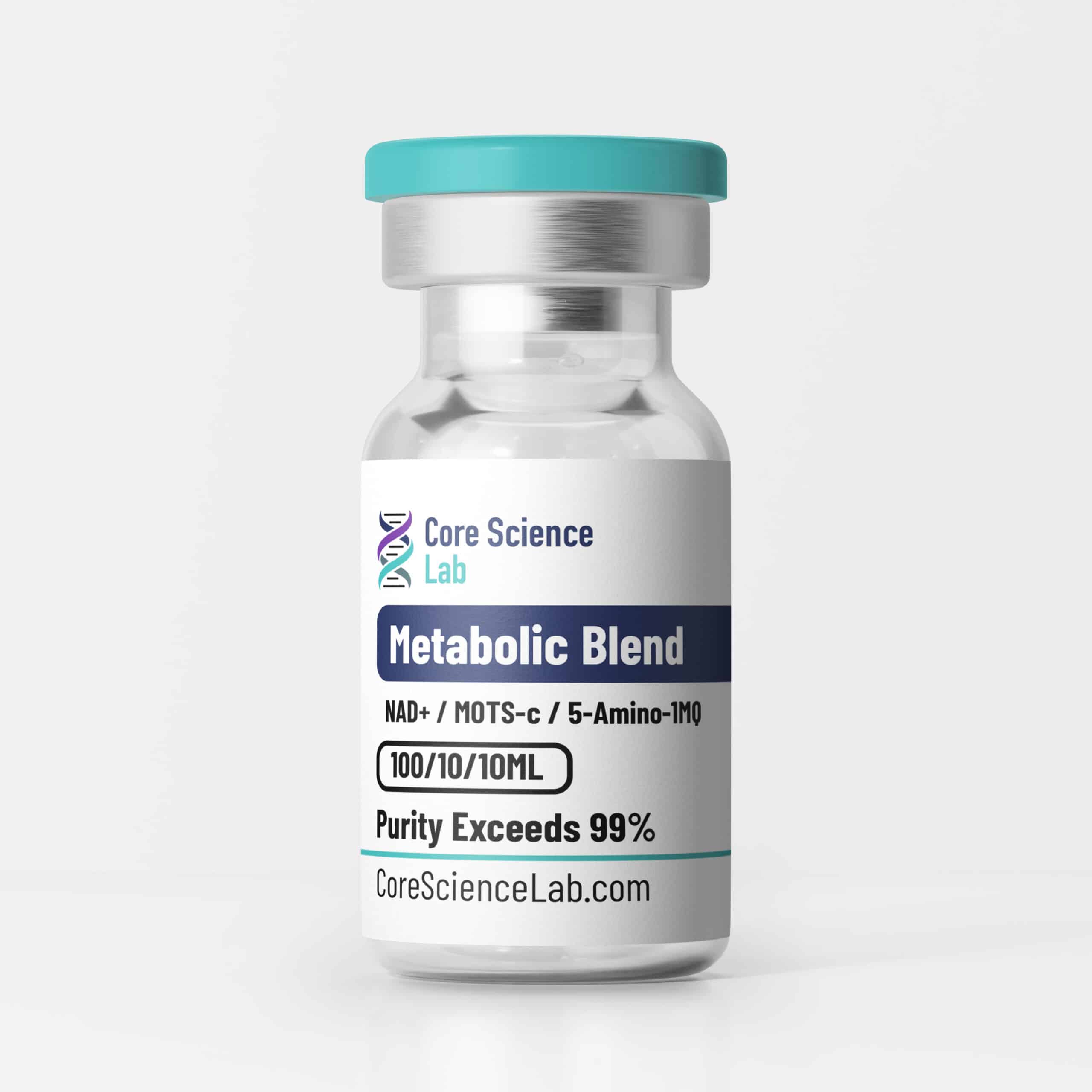
A high-purity, lyophilized multi-component research formulation combining the coenzyme NAD+, the mitochondrial-derived peptide MOTS-c, and the small molecule NNMT inhibitor 5-Amino-1MQ. It is extensively utilized in research to investigate synergistic effects on cellular energy homeostasis, metabolic reprogramming, and the comprehensive modulation of the NAD+ salvage pathway.
Trust & Quality Verification
Purity Standard
Verified Analysis
Available
Shipping
The Metabolic Blend NAD+ / MOTS-c / 5-Amino-1MQ is a composite research reagent that integrates three distinct regulators of cellular metabolism. 5-Amino-1MQ is a membrane-permeable small molecule that selectively inhibits Nicotinamide N-methyltransferase (NNMT), preventing the metabolic depletion of nicotinamide. MOTS-c is a 16-amino acid mitochondrial-derived peptide that functions as an exercise mimetic, translocating to the nucleus during stress to regulate energy homeostasis. NAD+ (Nicotinamide adenine dinucleotide) is a critical dinucleotide coenzyme involved in cellular redox reactions. Researchers utilize this complex blend to investigate the intersection of these pathways, specifically evaluating how simultaneously fueling the NAD+ salvage pathway and providing mitochondrial signaling peptides impacts metabolic flux, insulin resistance, and cellular longevity models.
Biochemical Characteristics
Chemical Properties
| Property | Specification |
| Molecule Name | Metabolic Blend (NAD+ / MOTS-c / 5-Amino-1MQ) |
| Synonyms | Nadide / Mitochondrial open reading frame of the 12S rRNA-c / 5-amino-1-methylquinolinium |
| PubChem CID | 5892 (NAD+); 146675088 (MOTS-c); 950107 (5-Amino-1MQ) |
| Molecular Formula | Mixture (C21H27N7O14P2 / C101H152N28O22S2 / C10H11N2) |
| Molecular Weight | ~663.4 g/mol (NAD+) / 2174.6 g/mol (MOTS-c) / 159.2 g/mol (5-Amino-1MQ) |
| Form | Lyophilized Powder |
| Purity | 99% (Verified via HPLC) |
| Solubility | Soluble in water and aqueous buffers (refer to SDS) |
| Documentation | COA and SDS available per lot |
The Metabolic Blend is strictly for laboratory research and is commonly employed in the following investigational areas:
Metabolic Homeostasis and Obesity
Research models utilize this blend to evaluate the synergistic regulation of adipose tissue and lipid metabolism. Investigations focus on quantifying how MOTS-c promotes metabolic homeostasis and reduces obesity/insulin resistance, while NNMT inhibition via 5-Amino-1MQ prevents the drainage of NAD+ precursors, driving a systemic shift toward increased energy expenditure.
Cellular Bioenergetics and Mitochondrial Dysfunction
Experimental protocols employ this combination to characterize intracellular energy states. Studies assess mitochondrial efficiency, oxidative phosphorylation, and the molecular stress response, observing how MOTS-c translocates to the nucleus during metabolic stress to regulate adaptive gene expression.
Neuroprotection and Cognitive Health
In models of neuroinflammation and cognitive decline, researchers utilize NAD+-boosting compounds to study their restorative effects. Assays measure the activation of Sirt1/PGC-1α signaling pathways to determine the capacity of the blend to improve cognition and maintain neural cell viability.
Oncology and Epigenetic Regulation
This blend is used in specialized oncology research to determine the effects of NNMT inhibition on tumor cell metabolism. By combining 5-Amino-1MQ with NAD+ and MOTS-c, investigators explore how altering the cellular methylation potential and NAD+ availability influences the “Warburg effect” and broader epigenetic cancer progression.
Pathway / Mechanistic Context
The primary mechanistic context for this blend involves a multi-targeted, systems-level approach to energy restoration and metabolic signaling.
Preclinical Research Summary
Published preclinical literature documents investigations of the components within this blend across multiple experimental models:
Form & Analytical Testing
Referenced Citations
References are provided for informational purposes only and are not clinical claims.
RESEARCH USE ONLY
This product is intended strictly for laboratory research use only. It is not for human or veterinary use. It is not intended for diagnosis, treatment, cure, or prevention of any disease. All purchases are subject to our Terms of Service and Purity Guarantee.
No COAs available for this product.
RESEARCH USE ONLY
This product is intended strictly for laboratory research use only. It is not for human or veterinary use. It is not intended for diagnosis, treatment, cure, or prevention of any disease. All purchases are subject to our Terms of Service and Purity Guarantee.
Reviews
There are no reviews yet.