Description
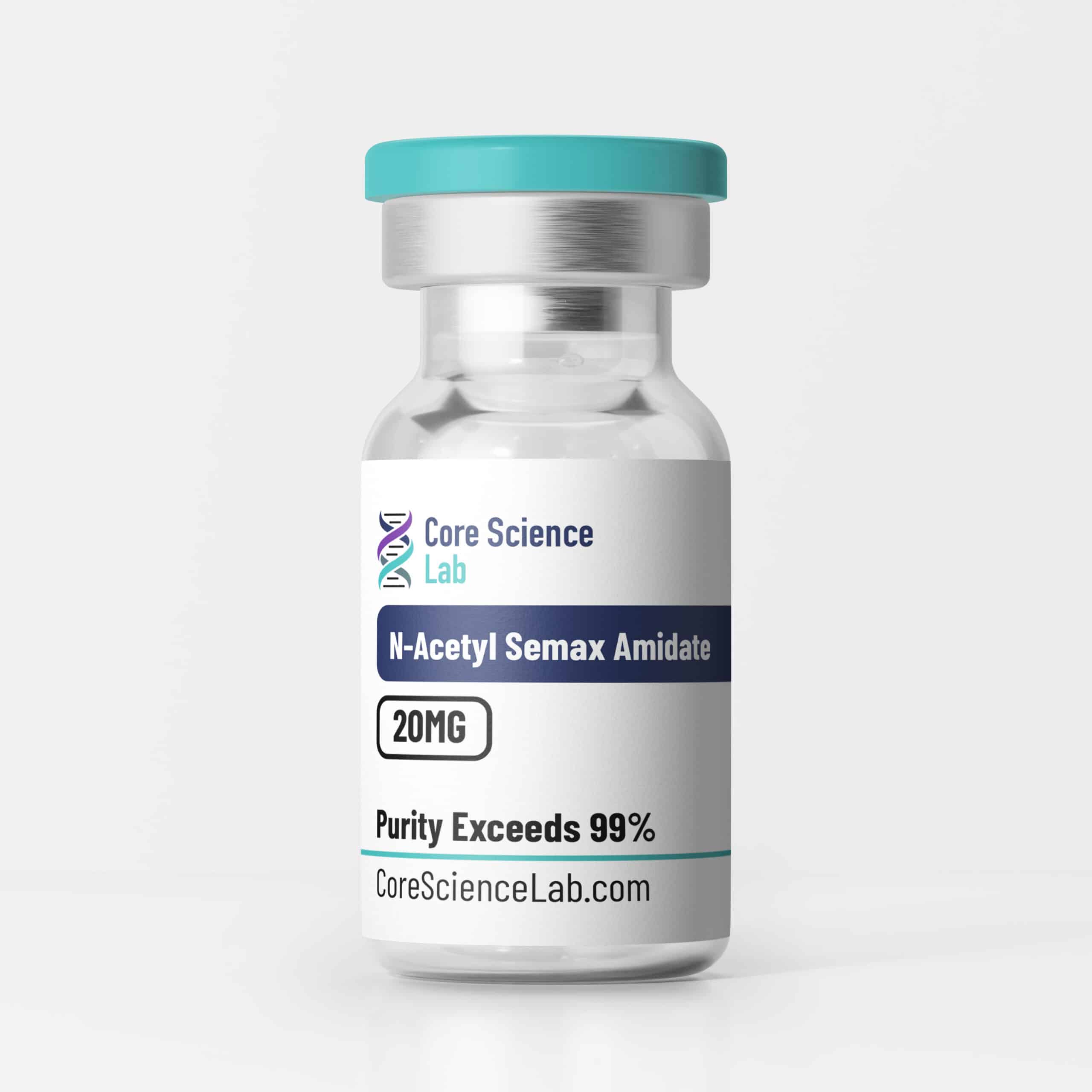
N-Acetyl Semax Amidate is a synthetically modified heptapeptide research reagent derived from the endogenous adrenocorticotropic hormone fragment ACTH(4-10). It is chemically distinct from standard Semax due to the addition of an acetyl group at the N-terminus and an amide group at the C-terminus, modifications designed to resist enzymatic degradation and significantly enhance blood-brain barrier permeability. Researchers utilize this molecule to investigate the modulation of neurotrophic factors (such as BDNF), the protection of neuronal tissues during ischemic stroke models, and its broader systemic effects on the immune system under stress conditions.
Biochemical Characteristics
- Sequence/Structure: Peptide (7 amino acids); Ac-Met-Glu-His-Phe-Pro-Gly-Pro-NH2; N-acetyl and C-amide modified heptapeptide.
- Permeability: Demonstrates exceptional ability to cross the blood-brain barrier due to its modified, uncharged termini, facilitating robust central nervous system interactions.
- Stability: Supplied as a lyophilized salt to ensure long-term stability. The acetylation and amidation prevent rapid proteolytic cleavage by exopeptidases, drastically increasing its half-life compared to the unmodified peptide.
- Specificity: Highly specific modulator of central monoaminergic systems and neurotrophin expression, acting without the steroidal (cortisol-releasing) activity of full-length ACTH.
Chemical Properties
| Property |
Specification |
| Molecule Name |
N-Acetyl Semax Amidate |
| Synonyms |
N-acetyl semax; Ac-MEHFPGP-NH2 |
| PubChem CID |
172638603 |
| Molecular Formula |
C39H54N10O10S |
| Molecular Weight |
855.0 g/mol |
| Form |
Lyophilized Powder |
| Purity |
$\ge99\%$ (Verified via HPLC) |
| Solubility |
Soluble in water and aqueous buffers (refer to SDS) |
| Documentation |
COA and SDS available per lot |
N-Acetyl Semax Amidate is strictly for laboratory research and is commonly employed in the following investigational areas:
Neuroprotection and Ischemic Stroke
Research models utilize this modified peptide to evaluate its efficacy in mitigating ischemic damage. Investigations focus on the acute period of ischemic stroke, quantifying changes in gene expression related to the immune and vascular systems, and assessing functional recovery in chronic brain ischemia.
Cognitive Enhancement and Neurotrophin Modulation
Experimental protocols employ the molecule to characterize its effects on learning and memory. Studies specifically measure its capacity to bind in the basal forebrain and increase the protein levels of Brain-Derived Neurotrophic Factor (BDNF), as well as its modulatory effects on central dopaminergic and serotoninergic systems.
Immunomodulation and Stress Response
In physiological research, N-Acetyl Semax Amidate is used to study the interplay between the nervous and immune systems. Researchers evaluate its immunomodulating action during “social” and acute stress models, quantifying its influence on the levels of pro- and anti-inflammatory cytokines and the intensity of lipid peroxidation in immunocompetent organs.
Protein Aggregation and Amyloidosis
In vitro biochemical assays utilize the peptide to investigate neurodegenerative disease mechanisms. Studies assess its ability to interact with artificial membrane models and inhibit copper-induced amyloid-beta (Abeta) aggregation and amyloid formation.
Pathway / Mechanistic Context
The primary mechanism of action for N-Acetyl Semax Amidate in research settings involves its pleiotropic regulatory influence on neurotrophin expression, monoamine neurotransmission, and inflammatory signaling.
- BDNF Upregulation: Specifically binds to receptors in the basal forebrain to stimulate the synthesis and release of Brain-Derived Neurotrophic Factor, supporting cholinergic neuronal survival.
- Monoaminergic Modulation: Enhances the activity and turnover rates of dopamine and serotonin in the brain, which correlates with restored cognitive function and behavioral activation.
- Anti-Inflammatory/Antioxidant Signaling: Modulates the expression of immunovascular genes during focal ischemia and suppresses lipid peroxidation and inflammatory cytokine release under acute and chronic stress conditions.
Preclinical Research Summary
Published preclinical literature documents the extensive investigation of Semax and its modified analogues across diverse experimental models focusing on neurology, immunology, and stress.
- In focal ischemia models, genome-wide transcriptional analysis revealed that Semax profoundly affects the expression of genes related to the immune and vascular systems, providing a mechanism for its neuroprotective effect during acute stroke.
- Research on cognitive function in rats with chronic brain ischemia demonstrated that Semax administration successfully restores memory and learning behaviors.
- Biochemical studies indicate that the synthetic regulatory peptide can prevent copper-induced amyloid-beta aggregation in artificial membrane models, suggesting a protective role against amyloidogenic neurodegeneration.
- In models of “social” and acute stress, the peptide demonstrated robust immunomodulating actions, regulating the balance of pro- and anti-inflammatory cytokines and protecting immunocompetent organs from lipid peroxidation.
- Neurochemical assays confirmed that the analogue specifically increases BDNF levels in the basal forebrain and modulates dopaminergic and serotoninergic systems without unwanted hormonal side effects.
Form & Analytical Testing
- Solid-Phase Peptide Synthesis and Terminal Modification
- Lyophilization
- Identity Verification: Mass Spectrometry (MS) to confirm molecular weight and identity.
- Purity Verification: High-Performance Liquid Chromatography (HPLC) is performed to ensure the product meets the purity standard.
References are provided for informational purposes only and are not clinical claims.
- Sciacca, M., Naletova, I., Giuffrida, M., & Attanasio, F. (2022). Semax, a Synthetic Regulatory Peptide, Affects Copper-Induced Abeta Aggregation and Amyloid Formation in Artificial Membrane Models. ACS Chemical Neuroscience, 13, 486 – 496. https://doi.org/10.1021/acschemneuro.1c00707.
- Miasoedova, N., Skvortsova, V., Nasonov, E., Zhuravleva, E., Grivennikov, I., Arsen’eva, E., & Sukhanov, I. (1999). [Investigation of mechanisms of neuro-protective effect of semax in acute period of ischemic stroke].. Zhurnal nevrologii i psikhiatrii imeni S.S. Korsakova, 99 5, 15-9. https://pubmed.ncbi.nlm.nih.gov/17603664/.
- Kirchev, V. (2023). Cognitive function restoration in rats with chronic brain ischemia using Semax and hopantenic acid comprehensive administration. Journal of Education, Health and Sport. https://doi.org/10.12775/jehs.2023.13.04.046.
- Eremin, K., Kudrin, V., Grivennikov, I., Miasoedov, N., & Rayevsky, K. (2004). Effects of Semax on Dopaminergic and Serotoninergic Systems of the Brain. Doklady Biological Sciences, 394, 1-3. https://doi.org/10.1023/B:DOBS.0000017114.24474.40.
- Dolotov, O., Karpenko, E., Seredenina, T., Inozemtseva, L., Levitskaya, N., Zolotarev, Y., Kamensky, A., Grivennikov, I., Engele, J., & Myasoedov, N. (2006). Semax, an analogue of adrenocorticotropin (4–10), binds specifically and increases levels of brain‐derived neurotrophic factor protein in rat basal forebrain. Journal of Neurochemistry, 97. https://doi.org/10.1111/j.1471-4159.2006.03658.x.
- Grivennikov, I., Dolotov, O., Zolotarev, Y., Andreeva, L., Myasoedov, N., Leacher, L., Black, I., & Dreyfus, C. (2008). Effects of behaviorally active ACTH (4-10) analogue – Semax on rat basal forebrain cholinergic neurons.. Restorative neurology and neuroscience, 26 1, 35-43. https://pubmed.ncbi.nlm.nih.gov/18431004/.
- Yasenyavskaya, A., Samotrueva, M., Myasoedov, N., & Andreeva, L. (2022). The experimental study of the immunomodulating action of Semax and Selank on the model of „social” stress. European Pharmaceutical Journal, 69, 54 – 60. https://doi.org/10.2478/afpuc-2022-0004.
- Yasenyavskaya, A., Samotrueva, M., Tsibizova, A., Bashkina, O., Andreeva, L., & Myasoedov, N. (2022). Influence of Semax on the Level of Pro- and Anti-Inflammatory Cytokines in Conditions of “Social” Stress. Current Drug Therapy. https://doi.org/10.2174/1574885517666220831155411.
- Glazova, N., Myasoedov, N., Limborska, S., Dergunova, L., Kamensky, A., Andreeva, L., Sebentsova, E., Vilensky, D., Manchenko, D., & Levitskaya, N. (2023). Effects of Semax in the Models of Acute Stress. Российский физиологический журнал им И М Сеченова. https://doi.org/10.31857/s0869813923010053.
- Samotrueva, M., Yasenyavskaya, A., Murtalieva, V., Myasoedov, N., & Andreeva, L. (2019). INFLUENCE OF SEMAX ON THE INTENSITY OF LIPID PEROXIDATION IN IMMUNOCOMPETENT ORGANS IN THE CONDITIONS OF “SOCIAL” STRESS. , 19, 188-191. https://doi.org/10.17816/maj191s1188-191.
- Medvedeva, E., Dmitrieva, V., Povarova, O., Limborska, S., Skvortsova, V., Myasoedov, N., & Dergunova, L. (2014). The peptide semax affects the expression of genes related to the immune and vascular systems in rat brain focal ischemia: genome-wide transcriptional analysis. BMC Genomics, 15, 228 – 228. https://doi.org/10.1186/1471-2164-15-228.
RESEARCH USE ONLY
This product is intended strictly for laboratory research use only. It is not for human or veterinary use. It is not intended for diagnosis, treatment, cure, or prevention of any disease. All purchases are subject to our Terms of Service and Purity Guarantee.
No COAs available for this product.

Reviews
There are no reviews yet.