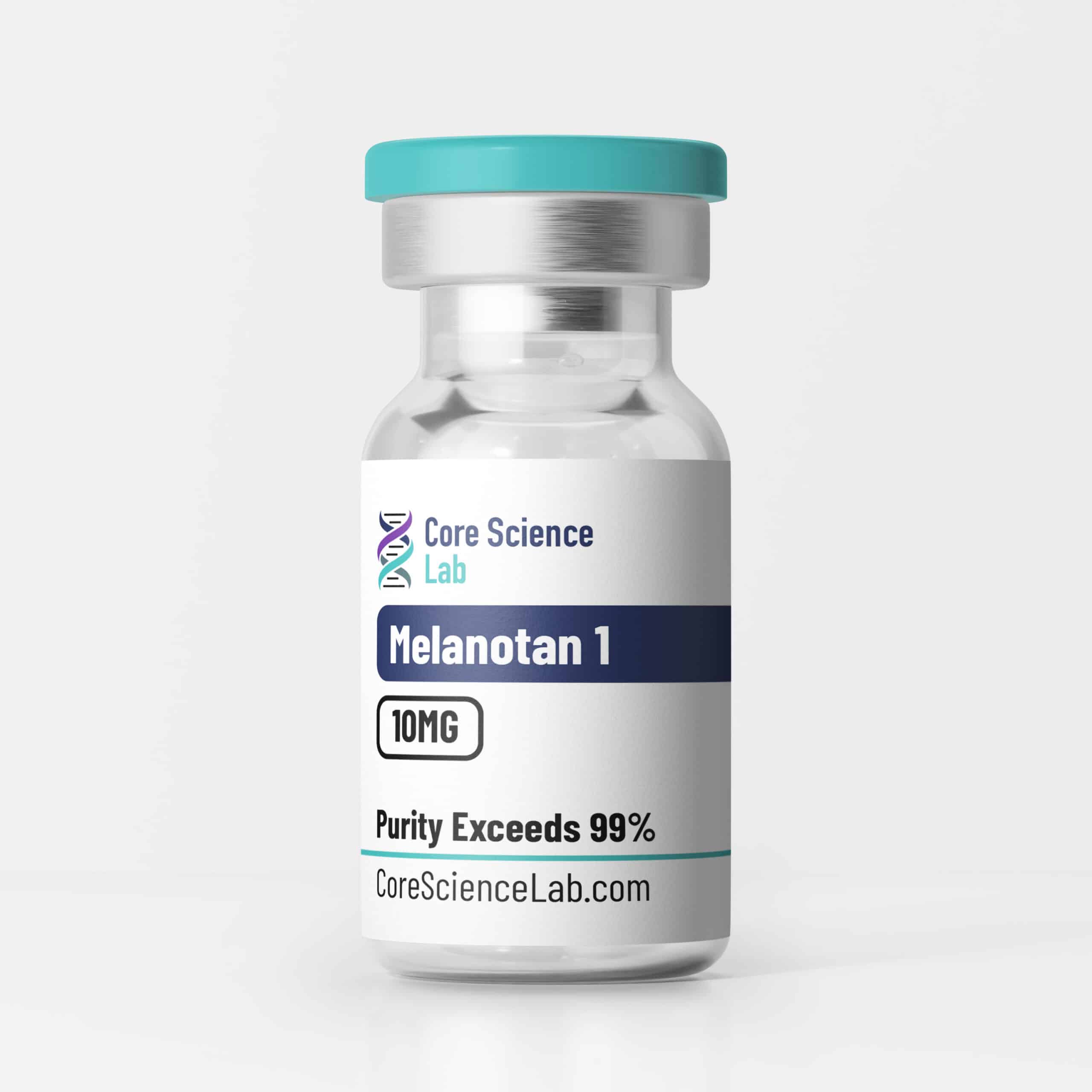
Melanotan 1 (10mg)

A linear, synthetic analogue of alpha-Melanocyte Stimulating Hormone (alpha-MSH) acting as a potent agonist of the melanocortin-1 receptor (MC1R), characterized for research applications involving melanogenesis, photoprotection, and the modulation of neuroinflammatory pathways.

Trust & Quality Verification

  • Research Use Only. Not for human or veterinary use.
  • 99% Purity Replacement Guarantee
  • Verifiable purity via HPLC & Mass Spectrometry
  • Supplied as lyophilized powder for stability during transport and storage
  • Certificate of Analysis (COA) available per lot
  • Safety Data Sheet (SDS) available

Email when stock available

SKU: V-MT1-10MG Category:

99%+

Purity Standard

HPLC

Verified Analysis

COA

Available

Free

Shipping

Description

Melanotan 1 (also known as Afamelanotide or [Nle4, D-Phe7]-α-MSH) is a synthetic peptide designed to mimic the physiological effects of alpha-MSH while exhibiting significantly enhanced enzymatic stability and receptor potency. It functions as a specific agonist for the Melanocortin-1 Receptor (MC1R), a G-protein coupled receptor central to the regulation of mammalian pigmentation and photoprotection.

In research settings, Melanotan 1 is the primary reagent for investigating the induction of eumelanin synthesis (melanogenesis) as a photoprotective mechanism against UV-induced damage. Beyond dermatology, the peptide is extensively utilized in neurology and hepatology to study the “non-pigmentary” effects of MC1R activation, specifically its role in attenuating inflammation, preserving blood-brain barrier (BBB) integrity, and regulating mitochondrial metabolism in injury models.

Biochemical Characteristics

Chemically, Melanotan 1 is a linear peptide modified with Norleucine (Nle) and D-Phenylalanine (D-Phe). These substitutions protect the peptide from rapid proteolytic degradation and enhance its affinity for the MC1R.

  • Structure: Linear peptide ([Nle4, D-Phe7]-α-MSH).
  • Signaling: Activation of MC1R triggers the Gs-cAMP-PKA signaling cascade, leading to the phosphorylation of CREB and upregulation of Mitf.
  • Interaction: Recent structural analysis reveals that MC1R recognition is mediated by calcium ions, which are essential for the efficient binding of the peptide and subsequent G-protein coupling.
  • Specificity: Primarily targets MC1R to drive melanogenic and anti-inflammatory responses in melanocytes and macrophages.

Chemical Properties

Property Specification
Molecule Name Melanotan 1
Synonyms Afamelanotide; NDP-MSH; [Nle4, D-Phe7]-α-MSH
Sequence Ac-Ser-Tyr-Ser-Nle-Glu-His-D-Phe-Arg-Trp-Gly-Lys-Pro-Val-NH2
Molecular Formula C₅₀H₆₉N₁₅O₉
Molecular Weight 1024.18 g/mol
Form Lyophilized Powder
Purity ≥99% (Verified via HPLC)
Solubility Soluble in water (refer to SDS)
Documentation COA available per lot; SDS available

Melanotan 1 is strictly for laboratory research and is commonly employed in the following investigational areas:

Photoprotection and Protoporphyria

Melanotan 1 is the standard investigative compound for Erythropoietic Protoporphyria (EPP). Researchers utilize it to evaluate the capacity of MC1R agonists to increase melanin density (eumelanin) and provide a “biological shield” against phototoxic reactions.

Neuroinflammation and Brain Injury

In models of intracerebral and subarachnoid hemorrhage, Melanotan 1 (NDP-MSH) is used to study neuroprotection. Research focuses on its ability to ameliorate blood-brain barrier disruption and suppress neuroinflammation. Studies quantify the peptide’s impact on inhibiting the NF-κB pathway and activating AMPK/SIRT1 axes to control mitochondrial metabolism and reduce neuronal apoptosis.

Liver Physiology and Cytoprotection

The peptide is employed to investigate the anti-inflammatory role of the melanocortin system in the liver. Early studies demonstrated that alpha-MSH analogues reduce endotoxin-induced liver inflammation. More recent observational research in EPP models suggests that Melanotan 1 administration may be associated with signs of liver protection, potentially through systemic anti-inflammatory mechanisms.

Macrophage Regulation

Researchers use Melanotan 1 to explore the role of melanocortin receptors as effectors of macrophage responses. The peptide is utilized to modulate macrophage phenotype and cytokine secretion, providing data on the resolution of inflammation.

Pathway / Mechanistic Context

The primary mechanism of action for Melanotan 1 in research settings involves the pleiotropic activation of MC1R downstream pathways.

  • Melanogenesis: Binding to MC1R activates adenylate cyclase, increasing cAMP and activating PKA. This leads to CREB phosphorylation and the upregulation of Tyrosinase, the rate-limiting enzyme in melanin synthesis.
  • Anti-Inflammatory (NF-κB): In neural tissues, MC1R activation by the peptide suppresses the nuclear translocation of NF-κB, thereby reducing the expression of pro-inflammatory cytokines.
  • Antioxidant (Nrf2): The peptide activates the PI3K/Akt/Nrf2 pathway, promoting the expression of antioxidant genes (HO-1, NQO1) to counteract oxidative stress in neuronal models.

Preclinical Research Summary

Published preclinical literature documents investigations of Melanotan 1 across multiple experimental models:

  • Hemorrhagic Stroke: In mouse models of intracerebral hemorrhage, treatment with NDP-MSH (Melanotan 1) significantly reduced brain edema and improved neurological scores by modulating the CREB/Nr4a1/NF-κB pathway.
  • Subarachnoid Hemorrhage: Research indicates that MC1R activation attenuates early brain injury by controlling mitochondrial metabolism via the AMPK/SIRT1/PGC-1α pathway.
  • Oxidative Stress: Studies demonstrate that the peptide attenuates neuronal apoptosis and oxidative stress through the PI3K/Akt/Nrf2 signaling cascade.
  • Melanogenic Induction: Biochemistry studies confirm the peptide’s role in upregulating melanogenesis-related proteins, providing a model for studying skin pigmentation disorders.

Form & Analytical Testing

This material is produced via robust solid-phase peptide synthesis and supplied as a lyophilized (freeze-dried) powder.

  • Lyophilization: Removes water content under vacuum to maintain peptide integrity and extend shelf-life.
  • Identity Verification: Each lot undergoes Mass Spectrometry (MS) to confirm molecular weight and identity.
  • Purity Verification: High-Performance Liquid Chromatography (HPLC) is performed to ensure the product meets the ≥99% purity standard required for reproducible research data.

Referenced Citations

References are provided for informational purposes only and are not clinical claims.

  • Polańska, A., et al. (2024). Afamelanotide in protoporphyria and other skin diseases: a review. Advances in Dermatology and Allergology. https://doi.org/10.5114/ada.2024.138818
  • Wang, F., et al. (2024). The biochemistry of melanogenesis: an insight into the function and mechanism of melanogenesis-related proteins. Frontiers in Molecular Biosciences. https://doi.org/10.3389/fmolb.2024.1440187
  • Ma, S., et al. (2021). Structural mechanism of calcium-mediated hormone recognition and Gβ interaction by the human melanocortin-1 receptor. Cell Research. https://doi.org/10.1038/s41422-021-00557-y
  • Wolf Horrell, E. M., et al. (2016). Melanocortin 1 Receptor: Structure, Function, and Regulation. Frontiers in Genetics. https://doi.org/10.3389/fgene.2016.00095
  • Patel, H. B., et al. (2011). Melanocortin Receptors as Novel Effectors of Macrophage Responses in Inflammation. Frontiers in Immunology. https://doi.org/10.3389/fimmu.2011.00041
  • Wu, X., et al. (2019). NDP-MSH binding melanocortin-1 receptor ameliorates neuroinflammation and BBB disruption through CREB/Nr4a1/NF-κB pathway after intracerebral hemorrhage in mice. Journal of Neuroinflammation. https://doi.org/10.1186/s12974-019-1591-4
  • Xu, W., et al. (2020). Activation of Melanocortin 1 Receptor Attenuates Early Brain Injury in a Rat Model of Subarachnoid Hemorrhage via the Suppression of Neuroinflammation through AMPK/TBK1/NF-κB Pathway in Rats. Neurotherapeutics. https://doi.org/10.1007/s13311-019-00772-x
  • Xu, W., et al. (2021). Melanocortin 1 receptor attenuates early brain injury following subarachnoid hemorrhage by controlling mitochondrial metabolism via AMPK/SIRT1/PGC-1α pathway in rats. Nanotheranostics. https://doi.org/10.7150/thno.49426
  • Fu, S., et al. (2020). Activation of the Melanocortin-1 Receptor by NDP-MSH Attenuates Oxidative Stress and Neuronal Apoptosis through PI3K/Akt/Nrf2 Pathway after Intracerebral Hemorrhage in Mice. Oxidative Medicine and Cellular Longevity. https://doi.org/10.1155/2020/8864100
  • Yu, S., et al. (2021). Activation of MC1R with BMS-470539 attenuates neuroinflammation via cAMP/PKA/Nurr1 pathway after neonatal hypoxic-ischemic brain injury in rats. Journal of Neuroinflammation. https://doi.org/10.1186/s12974-021-02078-2
  • Minder, A.-E., et al. (2021). Beyond pigmentation: signs of liver protection during afamelanotide treatment in Swiss patients with erythropoietic protoporphyria, an observational study. Therapeutic Advances in Rare Diseases. https://doi.org/10.1177/26330040211065453
  • Chiao, H., et al. (1996). Alpha-melanocyte-stimulating hormone reduces endotoxin-induced liver inflammation. Journal of Clinical Investigation. https://doi.org/10.1172/jci118639
  • Langendonk, J. G., et al. (2015). Afamelanotide for Erythropoietic Protoporphyria. New England Journal of Medicine. https://doi.org/10.1056/nejmoa1411481
  • Stable at room temperature for up to 90 days. For long-term storage, keep at -20°C (-4°F) or colder.
  • Once mixed with a solvent (e.g., bacteriostatic water), the solution must be stored at 4 °C (39°F) and utilized within 30 days. Avoid repeated freeze-thaw cycles, as this degrades the peptide structure.

RESEARCH USE ONLY

This product is intended strictly for laboratory research use only. It is not for human or veterinary use. It is not intended for diagnosis, treatment, cure, or prevention of any disease. All purchases are subject to our Terms of Service and Purity Guarantee.
No COAs available for this product.

Reviews

There are no reviews yet.

Be the first to review “Melanotan 1 (10mg)”

Your email address will not be published. Required fields are marked *

RESEARCH USE ONLY

This product is intended strictly for laboratory research use only. It is not for human or veterinary use. It is not intended for diagnosis, treatment, cure, or prevention of any disease. All purchases are subject to our Terms of Service and Purity Guarantee.
0