Description
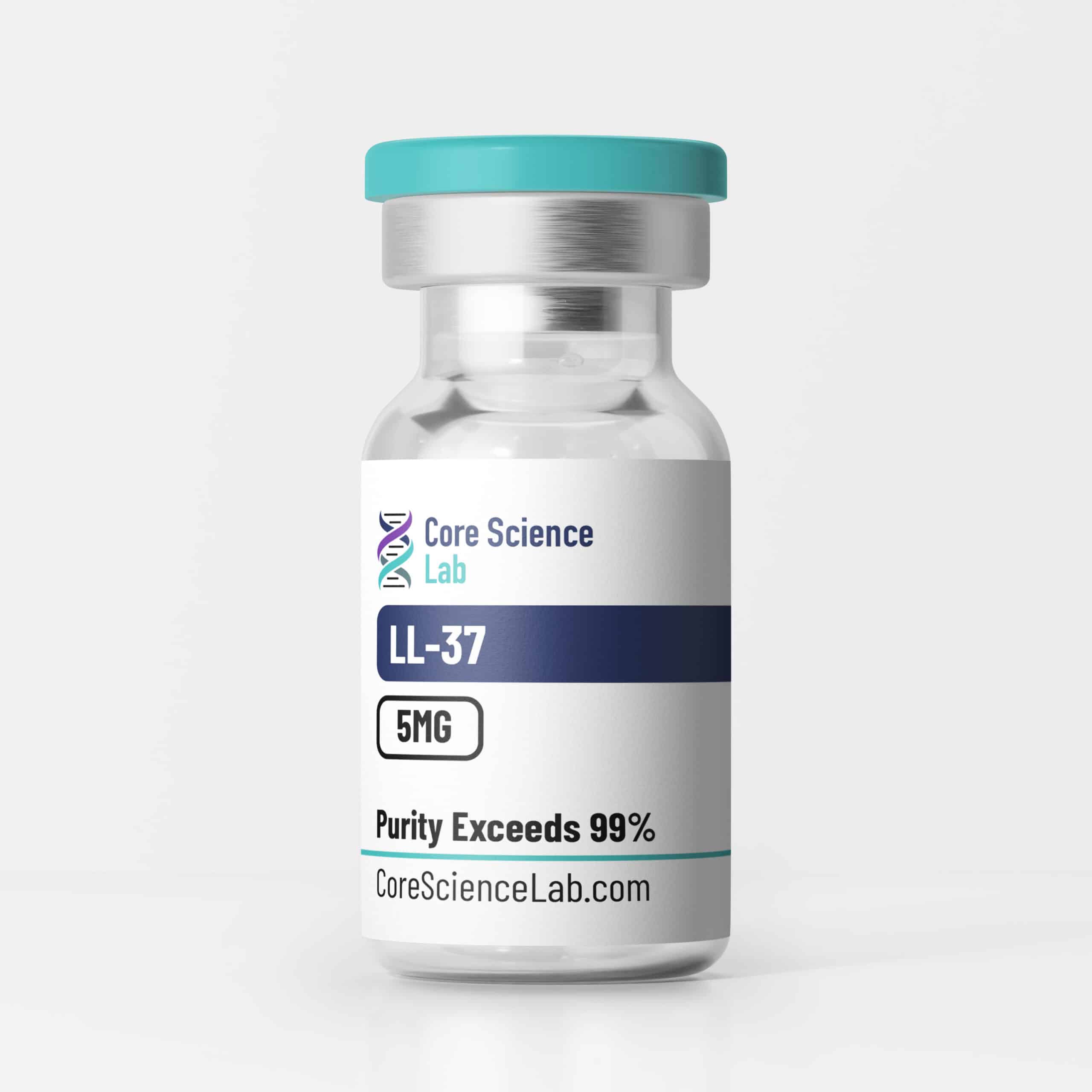
LL-37 is the only known member of the cathelicidin family of antimicrobial peptides expressed in humans. Originally identified in neutrophils, it is also expressed by epithelial cells where it functions as a critical component of the innate immune defense. In research settings, LL-37 is utilized to study the promotion of wound healing and re-epithelialization, with studies noting its absence in the epithelium of chronic ulcers.
Beyond its direct antimicrobial activity, LL-37 is a potent chemoattractant. It is used in immunological assays to investigate the recruitment of neutrophils, monocytes, and T cells, as well as mast cells and eosinophils.
Biochemical Characteristics
Chemically, LL-37 is an amphipathic peptide that adopts an alpha-helical structure upon interaction with phospholipid membranes, a feature relevant to its non-cell-selective activity.
- Structure: Linear peptide (37 amino acids).
- Membrane Interaction: Exhibits structural organization in phospholipid environments, facilitating membrane permeation.
- Receptor Affinity: Functions as a ligand for Formyl Peptide Receptor-Like 1 (FPRL1), triggering specific chemotactic responses.
- Stability: Active in physiological salt conditions, though its oligomerization state can influence activity.
Chemical Properties
| Property |
Specification |
| Molecule Name |
LL-37 |
| Synonyms |
CAMP; hCAP-18 fragment |
| Sequence |
LLGDFFRKSKEKIGKEFKRIVQRIKDFLRNLVPRTES |
| Molecular Formula |
C₂₀₅H₃₄₀N₆₀O₅₃ |
| Molecular Weight |
4493.3 g/mol |
| Form |
Lyophilized Powder |
| Purity |
≥99% (Verified via HPLC) |
| Solubility |
Soluble in water (refer to SDS) |
| Documentation |
COA available per lot; SDS available |
LL-37 is strictly for laboratory research and is commonly employed in the following investigational areas:
Wound Healing and Re-epithelialization
LL-37 is a primary reagent in dermatological research. It is used to study the mechanisms of skin repair, where it has been shown to induce angiogenesis and promote re-epithelialization in both in vitro and in vivo models.
Sepsis and Macrophage Regulation
In models of sepsis, LL-37 is investigated for its immunomodulatory effects. Research indicates that LL-37 can inhibit the pyroptosis of macrophages, thereby improving survival rates in polybacterial septic mice.
Immune Cell Chemotaxis
Researchers utilize LL-37 to map immune cell trafficking. It serves as a chemoattractant for a variety of leukocytes, including neutrophils and eosinophils, via the activation of formyl-peptide receptors. It is also used to study mast cell migration.
Pathway / Mechanistic Context
The primary mechanisms of action for LL-37 in research settings involve receptor activation and membrane modulation.
- FPRL1 Signaling: LL-37 utilizes the Formyl Peptide Receptor-Like 1 (FPRL1) to chemoattract human peripheral blood neutrophils, monocytes, and T cells.
- Pyroptosis Inhibition: LL-37 modulates the inflammatory response by inhibiting macrophage pyroptosis, a pathway critical in the progression of sepsis.
- Membrane Disruption: The peptide’s amphipathic alpha-helical structure allows it to interact with and perturb phospholipid membranes, which is central to its antimicrobial mode of action.
Preclinical Research Summary
Published preclinical literature documents investigations of LL-37 across multiple experimental models:
- Wound Repair: In vivo studies demonstrate that LL-37 promotes wound healing, validating its role in the proliferative phase of skin regeneration.
- Septic Survival: Research in mouse models of sepsis shows that LL-37 administration significantly improves survival by modulating macrophage function and suppressing excessive inflammation.
- Chronic Ulcers: Analysis of human tissue samples indicates that a deficiency of LL-37 in the epithelium is associated with the pathology of chronic ulcers, establishing it as a marker of impaired healing.
Form & Analytical Testing
This material is produced via robust solid-phase peptide synthesis and supplied as a lyophilized (freeze-dried) powder.
- Lyophilization: Removes water content under vacuum to maintain peptide integrity and extend shelf-life.
- Identity Verification: Each lot undergoes Mass Spectrometry (MS) to confirm molecular weight and identity.
- Purity Verification: High-Performance Liquid Chromatography (HPLC) is performed to ensure the product meets the ≥99% purity standard required for reproducible research data.
Referenced Citations
References are provided for informational purposes only and are not clinical claims.
- Turner, J., Cho, Y., Dinh, N., Waring, A., & Lehrer, R. (1998). Activities of LL-37, a Cathelin-Associated Antimicrobial Peptide of Human Neutrophils. Antimicrobial Agents and Chemotherapy, 42, 2206 – 2214. https://doi.org/10.1128/AAC.42.9.2206.
- Oren, Z., Lerman, J., Gudmundsson, G., Agerberth, B., & Shai, Y. (1999). Structure and organization of the human antimicrobial peptide LL-37 in phospholipid membranes: relevance to the molecular basis for its non-cell-selective activity. The Biochemical journal, 341 ( Pt 3), 501-13. https://doi.org/10.1042/BJ3410501.
- Hu, Z., Murakami, T., Suzuki, K., Tamura, H., Reich, J., Kuwahara-Arai, K., Iba, T., & Nagaoka, I. (2016). Antimicrobial cathelicidin peptide LL-37 inhibits the pyroptosis of macrophages and improves the survival of polybacterial septic mice. International immunology, 28 5, 245-53. https://doi.org/10.1093/intimm/dxv113.
- Carretero, M., Escámez, M., García, M., Duarte, B., Holguín, A., Retamosa, L., Jorcano, J., Río, M., & Larcher, F. (2008). In vitro and in vivo wound healing-promoting activities of human cathelicidin LL-37. The Journal of investigative dermatology, 128 1, 223-36. https://doi.org/10.1038/SJ.JID.5701043.
- Heilborn, J., Nilsson, M., Kratz, G., Weber, G., Sørensen, O., Borregaard, N., & Ståhle-Bäckdahl, M. (2003). The cathelicidin anti-microbial peptide LL-37 is involved in re-epithelialization of human skin wounds and is lacking in chronic ulcer epithelium. The Journal of investigative dermatology, 120 3, 379-89. https://doi.org/10.1046/J.1523-1747.2003.12069.X.
- Yang, D., Chen, Q., Schmidt, A., Anderson, G., Wang, J., Wooters, J., Oppenheim, J., & Chertov, O. (2000). Ll-37, the Neutrophil Granule–And Epithelial Cell–Derived Cathelicidin, Utilizes Formyl Peptide Receptor–Like 1 (Fprl1) as a Receptor to Chemoattract Human Peripheral Blood Neutrophils, Monocytes, and T Cells. The Journal of Experimental Medicine, 192, 1069 – 1074. https://doi.org/10.1084/JEM.192.7.1069.
- Niyonsaba, F., Iwabuchi, K., Someya, A., Hirata, M., Matsuda, H., Ogawa, H., & Nagaoka, I. (2002). A cathelicidin family of human antibacterial peptide LL‐37 induces mast cell chemotaxis. Immunology, 106. https://doi.org/10.1046/j.1365-2567.2002.01398.x.
- Tjabringa, G., Ninaber, D., Drijfhout, J., Rabe, K., & Hiemstra, P. (2006). Human Cathelicidin LL-37 Is a Chemoattractant for Eosinophils and Neutrophils That Acts via Formyl-Peptide Receptors. International Archives of Allergy and Immunology, 140, 103 – 112. https://doi.org/10.1159/000092305.
RESEARCH USE ONLY
This product is intended strictly for laboratory research use only. It is not for human or veterinary use. It is not intended for diagnosis, treatment, cure, or prevention of any disease. All purchases are subject to our Terms of Service and Purity Guarantee.
No COAs available for this product.

Reviews
There are no reviews yet.