
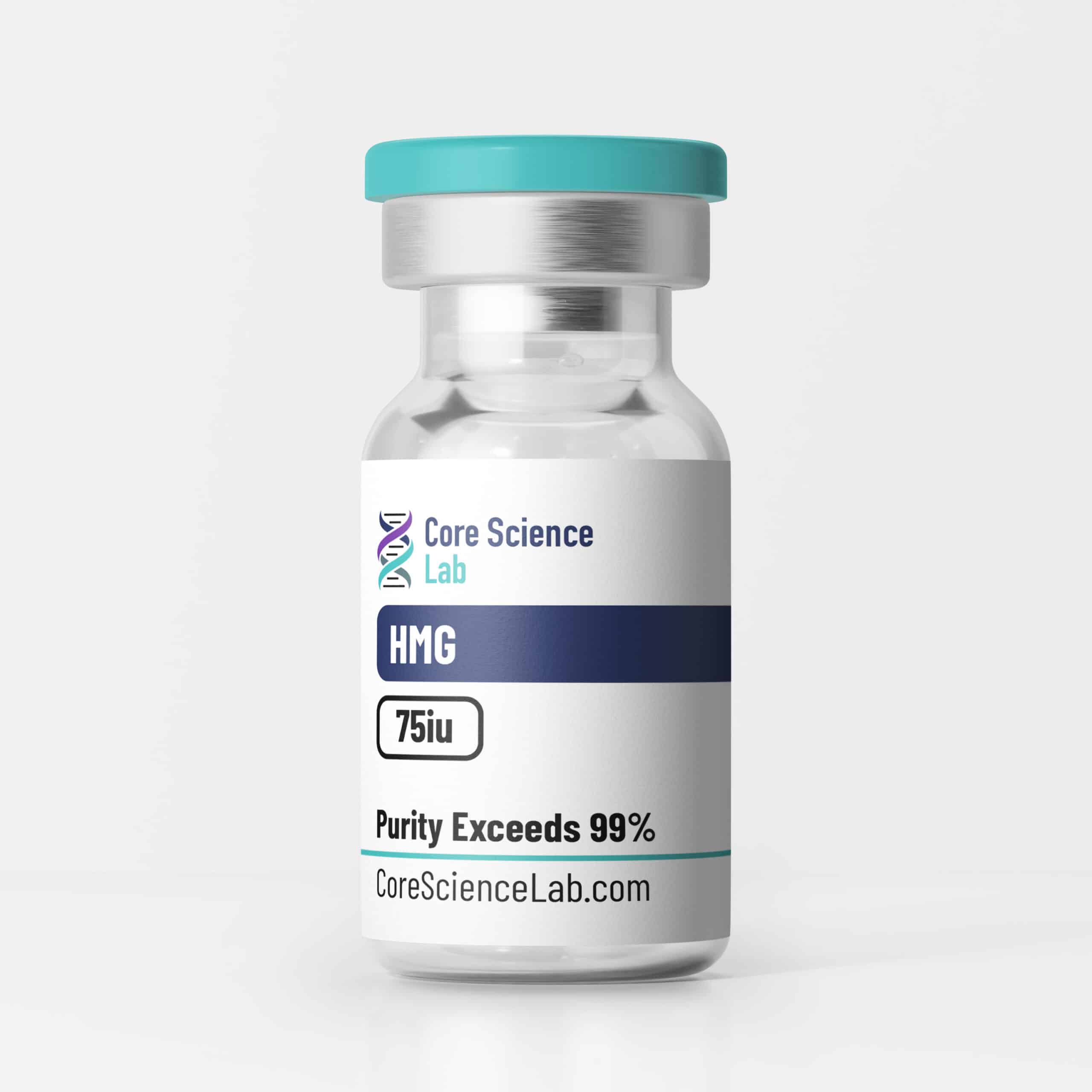
A high-purity, lyophilized glycoprotein mixture of Human Menopausal Gonadotropin (HMG), also known as Menotropin. It contains a physiological 1:1 ratio of Follicle-Stimulating Hormone (FSH) and Luteinizing Hormone (LH) activity. It is widely characterized for research applications involving gonadal steroidogenesis, cellular hyperstimulation models, and the investigation of the cAMP/PKA intracellular signaling axis.
Trust & Quality Verification
$55.00
1 in stock
Purity Standard
Verified Analysis
Available
Shipping
Human Menopausal Gonadotropin (HMG), commonly referred to as Menotropin, is a highly purified glycoprotein research reagent originally extracted from biological sources. In contrast to isolated recombinant single-hormone preparations, HMG provides an equal, synergistic ratio of FSH and LH biological activity (typically standardized to 75 international units of each per vial).
In experimental endocrinology and reproductive biology, researchers utilize this mixed preparation to investigate complex, multi-receptor feedback loops. HMG acts as a potent dual-agonist for both the Follicle-Stimulating Hormone Receptor (FSHR) and the Luteinizing Hormone/Choriogonadotropin Receptor (LHCGR). It is a vital chemical probe for studying Leydig and Sertoli cell function in spermatogenesis models, as well as theca and granulosa cell dynamics in ovarian hyperstimulation assays.
Biochemical Characteristics
Chemically, HMG is a complex mixture of heterodimeric glycoproteins. Both FSH and LH share an identical alpha subunit but differ in their distinct, receptor-specific beta subunits.
Chemical Properties
| Property | Specification |
| Molecule Name | Human Menopausal Gonadotropin (HMG) |
| Synonyms | Menotropin; hMG; FSH/LH Mixture |
| PubChem CID | 672871 (Menotropins) |
| Molecular Formula | Complex Glycoprotein Mixture |
| Molecular Weight | ~28,000 to 30,000 g/mol (per glycoprotein dimer) |
| Form | Lyophilized Powder |
| Purity | ≥99% (Verified via HPLC and biological assays) |
| Solubility | Soluble in water and aqueous buffers (refer to SDS) |
| Documentation | COA available per lot; SDS available |
HMG is strictly for laboratory research and is commonly employed in the following investigational areas:
Gonadal Hyperstimulation Models
HMG is extensively utilized in experimental models of ovarian follicular growth. Researchers employ this reagent in in vitro and in vivo models to map the dose-dependent stimulation of granulosa and theca cells, evaluating the synergistic role of LH activity alongside FSH in promoting optimal follicle maturation and estrogen synthesis.
Spermatogenesis and Testicular Bioassays
In reproductive models, researchers use HMG to study the distinct yet complementary roles of gonadotropins in male gonads. Assays focus on LH-mediated testosterone production via Leydig cells and FSH-mediated support of the seminiferous epithelium and Sertoli cell function, quantifying resulting markers of spermatogenesis.
Receptor Binding and GPCR Dynamics
Due to its dual hormone nature, HMG serves as an ideal probe for studying G protein-coupled receptor kinetics. Investigators study the simultaneous activation of FSHR and LHCGR, examining receptor dimerization, cellular internalization rates, and homologous desensitization under continuous exposure.
cAMP/PKA Pathway Profiling
Cell culture studies utilize HMG to map intracellular signal transduction. Researchers measure the rapid accumulation of intracellular cyclic AMP (cAMP) and the downstream activation of Protein Kinase A (PKA), leading to the transcription of steroidogenic acute regulatory protein (StAR) and various cytochrome P450 enzymes.
Pathway / Mechanistic Context
The primary mechanism of action for HMG in research settings involves the targeted activation of two distinct GPCR pathways.
Preclinical Research Summary
Published preclinical literature documents investigations of HMG (Menotropins) across multiple experimental models for pathway characterization:
Form & Analytical Testing
This material is produced via robust purification processes and supplied as a lyophilized (freeze-dried) powder.
Storage & Handling
Stable at room temperature for up to 90 days. For long-term storage, keep at -20C (-4F) or colder. Once mixed with a solvent (e.g., bacteriostatic water), the solution must be stored at 4C (39F) and utilized within 30 days. Avoid repeated freeze-thaw cycles, as this degrades the delicate glycoprotein structures.
Referenced Citations
References are provided for informational purposes only and are not clinical claims.
Casarini, L., & Crépieux, P. (2020). Molecular Mechanisms of Action of FSH. Frontiers in Endocrinology, 10, 305. https://doi.org/10.3389/fendo.2019.00305
RESEARCH USE ONLY
This product is intended strictly for laboratory research use only. It is not for human or veterinary use. It is not intended for diagnosis, treatment, cure, or prevention of any disease. All purchases are subject to our Terms of Service and Purity Guarantee.
No COAs available for this product.
RESEARCH USE ONLY
This product is intended strictly for laboratory research use only. It is not for human or veterinary use. It is not intended for diagnosis, treatment, cure, or prevention of any disease. All purchases are subject to our Terms of Service and Purity Guarantee.
Reviews
There are no reviews yet.