
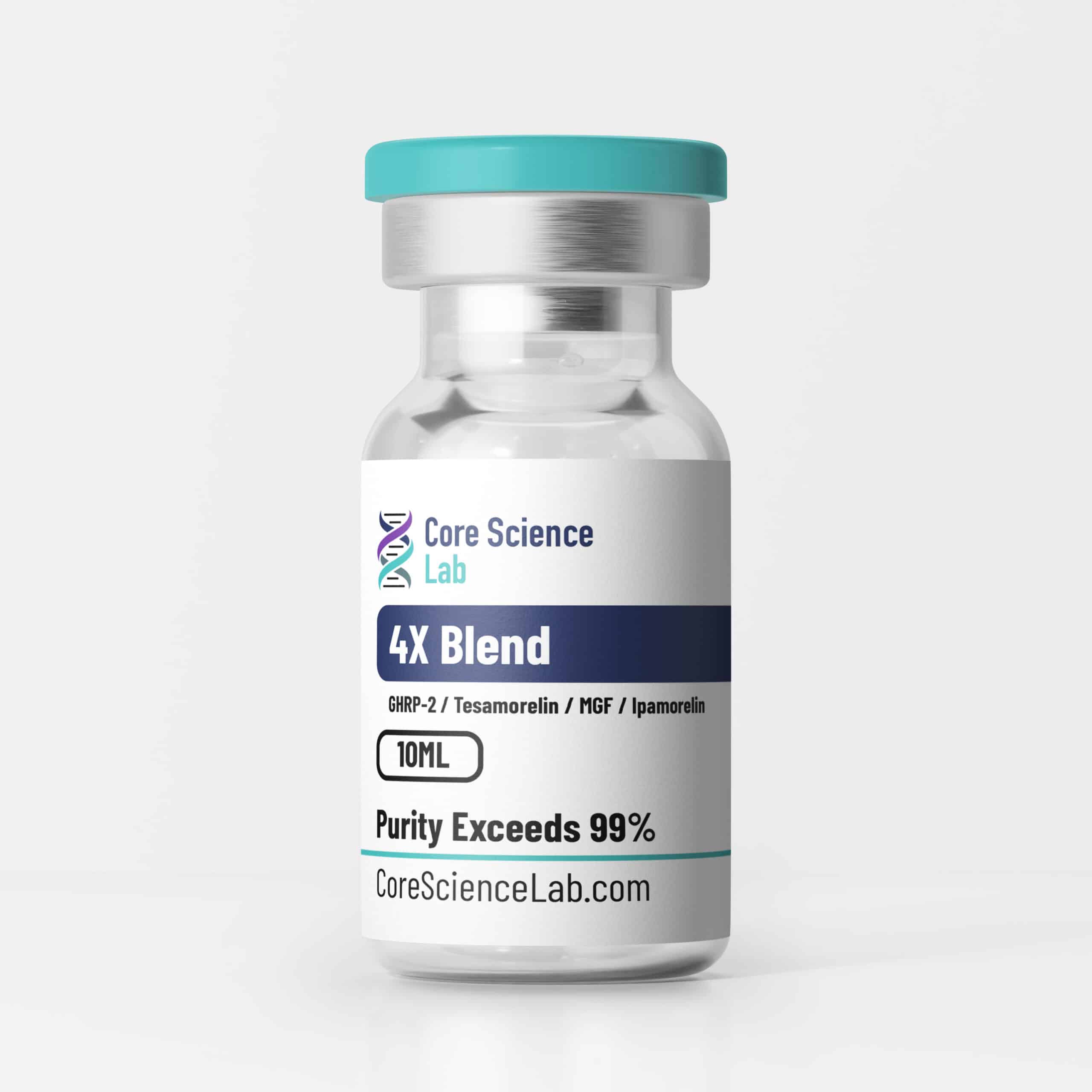
A high-purity, multi-peptide lyophilized blend engineered for comprehensive somatotropic axis research. This specialized combination incorporates growth hormone-releasing hormone (GHRH) analogues, selective ghrelin receptor agonists, and an insulin-like growth factor-1 (IGF-1) splice variant to investigate synergistic neuroendocrine signaling, metabolic flux, and tissue regeneration pathways.
Trust & Quality Verification
Purity Standard
Verified Analysis
Available
Shipping
This experimental blend combines four highly characterized synthetic peptides to facilitate advanced research into the hypothalamic-pituitary-somatotropic axis and downstream cellular hypertrophy:
In experimental models, the concurrent administration of a GHRH analogue (Tesamorelin) and GHSR-1a agonists (GHRP-2, Ipamorelin) produces a highly synergistic, rather than additive, amplification of pulsatile GH secretion. The inclusion of MGF allows researchers to simultaneously observe localized autocrine/paracrine cellular repair mechanisms in muscle and connective tissue assays.
Biochemical Characteristics
Chemically, this blend provides a multi-receptor targeting approach for in vitro and in vivo metabolic assays.
Chemical Properties
| Property | Specification |
| Molecule Name | GHRP-2 / Tesamorelin / MGF / Ipamorelin Blend |
| Component Ratios | GHRP-2 (5mg) / Tesamorelin (5mg) / MGF (500mcg) / Ipamorelin (2.5mg) |
| Form | Lyophilized Powder |
| Purity | ≥99% (Verified via HPLC for all components) |
| Solubility | Soluble in water and organic solvents (refer to SDS) |
| Documentation | COA available per lot; SDS available |
(Note: Exact Molecular Weights and individual component Formulas should be verified per lot COA/SDS, as this is a blended product.)
This specific peptide matrix is strictly for laboratory research and is commonly employed in the following investigational areas:
Synergistic Somatotropic Axis Modulation
The blend is utilized as a chemical probe to study the complex biophysics of pituitary receptor activation. Researchers use it to quantify the synergistic release of GH when the GHRH receptor and the ghrelin receptor are activated simultaneously, effectively bypassing somatostatin-mediated negative feedback in isolated neuroendocrine models.
Lipid Metabolism & Adipocyte Bioenergetics
Tesamorelin and GHRPs are heavily researched in metabolic models examining lipolysis and visceral adiposity. Assays focus on how amplified, pulsatile GH secretion alters lipid droplet mobilization, hepatic fat oxidation, and the preservation of lean body mass under metabolic stress.
Satellite Cell Activation and Tissue Hypertrophy
The inclusion of MGF directs research toward localized tissue repair. In vitro studies involving primary myoblasts utilize this blend to observe the proliferation of muscle satellite cells, mapping the molecular cascade that precedes cellular fusion and hypertrophic adaptation following mechanical or chemically induced damage.
Pathway / Mechanistic Context
The primary mechanism of action for this blend involves the integration of three distinct cellular signaling pathways:
Preclinical Research Summary
Published preclinical literature documents investigations of these constituent peptides across multiple experimental models:
Form & Analytical Testing
This material is produced via robust chemical synthesis and supplied as a lyophilized (freeze-dried) powder.
Storage & Handling
Stable at room temperature for up to 90 days. For long-term storage, keep at -20C (-4F) or colder. Once mixed with a solvent (e.g., bacteriostatic water), the solution must be stored at 4C (39F) and utilized within 30 days. Avoid repeated freeze-thaw cycles, as this degrades the peptide structure.
Referenced Citations
References are provided for informational purposes only and are not clinical claims.
RESEARCH USE ONLY
This product is intended strictly for laboratory research use only. It is not for human or veterinary use. It is not intended for diagnosis, treatment, cure, or prevention of any disease. All purchases are subject to our Terms of Service and Purity Guarantee.
No COAs available for this product.
RESEARCH USE ONLY
This product is intended strictly for laboratory research use only. It is not for human or veterinary use. It is not intended for diagnosis, treatment, cure, or prevention of any disease. All purchases are subject to our Terms of Service and Purity Guarantee.
Reviews
There are no reviews yet.