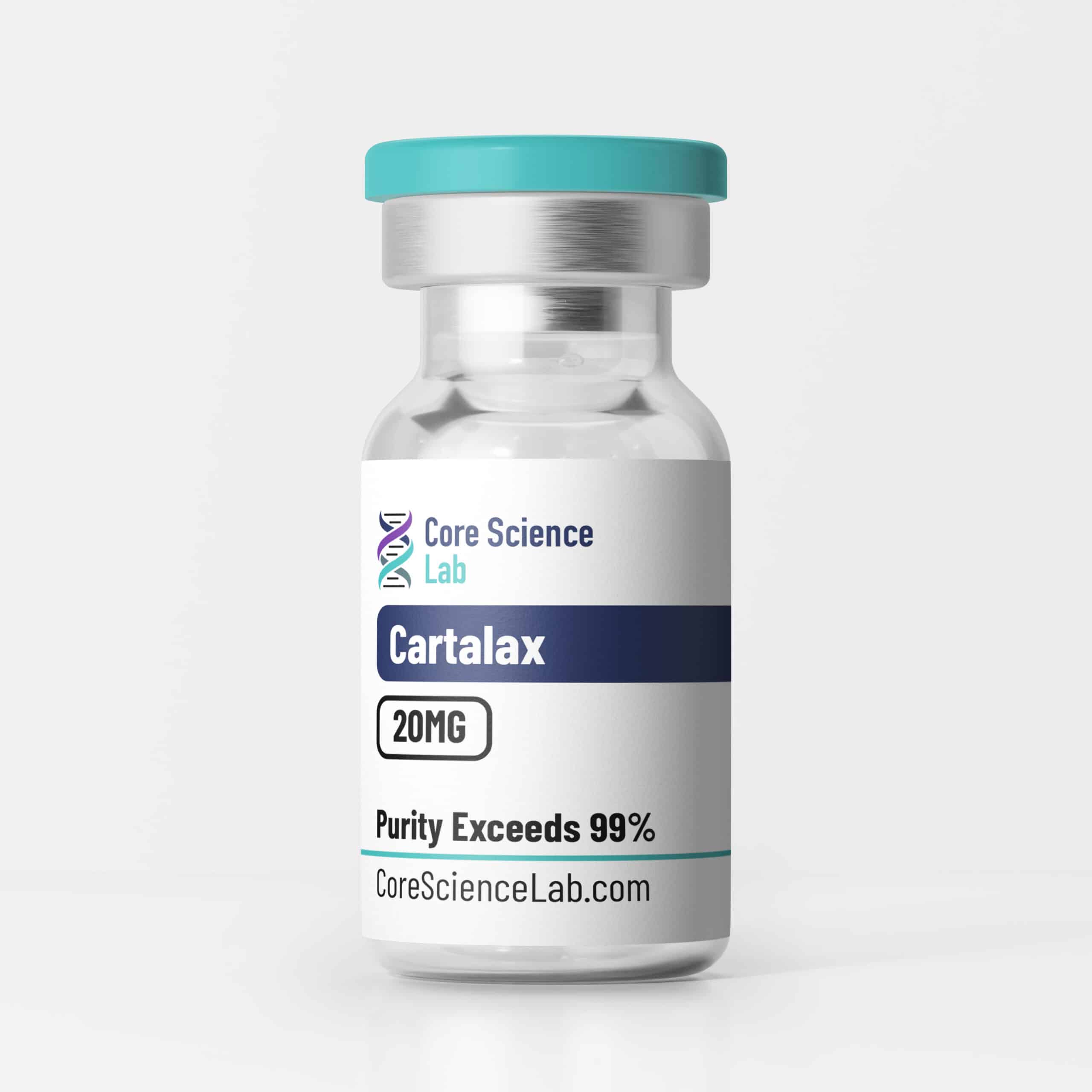
Cartalax (20mg)

A high-purity, lyophilized tripeptide bioregulator composed of the amino acids L-alanine, L-glutamic acid, and L-aspartic acid. Cartalax is investigated for its role in cellular renewal, particularly within cartilaginous and connective tissues, by modulating gene expression and protein synthesis in mesenchymal-derived cell lines.

Trust & Quality Verification

  • Research Use Only. Not for human or veterinary use.
  • 99% Purity Replacement Guarantee
  • Verifiable purity via HPLC & Mass Spectrometry
  • Supplied as lyophilized powder for stability during transport and storage
  • Certificate of Analysis (COA) available per lot
  • Safety Data Sheet (SDS) available

Email when stock available

SKU: V-CARTA-20MG Category:

99%+

Purity Standard

HPLC

Verified Analysis

COA

Available

Free

Shipping

Description

Cartalax (Ala-Glu-Asp) is a synthetic tripeptide research reagent characterized for its high biological activity in experimental models of tissue aging. It belongs to a class of short-chain peptides studied for their ability to interact with specific DNA sequences, potentially influencing the epigenetic regulation of metabolic pathways in fibroblasts and chondrocytes.

Due to its small molecular weight, Cartalax exhibits efficient membrane permeability, allowing it to be utilized in complex in vitro assays to observe changes in cellular bioenergetics and the preservation of tissue integrity. Researchers use this reagent to investigate the signaling cascades involved in cellular senescence and the restoration of functional activity in aged tissue models.

Biochemical Characteristics

Chemically, Cartalax is a tripeptide that serves as a signaling molecule within the extracellular matrix and intracellular compartments.

  • Sequence/Structure: Ala-Glu-Asp (AED).
  • Permeability: The molecule’s tripeptide structure facilitates its interaction with cytosolic and nuclear targets in various cell cultures.
  • Stability: Supplied as a lyophilized salt to ensure long-term stability and prevent enzymatic degradation during shipping and storage.
  • Specificity: Designed for research involving the targeted modulation of gene expression in connective and cartilaginous tissue models.

Chemical Properties

Property Specification
Molecule Name Cartalax
Synonyms Alanyl-glutamyl-aspartic acid; AED; T-31
PubChem CID 87815447
Molecular Formula C12H19N3O8
Molecular Weight 333.29 g/mol
Form Lyophilized Powder
Purity ≥99% (Verified via HPLC)
Solubility Soluble in water and aqueous buffers
Documentation COA available per lot; SDS available

Cartalax is commonly employed in the following investigational areas:

Dermal Fibroblast Modulation

Investigations utilize Cartalax to study its impact on the functional activity of skin fibroblasts. Researchers quantify the synthesis of structural proteins and examine the peptide’s role in counteracting markers of cellular senescence in in vitro aging models.

Chondrocyte Proliferation and Cartilage Homeostasis

In laboratory studies involving cartilage tissue cultures, Cartalax is used to observe the regulation of chondrocyte proliferation. Data from these models focus on the peptide’s influence on the metabolic status of cartilage cells under experimental conditions of oxidative stress or age-related decline.

Stem Cell Differentiation and Gene Expression

Cartalax is employed as a chemical probe to study the differentiation of human mesenchymal stem cells. Research focuses on how the peptide modulates the expression of genes involved in cell survival and lineage specification.

Renal Tissue Renewal Processes

Experimental models utilizing kidney tissue cultures employ Cartalax to investigate the regulation of cell renewal. Studies focus on the peptide’s ability to maintain cellular homeostasis in tissues derived from both young and aged experimental subjects.

Pathway / Mechanistic Context

The primary mechanism of action for Cartalax in research settings involves the epigenetic regulation of protein synthesis.

  • Chromatin Interaction: Research suggests that Cartalax can interact directly with DNA structures, facilitating the transition of heterochromatin to euchromatin, which allows for the transcription of previously silenced genes.
  • Synthesis Modulation: By influencing transcriptional activity, the peptide is studied for its ability to regulate the production of tissue-specific proteins necessary for matrix maintenance.
  • Mitochondrial Signaling: Experimental data indicate that short peptides like Cartalax may influence mitochondrial respiration and ATP production in aged cell lines.

Preclinical Research Summary

Published preclinical literature documents investigations of Cartalax across multiple experimental models for pathway characterization:

  • Skin Aging: Studies in aged fibroblast cultures have observed that treatment with Cartalax may enhance the synthesis of collagen and other extracellular matrix components.
  • Cartilage Restoration: Data from chondrocyte assays suggest that the peptide can increase the proliferative index of cartilage cells, indicating a potential role in joint tissue homeostasis research.
  • Renal Bioenergetics: Research in kidney cell models indicates that Cartalax may preserve the renewal capacity of cells by modulating markers of oxidative phosphorylation and metabolic efficiency.

Form & Analytical Testing

This material is produced via robust chemical synthesis and supplied as a lyophilized (freeze-dried) powder.

  • Lyophilization: Removes water content under vacuum to maintain molecular integrity and extend shelf-life.
  • Identity Verification: Each lot undergoes Mass Spectrometry (MS) to confirm the specific molecular weight and sequence identity of the tripeptide.
  • Purity Verification: High-Performance Liquid Chromatography (HPLC) is performed to ensure the product meets the ≥99% purity standard required for reproducible research data.

Referenced Citations

References are provided for informational purposes only and are not clinical claims.

  • Linkova, N., Drobintseva, A., Orlova, O., Kuznetsova, E., Polyakova, V., Kvetnoy, I., & Khavinson, V. (2016). Peptide Regulation of Skin Fibroblast Functions during Their Aging In Vitro. Bulletin of Experimental Biology and Medicine, 161, 175 – 178. https://doi.org/10.1007/s10517-016-3370-x
  • Khavinson, V., Linkova, N., Diatlova, A., Gutop, E., & Orlova, O. (2020). [Short peptides: regulation of skin function during aging.]. Advances in gerontology = Uspekhi gerontologii, 33 1, 46-54. https://pubmed.ncbi.nlm.nih.gov/32362083/
  • Khavinson, V. K.h, Tarnovskaia, S. I., Lin’kova, N. S., Poliakova, V. O., Durnova, A. O., Nichik, T. E., Kvetnoĭ, I. M., D’iakonov, M. M., & Iakutseni, P. P. (2014). Advances in gerontology = Uspekhi gerontologii, 27(4), 651–656. https://pubmed.ncbi.nlm.nih.gov/25946838/
  • Chalisova, N. I., Lin’kova, N. S., Nichik, T. E., Ryzhak, A. P., Dudkov, A. V., & Ryzhak, G. A. (2015). Peptide Regulation of Cells Renewal Processes in Kidney Tissue Cultures from Young and Old Animals. Bulletin of experimental biology and medicine, 159(1), 124–127. https://doi.org/10.1007/s10517-015-2906-9
  • Ashapkin, V., Khavinson, V., Shilovsky, G., Linkova, N., & Vanuyshin, B. (2020). Gene expression in human mesenchymal stem cell aging cultures: modulation by short peptides. Molecular biology reports, 47(6), 4323–4329. https://doi.org/10.1007/s11033-020-05506-3
  • Caputi, S., Trubiani, O., Sinjari, B., Trofimova, S., Diomede, F., Linkova, N., Diatlova, A., & Khavinson, V. (2019). Effect of short peptides on neuronal differentiation of stem cells. International Journal of Immunopathology and Pharmacology, 33. https://doi.org/10.1177/2058738419828613
  • Myakisheva, S., Linkova, N., Polyakova, V., & Ryzhak, G. (2023). PEPTIDES OF CARTILAGE TISSUE: REGULATION OF CHONDROCYTE PROLIFERATION, GEROPROTECTION AND PROSPECTS FOR USE IN OSTEOARTHROSIS. Vrach. https://doi.org/10.29296/25877305-2023-10-08
  • Stable at room temperature for up to 90 days. For long-term storage, keep at -20°C (-4°F) or colder.
  • Once mixed with a solvent (e.g., bacteriostatic water), the solution must be stored at 4 °C (39°F) and utilized within 30 days. Avoid repeated freeze-thaw cycles, as this degrades the peptide structure.

RESEARCH USE ONLY

This product is intended strictly for laboratory research use only. It is not for human or veterinary use. It is not intended for diagnosis, treatment, cure, or prevention of any disease. All purchases are subject to our Terms of Service and Purity Guarantee.
No COAs available for this product.

Reviews

There are no reviews yet.

Be the first to review “Cartalax (20mg)”

Your email address will not be published. Required fields are marked *

RESEARCH USE ONLY

This product is intended strictly for laboratory research use only. It is not for human or veterinary use. It is not intended for diagnosis, treatment, cure, or prevention of any disease. All purchases are subject to our Terms of Service and Purity Guarantee.

0